Read this story: Wolverton Station

If you’re a fan of horror fiction and haven’t heard of Joe Hill, get yourself to the nearest bookstore now. For starters, check out his short story Wolverton Station. What you’ll get from Hill—and this story—is solid (if not a little workman-like) heart-thudding chills.

wolverton stationThe plot: Saunders is a corporate hatchet man traveling the rails in England. He’s off to scout out new sites for a Starbucks-like chain called Jimi Coffee. He’s greeted not only by protests, but wolves as well. Soon enough he finds himself trapped among the wolves.

I read this story cold. All I knew was that it was horror, and I enjoyed Hill’s book Heart-Shaped Box, so I gave this one a try.

First, the good:

–Hill manages to create a complex, if not entirely likable, character in Saunders in a brief amount of time. I could not say that I liked him, but definitely felt for him.

–There’s some deft sleight of hand that Hill manages to pull off. At first it seems as if the story is classic horror, then it veers away from that, only to return with a vengeance. One of the hallmarks of good horror is to keep the reader always off-balance. I could never find my footing in this story, so well done.

–As the story rolls along, the tension reaches 10 out of 10. One of the most intense scenes took place on a train with no exits.

And the not as good:

–My main criticism is that Hill’s writing is, as mentioned earlier, workman-like. There’s nothing particularly new or innovative in his work. He is not forging new pathways in horror fiction, but he’s staying on the well-worn trails. But this is just a minor criticism.

So for some good horror thrills, check out Wolverton Station, and the rest of Joe Hill’s works.


See-through science

Ever wanted to be invisible? Not in the metaphorical sense, but truly transparent?

Me either. But for those who do, scientists are a step closer to making see-through skin.

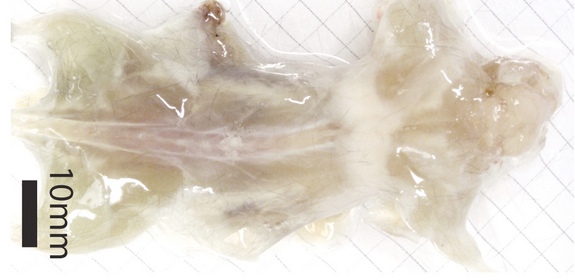
Researchers at the California Institute of Technology have advanced a process called tissue clearing that basically strips away all the color from the body. They did this in mice (not humans). What they got was a blurry, goopy messy looking thing. Ugly, but still intact.

see-through-mouse-1

How did they do this? By injecting a gel and detergents into the mouse’s bloodstream, which somehow stripped away most of the things that block our view.

Why would they do this? Having see-through organs would allow scientists to study body processes in real-time, as they happen. This would allow scientists to better understand conditions such as chronic pain.

I support most science, but for now, I’m adding this to the “not too sure this is a good idea” pile. I can imagine this getting into the hands of mad scientists who try this (illegally) on humans.

At the very least, it would make a really horrific story.

No word on how the mice fared, though. I can’t imagine it feels good to be injected with gel and detergents.


Fiction and fear

What are you most afraid of? Spiders? Dogs? Death? Loneliness?

Chances are, whatever your fear is, it’s been dramatized. Horror stories are about laying bare our fears. Think of some of the most notable horror stories and at their root you can find a fear.

jaws_dts_hires–Bram Stoker’s Dracula is about the fear of sex and sexuality, a direct reflection of the repressed Victorian era

–Mary Shelley’s Frankenstein and Ridley Scott’s Alien franchise have both been interpreted as a fear of becoming a parent

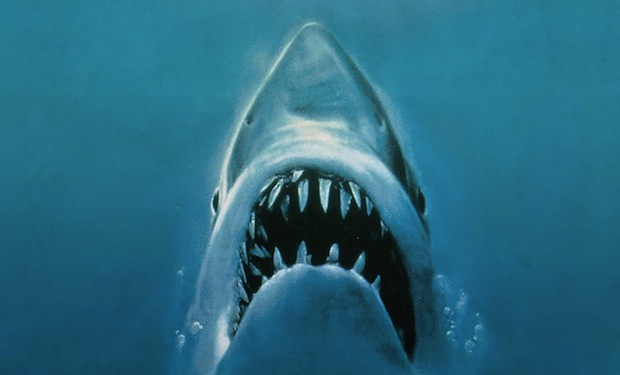
Jaws is not only about a fear of sharks, but it touches on a primal fear of our vulnerability to deadly creatures that lurk in the deep

One thing that always frightened me is mental illness, especially the kind that leads to delusions. I know this type of mental illness has a physiological underpinning, but it still disturbs me on a core level. I incorporated my own fear into my new novella, House of Flies.

House of Flies

The plot: 19-year-old Alec Pearson, recently orphaned, lives in a huge house and has all the money he could need. Then he starts seeing flies. These aren’t ordinary flies; they carry with them dark visions. He tries to fight the flies but he fears he’s losing his mind. Finally he takes a drastic step to rid himself of the madness around him.

I used a common horror trope—insects, specifically flies—as a way to dramatize Alec’s plight. Insects creep most people out, so it’s a built in special effect. The whole point of the story, though, was to discover how suppressing emotions—grief in this instance—can push you to the brink of madness.

Writers are lucky. We have a vehicle to explore our fears, examine them, and work through them in a way that not only benefits us, but hopefully entertain others. If you have the chance, check out House of Flies.

Reinventing Lovecraft at Tor

A fresh spin brings new life to a controversial horror legend.

full_litanyofearth

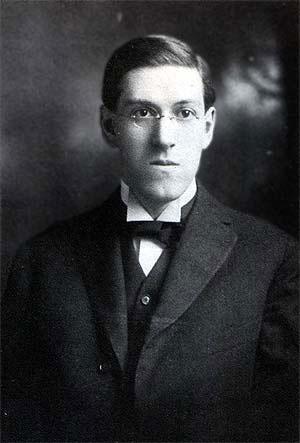
Arguably, HP Lovecraft is one of the fathers of modern horror (the grandfather would probably be Edgar Allen Poe). Rhode Island native Lovecraft, who lived from 1890-1937 created a bleak, horrific mythology that was both seamless and Howard_Phillips_Lovecraftexpansive. His creatures included the now iconic Cthulhu. His monsters were both alien in origin and Earth-evolved races that rose and fell long before Homo sapiens wandered off the savannnas.

What made Lovecraft a master of horror wasn’t necessarily his prose — it was his outlook. The monsters in his world were not remotely like us. In fact, they considered us no better than we would consider a nest of ants. It’s the theme that we don’t matter one bit to the universe that makes Lovecraft so horrific.

But Lovecraft is not without controversy. Today he’s widely derided as sexist and racist. His works are criticized for their fear and revulsion of the other. His critics have a point; I’ve always been hesitant to proscribe modern mores to past characters, though I wouldn’t let them off the hook.

This controversial aspect of Lovecraft has kept him at arms length from contemporary writers, which is a shame, because once you extract his personal views, there’s much gold to be mined from his works.

Leave it to Tor.com, one of my favorite (and free) sites for the latest in modern speculative fiction. They recently published a (long) short story, The Litany of Earth by Ruthanna Emrys. The writer brilliantly uses Lovecraft’s mythos to create a new world that, while it relies heavily on Lovecraft, removes all of his detestable aspects. Instead of reviling the other, Emrys’s world is about the other.

My point? Just because a writer/artist/actor/politician is a jerk in real life doesn’t necessarily mean we have to disregard all their efforts. Emrys’s short story is proof of this.

Here’s an intro to the story:

The state took Aphra away from Innsmouth. They took her history, her home, her family, her god. They tried to take the sea. Now, years later, when she is just beginning to rebuild a life, an agent of that government intrudes on her life again, with an offer she wishes she could refuse. 

Read the whole story here at Tor.com.

And, for an interesting take on Lovecraft’s controversial elements, read this blog post from the editor at Tor.com who decided to buy Emrys’s story. It’s fascinating to watch him grapple with his own mixed feelings.

(Art copyright © 2014 by Allen Williams)

Secrets of the Ouija board

Are Ouija boards dangerous? A comprehensive article traces its history, and the answers aren’t quite conclusive.

ouija 1

A Ouija board is a game that allows users to attempt to contact the spirit world. The board consists of letters and numbers. The player asks a question, and using a pointer, the spirit world will supposedly guide the pointer to letters that spell out an answer. Simple enough, right? Not really.

AlwaysMine_finalOuija boards have a bad reputation. Many consider them a gateway to evil. If this latest news report is to be believed, three young Americans in Mexico fell into convulsions after using a Ouija board (the local priest refused to perform an exorcism because none were parishioners). I used a Ouija board as an element in my horror story Always Mine, and from reader response, it struck a nerve.

But what’s the truth behind this game?

This long Smithsonian article breaks down the history of the Ouija board. It turns out that Ouija boards are a uniquely American creation. In the mid 1800s, a wave of spiritualism swept the US. People believed they could contact the spirit world, which would deliver messages. This belief dovetailed neatly with organized religion, which more or less sanctioned this practice.

Then, in the late 1800s, a canny investor caught wind of a “talking board” and formed a company to manufacture these boards.

Among the interesting facts about the Ouija board:

–The name Ouija supposedly came from the board itself.

–The US patent office approved its patent after the board revealed the patent official’s first name (proof that it worked).

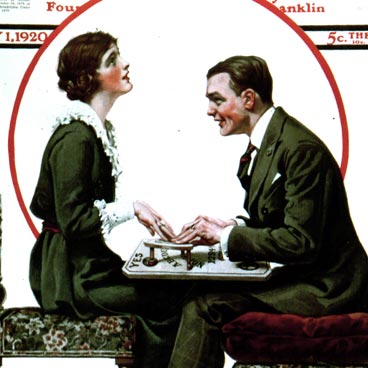
–It quickly became a best-seller, marketed as both a way to contact spirits, predict the future, and as wholesome family fun. Even Norman Rockwell got into the act.

ouija

But there was a dark side to it as well:

–One company head died after falling from a factory building, which he built based on advice from the Ouija board.

–In 1930, two women killed another based on the advice from a Ouija board.

And a quirky side:

–Writers have claimed that their works were written via Ouija board. One poet, James Merrill, won a major award for a poem that was “magnified” by his Ouija board.

So why have Ouija board become linked to evil?

Blame The Exorcist. Since that 1973 groundbreaking horror movie (which was supposedly inspired by actual events), Ouija boards lost any wholesome status they enjoyed. Following the phenomenal success of The Exorcist, Ouija boards have been denounced by religious groups and have become a staple for horror writers (guilty as charged). Interestingly, the board is still a hot seller.

The Smithsonian article delves in to the “why” of the Ouija board. In the simplest of terms, scientists believe Ouija boards tap into our unconscious mind. We may think we are talking to spirits, and in a sense, we are: our own.

But is this all there is to it? Maybe not. Check out these supposedly true scary stories of Ouija board freakiness.

To be honest, I’m not as concerned with how Ouija boards work. Don’t get me wrong: I love science. But when it comes to something like Ouija boards, I’d prefer to keep that element of scary suspense alive.

Spider fangs: nature’s perfect piercer

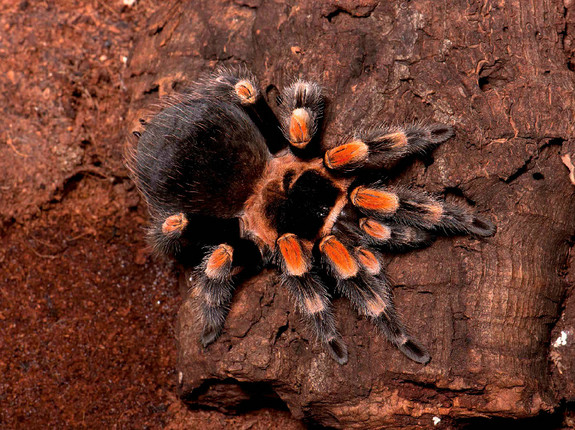
Some people love spiders (why??). Some people love to hate spiders. My view is: hey, Mr. Spider, you stay over there, I’ll stay over here. To me, they’re creepy as hell — horror movie creepy.

mexican-red-knee

Now there’s more to add to their creep factor. Not only are spiders adept at trapping their prey alive in a sticky web and sucking their blood and bodily fluids out in a slow, agonizing death, their fangs were honed by nature, God, evolution (take your pick, or as I believe, all of the above) to be the perfect piercing tools.

This article published in Scientific American discusses a study of spider fangs. It turns out that the curve of the spider fang allows the spider to not only attack from different directions, but also hold their prey while injecting their venom. And the hollow, conical shape gives the fangs strength.

Not cool.

The upside?

1) More fodder for horror writers. Now we’ve got an even more gruesome way to describe spider attacks.

2) Maybe they can design better piercing equipment, not only for medical applications, but also for those casual body piercers among us.

(Image courtesy of LiveScience.com)

Why were killer insects so popular in sci-fi?

I loved cheesy horror/sci-fi movies as a kid, everything from The Blob to The Thing.

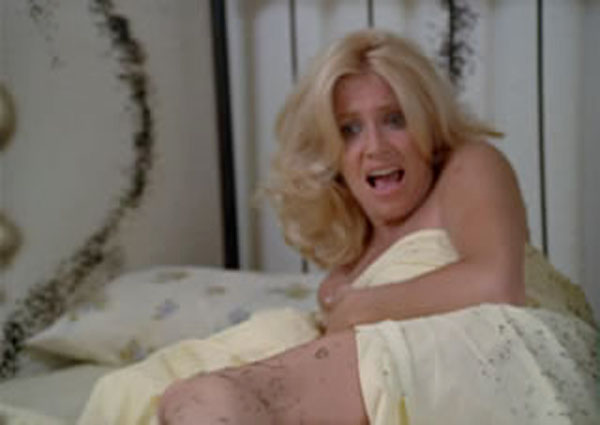
But what always freaked me out were the movies about bugs. I remember watching the 1977 film Ants, about swarming, poisonous ants, and being terrified there were ants crawling under my bed. I’d have to check carefully every night, and still I was never sure I was safe.

ants

io9.com has an article up analyzing why insects were a sci-fi staple, especially in the atomic age of the 1950s (with giant bugs such as those memorable monsters from Them!), but even later, through the ’70s.

them-ant-on-hill1

Some think that the fascination—and popularity—had to do with:

–fears of Communism and the reinforcement of trust in an all-powerful US government

–fears of radiation from nuclear fallout

–mistrust in science

–overreliance on chemicals that pervert our natural world.

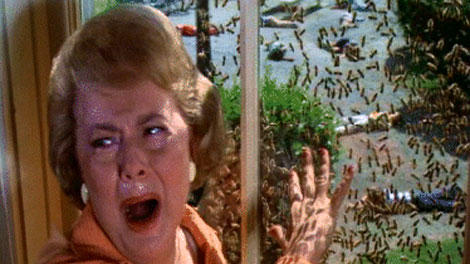
The article’s conclusion? The popularity of insects as villains was much more simple. That’s when we as a society became more aware of germs and diseases. And pesticides—bug spray, etc—were promoted to get rid of the vermin that were invading our homes.

killer-bees

We were constantly on the lookout for roaches and ants and mosquitoes in our homes and backyards, so naturally they’d morph into something even more insidious.

Whatever the reason, it made for fun and creepy horror stories.

See this movie: Oculus

Oculus is a cunning, tough horror movie that will leave you unsettled.

oculus_2014_horror_movie-wide

When we last left Karen Gillan, the Scottish woman with the big eyes who played Amy Pond in Doctor Who, she was staring at the weeping angels to avoid being sucked back in time (spoiler: she wasn’t successful).

Oculus Gillan

Now, in Oculus, the actress is donning an American accent (competently) as she stares into a haunted British mirror to fight an evil force.

Oculus is the latest horror offering from the forces behind the Saw series (too gory for me) and the Insidious flicks (good, fun horror). I was expecting something along the lines of Insidious. I was not prepared for a dark and harrowing tale of family madness, PTSD and psychological horror.

The setup: Tim is released from a mental hospital. Ten years earlier, he, along with his sister Kaylie (Karen Gillan), witnessed a horrific crime when their mother turned psychotic and was shot by their father. They only survived because Tim killed their father. Tim has been thoroughly rehabilitated. Kaylie, on the other hand, has gotten hold of the evil mirror which may have driven their parents (their mother is played effectively by Battlestar Galactica‘s Katee Sackhoff, aka Starbuck) to madness and death. She intends to defeat the evil that lies inside, along with Tim’s unwilling help.

Oculus

Oculus was great on two levels.

First, the narrative structure was brilliantly crafted. We bounce back and forth between the present and the original crime 10 years earlier. As the movie progresses, the past and present merge to great effect. And, even though we know the outcome of the events in the past, there’s still heart-pounding tension.

Second, one of the strengths of horror/sci-fi/fantasy is that it gives us the chance to explore common, painful themes in a fantastical setting. Oculus does that. On one level, this is the story of a horrific childhood, mental illness, and the stubborn hold that trauma has on our lives. A good chunk of the film is spent debating reality, for good reason. I enjoy writing about the supernatural because it allows me to explore deeper issues. The writers of Oculus obviously feel the same.

Oculus draws on a rich heritage of horror films. I picked up on the references to The Amityville Horror, a classic movie about possession that scared the life out of me as a kid. It uses these tropes effectively.

My main complaints would be that the Nightmare on Elm Street effects of “is this real or not” were overdone, and the nature of the evil, which was way stronger than our protagonists, was never hinted at (perhaps setting up a sequel). And the title sucks. I keep calling it Ocular. Not good.

Oculus is not an easy movie. It is not an escape. But it shows the power of horror to shine a spotlight on very human terrors.