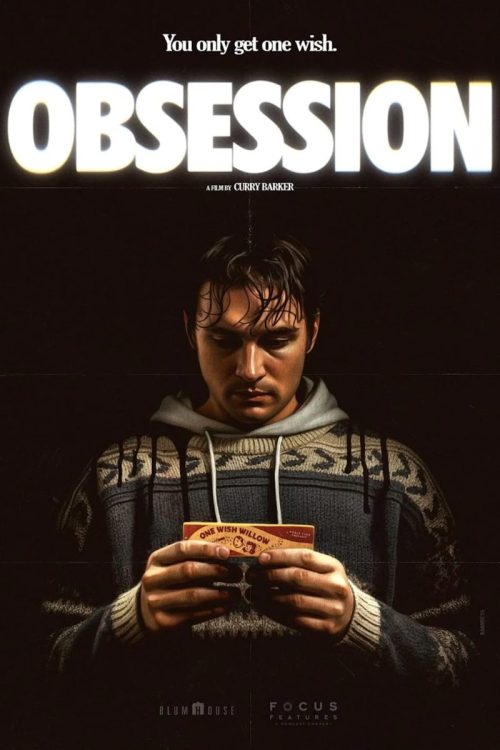
Obsession is one of the most talked about movies in recent times. What’s left to say about it?
I’ve got a couple things…
First, the basics. Obsession is an indie horror movie written and directed by Curry Barker, produced for $750,000 that could hit a $300 million gross. Insane. The premise is straightforward and not particularly original. Bear has a massive crush on Nikki, a childhood friend, coworker and member of his friend group. Unable to admit his feelings for her, he makes a wish using a novelty toy called One Wish Willow. His wish: that Nikki would love him more than anyone else in the world.
It works.
Almost instantly, Nikki becomes obsessed. Bear finds it odd and hard to believe, but he goes along with it. Naturally, hijinks ensue. By hijinks I mean horror.
As I alluded to, there’s not much particularly new about the premise. Obsession is a classic monkey’s paw tale, where a wish leads to horrible consequences. Plotwise nothing surprised me. And I could see the jump scares from miles away.
What makes Obsession shine is Barker’s level of craft. The world feels real, in the most tangible of ways: the sets, the look, the feel, all of it had a richness and a sense of claustrophobia. The acting was uncanny. How the hell did Inde Navarette prepare for her role as Nikki? The things she could do with her face and body and voice were chilling and funny and heartbreaking, sometimes all within a space of a minute. Michael Johnston as Bear had a tougher role—he’s the straight guy. The “victim” (though not really). His role was more reacting to Nikki’s antics. Plus he’s playing basically a loser. How do you inject sympathy into that role? I don’t know, but he did it. You might not be on his side, but you can see his side.
At least in the first act.
In the aftermath of this movie’s surprise success (Is anyone shocked that people don’t want another franchise garbage film?), there’ve been dozens, hundreds, thousands of podcasts and x posts and Substacks analyzing Obsession.
So, of course, why not one more?
Most of what I’ve seen focuses on things like Bear’s selfishness and Nikki’s lack of consent and what these say about modern culture. That bores me. Politics mostly bores me.
What interests me is the human condition, and Obsession tackles two.
The first is loneliness.
One of the media’s current bandwagons is about the so-called male loneliness epidemic. Here’s a tip: avoid bandwagons. Anything I’ve read on the topic turns out to be a backhanded way to bash men and masculinity. Instead, we should view loneliness not through a male or female lens but through the lens of the individual.
Obsession uses Bear to highlight this issue of loneliness. The opening scene is a tight shot on his face as he’s gushing out his feelings for Nikki. He’s nice looking and hopeful and scared. He’s relatable and sympathetic. He lives alone in his grandmother’s old apartment with his cat. No other family is mentioned, so I assume he’s been left alone. Early on, he comes home to find his cat dead. There’s a great shot of him sitting on his bed sobbing. The contrast of those two scenes really got to me. He’s a character who is aching and needy and alone.
But his tragic flaw is that he cannot get himself to take action in his own life. He’s paralyzed by fear.
A lot of criticism against Bear concerns the one action he DOES take: making that wish. First, a defense. Who hasn’t wished for something? Plus it’s not as if he truly believed the wish would work. The act of making that wish doesn’t make him the bad guy, and it’s a stretch to say that the wish was a sign of weakness or villainy.
But a case could be made that Bear’s culpability grew as he ignored the blaring signs that all was not right with Nikki. Even after he realized the wish did in fact work, he was still trying to find a loophole.
Still, I have a lot of sympathy. One of the roughest scenes emotionally is when Nikki is sleeping and she says something like, “she’s asleep, kill me,” (implying the real Nikki was trapped inside—she was), and his response was along the lines of “what’s so bad about loving me?” (probably misquoting but you get the gist). This told me that Bear’s pain was so intense that he couldn’t even see Nikki’s.
Horror can work as a morality tale, and this was one of the morals: loneliness can blind you to the truth. It can corrupt you. It can ruin you. Bear’s loneliness definitely did that for all involved.
What about Nikki’s story?
To see it clearly we’ve got to strip out the supernatural. It’s not cheating; horror works on metaphor. It examines human fears by exaggerating them.
Looking at it from this angle, Nikki’s story becomes easier to discern. It doesn’t take a genius to do so (hint: look at the title). (In her wishcast state) Nikki is obsessed with Bear. She acts out in the most creepy, disturbing, horrifying and violent ways because of her obsession. Almost everyone has dealt with, known of, or experienced themselves, a nasty case of obsession.
But what interests me most about Nikki’s story is that it operates on twl levels: an exterior and an interior.
First, the exterior. I’ve read some deep dives saying her behavior mimics borderline personality disorder. I don’t have a background in psychology so I won’t comment on whether this is truly BPD-like behavior. But the mood swings, the intense focus, the possessiveness, the anger, the desperation, and the terror of rejection all ring true to life. Watching Obsession called to mind Baby Reindeer, Richard Gadd’s non-supernatural yet still horrifying true account of his dealings with a stalker.
This is what makes the horror so intense. Yes, we all know that Nikki’s obsession was caused by a supernatural spark and thus not genuine, but her actions feel so real because of the emotional truth behind it. As a writer, I respect how Barker was able to convey this true-to-life experience in such a cartoonish setting and have it hit.
While the exterior experience of Nikki’s obsession is riveting, what intrigued me the most was Nikki’s interior experience. In the movie, the real Nikki is an unwilling participant in this obsession. She wants no part of it. But she’s trapped. An observer. A puppet with no control.
This is horrifying. She does not want this. Yet she’s forced to witness all of this.
But let’s pull back from the supernatural and shift to the real world. Oftentimes someone who’s in the grip of an obsession (or an addiction), knows logically that what they’re doing is either harmful or utterly pointless, yet they’re still compelled (or possessed, much like Nikki is possessed). One part of you acts out the rituals of your obsession/possession (as in the shrine she built to Bear). Another part of you watches as your compelled to do things you don’t want to do.
You cannot stop yourself. You’re trapped by your obsession and forced to witness your compulsion.
What is this if not horror?
Discover more from Read by Kevin
Subscribe to get the latest posts sent to your email.

