Charlie Hebdo and free expression

Time to get serious.

The world is reeling from the murders in Paris this week. Twelve people, including journalists and policemen, were murdered by Muslim terrorists. Why were these people killed? Because the journalists at the satirical publication Charlie Hebdo dared to express views these terrorists deemed unacceptable. Specifically, they criticized — and mocked — Muhammed.

This got these twelve humans killed.

Stephane Charbonnier, pictured below with one of the offending images, was the editor of Charlie Hebdo. He was among those murdered. He’d received death threats for daring to express himself. And his response?

CharlieHebdo_19092012_0

“I’d rather die standing than live on my knees.”

I can’t express the rage I feel regarding the animals who murdered Charbonnier and the eleven others. I have no respect for their values.

This tragedy has only reinforced one of my core beliefs: the freedom of expression. As a writer, I wholeheartedly believe in the God-given human right to express myself freely. I believe that the dignity of the individual takes precedence over groupthink, and I want to live in a society where everyone is allowed to express themselves (as long as they’re not openly inciting violence).

Don’t get me wrong — there are scores of examples of speech and actions I personally find offensive. The Kardashians, for instance, or anything Madonna has said and done in the past decade. And then there’s Eli Roth’s torture porn Hostel movies.

But if I am offended, I change the channel, or leave the web page. I don’t murder people. I understand that some people cherish their beliefs, and are hurt when they are mocked, but I will not submit to violence or intimidation.

I am thankful I live in a society where freedom of expression is an accepted—if not constantly debated—value. I don’t enjoy mocking someone’s beliefs for the sake of shock alone. But the world needs to understand that violence isn’t acceptable. These images need to be shared widely so their threatening power will be diluted.

These are just a couple of images that were worth killing over. If this is what your god demands of you, I will never understand your god.

Charlie-Hebdo

o-VEILED-570

Read this book: Black Moon

Have you ever had a wicked bout of insomnia? It’s near dawn and you haven’t been able to sleep, no matter what you do. The world outside your bedroom is fast asleep, but not you. And slowly, you begin to hate all these lucky sleepers as your mind jumps and skitters.

Imagine if that insomnia lasted not one night, but several days — and then endlessly. What would you do? How much of your sanity would remain?

Black MoonThis is the premise of Kenneth Calhoun’s debut novel Black Moon. An unexplained insomnia plague has struck. People are becoming sleepless zombies, losing their minds as they wander the landscape. A lucky few, however, can still sleep. Only they’re targeted by the angry hordes.

Black Moon is a new take on the zombie craze that refuses to die out. It includes several zombie tropes that we all know so well by now — the ravaged landscape, the plucky heroes targeted, the dystopian gloom. The fact that these “zombies” are still alive is a fresh twist.

This strong premise, and not the characterization or plotting, is what carries this book, and it’s unfortunate. Black Moon is a good book. It could have been a great one.

Time for the breakdown. First, the good:

— As I said, the premise is strong. It taps into a nearly universal experience. Most of us have been frustrated by not being able to fall asleep. And we have also had that spacey, drunk-like feeling of being sleep deprived. Black Moon raises an interesting question: how much of our daily life is simply a valiant effort to hold back the unconscious wildness that streaks through our minds at any given moment? Our dream worlds, like our inner monologues, are free flowing and chaotic. Which is our more natural state?

— Apocalyptic books can take one of two paths: the knowledgeable official (government, scientist, etc), who works to solve the problem, or the ordinary Joe/Jane who struggles to survive. I prefer the latter. Black Moon shifted between several characters — average people all struggling to cope. This book provided no answers, and it didn’t even try to. I appreciated that.

— At around 300 pages, Black Moon is short. It is a quick and thrilling read. And Calhoun can write quality prose.

And the not so good:

— Plotting is not one of the stronger suits of Black Moon. We shift between character viewpoints, which isn’t a problem, except when the shifts jump around, leaving the reader confused as to what happened and why. You may find yourself backtracking several times, and not in a good way. Calhoun had the room to explore several scenes more fully, and for some reason, he chose not to.

— The characters were a mixed bag. Biggs is one of the POV characters. He can sleep, and he searches for his insomniac wife, Carolyn. All the while, we get their back story as a couple. While I could relate to Biggs through his interactions with his dying world, I could not relate to the wife he described. I didn’t like her at all, and didn’t care. Several of the characters seemed like cardboard cut-outs, not flesh-and-blood people.

These drawbacks were not insignificant. Luckily, the premise is strong enough to counterbalance these flaws. Ultimately, Black Moon is a fun book. It’s a new take on the zombie craze that will keep you up at night as you race to finish it.

Why not Mars?

World building is an integral part of fiction. When it comes to sci-fi, Mars seems like the perfect world to build. It’s been long ignored. Now, it might get its chance chance.

Writers (myself included) are closet megalomaniacs. When you write, one of the more important, though hidden, tasks is you have to construct the fictional world your characters inhabit. This is true whether you write a true-to-life family drama or a space opera set in unexplored galaxies.

As a writer, I love that part of it. And I suspect most other writers do as well. Why? Because we get to create these worlds. We are in charge.

On that level, it’s all about the worlds. But what about literal worlds?

As a sci-fi fan, I could never figure out why Mars is always forgotten. It’s well represented in print (Ray Bradbury’s The Martian Chronicles, for one example of many). But on film and TV, apart from a few crappy movies, Mars has been largely ignored.

Mars

And it’s right next door. You can see it, if you have a good telescope.

That may change. Spike TV, of all networks, plans to produce a TV show adapted from Kim Stanley Robinson’s Mars trilogy (Red Mars, Blue Mars and M1_Red_MarsGreen Mars). I read these books years ago. I have some problems with the books, mostly involving pacing (slow…), but what he did brilliantly in his writing was build a world. Mars.

His books track the colonization and terraforming of Mars over centuries. He includes topics and themes such as genetic engineering and social unrest. His characters run the gamut of human nature. And he has a space elevator,which blew my young sci-fi mind when I first read about it years ago, but is now slowly turning from science fiction to science fact.

If this series comes to pass (which is always a huge question mark) and if it is done well (an even bigger question mark), it would finally give the Red Planet its due in the sci-fi world.

Let’s hope. Here’s to world building.

To life

A famous actor died last month. He committed suicide after reportedly suffering from bipolar disorder. Like a lot of people, it hit me hard. Unlike a lot of other people, it was difficult not just because he was a much-loved actor, but also for more personal reasons.

First, there’s a myth that creative people are more prone to mental conditions such as depression. But research doesn’t support that. If anything, those who are creative (and productive) show higher levels than the general population of psychosis and hypomania. Keep in mind, everyone has these traits, it’s just a matter of the degree expressed.

But in our popular culture, depression, melancholy, etc, are more commonly associated with writers, artists, actors, and other creatives. As someone who’s gone through a deep depression, I can attest that it does NOT enhance creativity. When you’re going through it, the last thing you want to do (or can do) is use your imagination to create something positive. Depression is the enemy of creation. If there is an upside, I’d say that having gone through depression makes you more empathetic to the human experience. It’s a tough trade-off.

Now back to the famous actor. While none of us can know what was going on in his head, I have great sympathy for what he went through. It’s not a cliche to say his death was tragic.

What really offended me, though, was the reaction. Many commented that he was finally at peace. One tweet specifically used the words “you’re free.” And anyone who dared to question this line of thought or point out the negative repercussions of suicide was attacked as heartless until they retracted their position.

I am not here to attack the actor for his suicide. What I am here to do is attack the idea that suicide is a viable “freeing” option for those who are in deep depression. Depression and bipolar are not a choice as much as a brain chemistry problem, but the act of suicide is a choice. And a final one. My heart breaks when I hear of someone committing suicide because I know the pain that led them to that point, and I know that the finality of their decision cuts off any hope of recovery. I’ve had friends who committed suicide. The tragedy rested in their pain and in their choice.

And it was a choice.

Suicide is seductive. When I heard of the actor’s death it awakened long dormant feelings that I thought I’d left behind forever. I hadn’t. What counters that voice—then and now—is the realization that life is pretty damn unique. Whether you believe it’s God-given or whether you believe it’s a random act of the universe, the fact that we exist, the fact of our awareness, is nothing short of a miracle.

Suicide should not be romanticized or glorified as a freeing act. It should be portrayed for what it is: a choice, a final action that is a rebuke to existence.


The Leftovers rehashed

A strong premise plus great performances does not equal a successful show.

Leftovers promo

I was looking forward to HBO’s new show The Leftovers for two reasons. The first was that it was created by Damon Lindelof, the mastermind behind Lost, one of my favorite TV shows ever.

The second reason was the premise: two percent of Earth’s population has suddenly, inexplicably vanished. This biblical premise has been presented before, and I was interested to see how it would be handled without an overtly religious point of view.

Once you leave behind the religious element, which The Leftovers did, there were two directions in which to take the show: 1) as a jumping point for a wider sci-fi/mystical/horror story, or 2) as a navel-gazing meditation on loss and grief. Unfortunately, the writers chose #2.

Leftovers KevinI wanted to like The Leftovers. And it seemed promising, even once I realized that the “why” of the disappearance would never be addressed.

I liked the cast, and several of the characters, at least in the beginning. Justin Theroux as Kevin Garvey, the police chief, was intense and intriguing. He hadn’t lost anyone close to him in the vanishing, but his family fell apart soon after. He seemed to be losing his mind, and struggled to fulfill his duty as police chief while keeping what was left of his family intact.

Leftovers Patti LaurieAmy Brenneman as his estranged wife Laurie was great at portraying a range of emotions while rarely uttering a word as a member of the Grieving Remnant, a cult that wore white, refused to talk, chain smoked, and harassed whoever they could find, all in the name of reminding people of their losses.

Ann Dowd was brutal as Patti, the local leader of the Grieving Remnant. But part of the problem with this show was not only Patti, but the whole Grieving Remnant. I never liked any of them, and I never understood their motivation, which kept me distant from them.

The ten episode long series seemed to spin in its wheels the whole time. We watched characters struggle to move past an event that occurred three years earlier, yet they never progressed. I wasn’t sure where the story was heading, and halfway through the series, once I realized we would never learn the why, I didn’t care.

However, The Leftovers contained two of the best hours of television I’ve seen in a long time. Usually each episode jumped between different characters, but for two episodes, they chose to focus on a single character.

The first episode followed Matt Jamison (played by Doctor Who‘s Christopher Eccleston). I’ve been a big fan of Eccleston since Shallow Grave. He has a manic intensity, and this episode followed Matt Jamison as he fought to save his bankrupt church. It was a heartbreaking hour of television.

Leftovers Matt

The second episode, which was the best of the season, followed Nora Durst (the sister of Matt Jamison). I’d never heard of Carrie Coon, the actor who played Nora, but she’s high on my radar now. Nora lost her husband and both children in the vanishing. She was left alone. We were given one hour tracking Nora, and it was brilliant, both in the storytelling and in Coon’s portrayal. If only all the episodes were like this, I’d be a fan of The Leftovers, regardless.

Leftovers Nora

I think the fatal flaw of this season was that it followed the Garvey clan, and we were never given any motivation for their surly, strange behavior. There was a flashback episode that showed the Garvey family just before the event, and it did sweeten the bitter Garveys just a bit, but it was too late to change my feelings toward them. If Nora Durst and Matt Jamison were the main characters, I’d be looking forward to season two.

Doctor Who: regenerated again

What do you do when you create an accidental hit TV show, and your lead actor leaves? If the show is the British sci-fi series Doctor Who, you give your time-traveling alien-in-human-form lead the power to regenerate.

Doctor Who

And now, with a change of actors on Doctor Who, we have yet another regeneration.

The era of Peter Capaldi as the latest Doctor begins with an episode titled Deep Breath, and what we saw was a Doctor thoroughly unsettled.

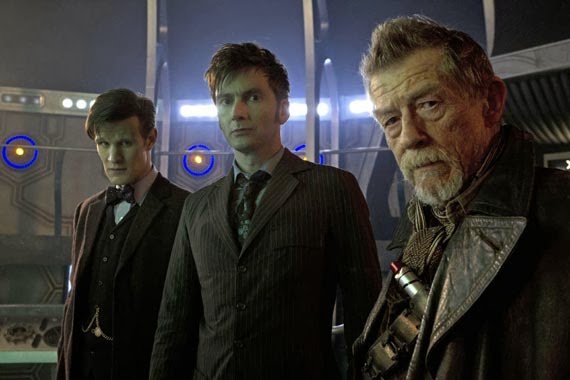
Age brings natural gravitas. Capaldi is older than the actors who’ve played the CapaldiDoctor in the modern era — Christopher Eccleston, David Tennant and Matt Smith. So, naturally, Capaldi’s Doctor seems so much older than the others.

How to maneuver around that? Capaldi’s Doctor, at least in the early days of his regeneration, is unhinged, nearly to the point of being child-like. In this way, Capaldi’s Doctor seems much younger than any of the modern Doctors.

This Doctor is a rambling, rummaging mess. He’s aggressively disoriented.

It’s not just the writing and acting that make it all so unsettled. The music is thumping and discordant, an angry rock soundtrack out of tune (in a good way). And the camera work is quick and jumpy without being shaky. It all combines in a way that let’s us know that this iteration of the Doctor may be far different than what we’ve been used to.

Regeneration is the theme of this episode. We’re along for the ride as his current human traveling companion Clara Oswald (Jenna-Louise Coleman) Clarastruggles to make sense of the whole concept of the Doctor regenerating. Not to mention the Doctor himself. Regeneration is never easy for the Doctor, and this one is especially difficult.

The writers use the theme of regeneration to hint at the insidious nature of the Doctor. Does this centuries-old alien wear a human face merely to be accepted by humans? Does he use this human face to keep from revealing who or what he truly is?

Philosophical questions aside, this first episode of the Capaldi era is classic Doctor Who, throwing a dinosaur into steampunk-infused Victorian-era London. But it also revels in the darkness that infuses many of Doctor Who‘s best episodes.

Based on this episode, I’m feeling pretty good about where we’re headed. Capaldi’s Doctor is clearly different from the rest, and Clara, as companion, is proving to be more Donna Noble than Martha Jones.

Finally, there was some great dialogue from this episode:

“You mustn’t worry my dear boy. By now he’s almost certainly had his throat cut by the violent poor.”

“Nothing is more important than my egomania.”

“It’s times like this I miss Amy.”

Read this story: Wolverton Station

If you’re a fan of horror fiction and haven’t heard of Joe Hill, get yourself to the nearest bookstore now. For starters, check out his short story Wolverton Station. What you’ll get from Hill—and this story—is solid (if not a little workman-like) heart-thudding chills.

wolverton stationThe plot: Saunders is a corporate hatchet man traveling the rails in England. He’s off to scout out new sites for a Starbucks-like chain called Jimi Coffee. He’s greeted not only by protests, but wolves as well. Soon enough he finds himself trapped among the wolves.

I read this story cold. All I knew was that it was horror, and I enjoyed Hill’s book Heart-Shaped Box, so I gave this one a try.

First, the good:

–Hill manages to create a complex, if not entirely likable, character in Saunders in a brief amount of time. I could not say that I liked him, but definitely felt for him.

–There’s some deft sleight of hand that Hill manages to pull off. At first it seems as if the story is classic horror, then it veers away from that, only to return with a vengeance. One of the hallmarks of good horror is to keep the reader always off-balance. I could never find my footing in this story, so well done.

–As the story rolls along, the tension reaches 10 out of 10. One of the most intense scenes took place on a train with no exits.

And the not as good:

–My main criticism is that Hill’s writing is, as mentioned earlier, workman-like. There’s nothing particularly new or innovative in his work. He is not forging new pathways in horror fiction, but he’s staying on the well-worn trails. But this is just a minor criticism.

So for some good horror thrills, check out Wolverton Station, and the rest of Joe Hill’s works.


Fiction and fear

What are you most afraid of? Spiders? Dogs? Death? Loneliness?

Chances are, whatever your fear is, it’s been dramatized. Horror stories are about laying bare our fears. Think of some of the most notable horror stories and at their root you can find a fear.

jaws_dts_hires–Bram Stoker’s Dracula is about the fear of sex and sexuality, a direct reflection of the repressed Victorian era

–Mary Shelley’s Frankenstein and Ridley Scott’s Alien franchise have both been interpreted as a fear of becoming a parent

Jaws is not only about a fear of sharks, but it touches on a primal fear of our vulnerability to deadly creatures that lurk in the deep

One thing that always frightened me is mental illness, especially the kind that leads to delusions. I know this type of mental illness has a physiological underpinning, but it still disturbs me on a core level. I incorporated my own fear into my new novella, House of Flies.

House of Flies

The plot: 19-year-old Alec Pearson, recently orphaned, lives in a huge house and has all the money he could need. Then he starts seeing flies. These aren’t ordinary flies; they carry with them dark visions. He tries to fight the flies but he fears he’s losing his mind. Finally he takes a drastic step to rid himself of the madness around him.

I used a common horror trope—insects, specifically flies—as a way to dramatize Alec’s plight. Insects creep most people out, so it’s a built in special effect. The whole point of the story, though, was to discover how suppressing emotions—grief in this instance—can push you to the brink of madness.

Writers are lucky. We have a vehicle to explore our fears, examine them, and work through them in a way that not only benefits us, but hopefully entertain others. If you have the chance, check out House of Flies.