Helix: the autopsy

This unexpected SyFy show proved to be worth the journey.

Image

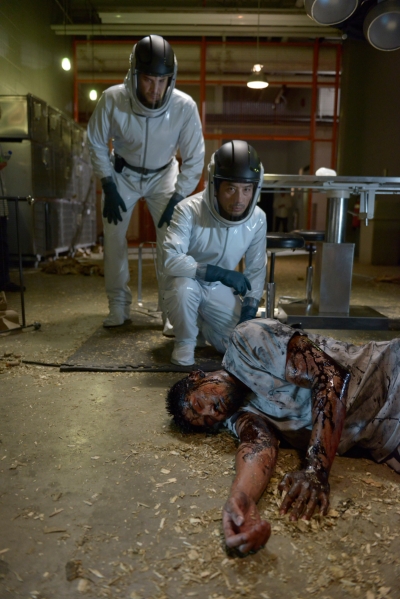
When I first saw the promos for the SyFy channel’s original series Helix I was intrigued. The premise: a group of CDC scientists travel to a remote arctic lab following a zombie-like outbreak. Initially what drew me were the zombies. What turned me off was the soap opera subplot: team leader Alan Farragut is joined by ex-wife Julia Walker, who slept with his brother Peter, who coincidentally is one of the infected.

It turns out I got it all wrong, and that was probably intentional on the part of the writers. (WARNING: spoilers ahead)

About the zombies. They were not zombies. By definition, zombies are the reanimated dead. Or, at the very least, they are not able to be cured, only destroyed. The writers kept us vague about the nature of the illness throughout, and once we saw the cure take effect, then I knew that these weren’t zombies. Instead they were a hive-like virus. Still damned scary.
Image

It turns out this whole zombie plot was nothing more than a MacGuffin. Simply put, a MacGuffin is a plot device that instigates the action, but in reality bears little importance to the story as a whole. One of the most famous MacGuffins is in Pulp Fiction. What was in that briefcase? We never knew, and its identity was irrelevant. Likewise, in Helix, the outbreak was a larger distraction from what the story was really about.

And what was it about? That’s hard to tell. On one level it was all about Julia Walker, the pouty, surly cheating scientist. She became the focal point of the storyline. And it worked. Julia was complex enough to be fully believable. She, along with Sergio Balleseros, a good/bad guy, were some of the more interesting characters in a show that suffered from weak characterizations.

Not only was Helix about Julia and her relationship with her estranged father Dr. Hatake, and missing mother (who showed up all too briefly), it was also about the cryptic Ilaria Corporation, which may not really be a corporation, but a collection of 500 immortals. It turns out that Ilaria, and not the outbreak, is the true focus of this show.

Image

So what does any of this have to do with that viral outbreak in an arctic lab? I’m not entirely sure. They hinted at population control, but that doesn’t explain the hive-mind of the infected.

Too many questions. Previously I doubted Helix would be renewed. It looks like I was wrong. In 2015 these questions may be answered (or not).

In the meantime, kudos for the writers for crafting a tightly wound puzzle of a show. There were no flashbacks, each episode consisted of a single day, and it was filmed in such a tight, claustrophobic way to keep you hooked. And it was not afraid of science. It was well worth my time.


Are multiple universes real? Some scientists say yes

The good news – they believe they may be real. The bad news – we may never be able to access them, or even want to.

How cool would it be to visit an alternate version of yourself, say, a world where you married your college girlfriend instead of breaking up? Or visit the version of yourself who is the ninja badass you always imagined yourself to be?

Image

Scientists have long theorized that multiple universes exist, and now they may have proof.

I won’t delve into the science behind all this — it’s over my head. But I’ll get to the heart of it: a recent discovery on the inflation of the universe, as explained in this Scientific American article, supports a hypothesis that multiple universes exist in this humongous thing called space.

How would it work? Imagine a glass of soda. In the soda there are tons of bubbles. Each bubble would be its own universe. Simple enough.

But there’s a catch. Actually, a few.

First, it is theorized that these alternate universes would follow different physical laws. Scientists have no reason to believe that the basic properties of matter hold true. It just seems to be the way our universe is constructed, by nature, by God, take your pick. Let your mind go crazy with how these other universes might be constructed. The possibilities are infinite. But we would stand no chance of surviving.

Second, how would we access these alternate universes, even if we wanted to? We can’t even get very far across our own universe, which is too large for us to rationally fathom.

Third, and this gets to my problem with science, this is all basically theory. Science and religion love bashing each other, but what they don’t realize is that they’re more alike than they’d care to admit. Both are tightly constructed belief systems with high priests who disseminate knowledge. Science relies on the observable world, and religion tends toward philosophy, but both frequently get it wrong. (For the record, I’m a fan of aspects of both.)

So, in the end, I think we’re stuck with multiple universes existing solely in our imaginations, which is good. I loved when the TV show Fringe, a great underrated sci-fi series, used alternate universes to enhance the show’s mythology. The old TV show Sliders, where the cast of characters went from alternate world to alternate world, was great fun. Doctor Who used parallel universes briefly and effectively. And I’m writing a story now that is centered on parallel worlds – and alternate versions of the main character.

While the science is exciting, I’ll stick with the fictional side of multiple universes. For now.

Helix: the last spasm?

The SyFy original was more than I thought it would be, but will the lack of character (and viewers) be its downfall?

Image

One episode left for SyFy’s 13-episode sci-fi series Helix. No word yet on whether it will be renewed. Knowing SyFy, we may never see Helix again, which would be a shame.

When Helix was first launched, I was intrigued. Was it a zombie story? A medical procedural? Knowing it was produced by Battlestar Galactica‘s Ronald D. Moore was a plus, but so what?

Over the past 12 episodes I’ve been surprised. It was not at all what I expected. The writers of Helix have seeded intrigue steadily and consistently, with more than enough plot twists to keep me coming back.

–About those “zombies” – I would liken them more to vampires in the sense that the infected don’t die and come back to life, but turn. And what do they turn into? A sort of hive collective. Think bees, or ants – parts of a whole. A snippet of dialogue explained that the virus appears to be acting in concert, across the bodies of the infected. Kind of like Star Trek‘s Borg collective. It’s a cool twist on an old trope. I loved when one of the infected spit a mouthful of blood into the Keep Calm mug.

Image

–The writers have built layers of mythology, the most notable being the identity of the company that is funding Dr. Hatake’s research: the Ilaria Corporation. Their rep was Constance Sutton, overacted by Jeri Ryan, who didn’t fare too well against a desperate Hatake. Now we know that Ilaria is populated by 500 “immortals.” Like Hatake. And… his daughter.

–And that would be Julia Walker. Sure, it was a soap opera move reminiscent of Star Wars, but I bought it. The reveal of Julia Walker as Hatake’s daughter was telegraphed, and it made sense in terms of Hatake’s motivations and actions. It explained his preoccupation with her, as well as the fact that he rescued her from the infected-zombielike fate by making her “immortal” too.

Image

–But what about this immortality? Is it a fact? Why? Where did it come from? And what does it have to do with the Narvik A virus, the one that’s creating the hive-minded people? Could it be that Ilaria and the 500 want to rid the world of those annoying mortals forever? But is that the best way?

–Speaking of pesky mortals, we’ve got a mixed bag of semi-developed characters, which is Helix‘s glaring weakness. Crusading CDC researcher Sarah Jordan has been on death’s door for a few episodes now, and honestly I don’t care. Peter Farragut was healed, but he was more interesting as a viral. Alan Farragut is noble but cardboard. The only characters who have moderately interested me are Julia Walker, Hatake, his stolen/adopted son Daniel, and the evil-but-trying-to be good Sergio Balleseros. Compare Helix to Lost: Lost made you care about the characters, whatever nonsensical craziness happened on that island. Helix struggles to make us care.

Image

–But then there’s the storytelling. While Helix fails in characterization, it excels in plot and pacing. It is consistent in giving me just enough to hook me. The plot twists keep me off-balance. The visuals are stilted and creative. The music is moody and disturbing. Helix is a quickly moving story. Each episode spans single day, and it’s told with no flashbacks. The structure is bound and wound.

There is something subtly different about Helix. It’s not perfect, but few TV shows are. There’s only one episode left, I suspect not just for this season but for good. If this is the case, then Helix was a great experiment in tight, daring storytelling.


Crime and punishment – sci-fi to sci-fact?

A near eternal hell on earth for felons? Maybe, if these scientists are to be believed.

Imagine a drug that, when given to a prisoner, would make him believe that a thousand years have passed in the matter of months. Imagine the hell of living for a thousand years in a jail cell, whether real or imagined.

We can argue over whether some crimes are so vicious that the perpetrators would deserve this treatment. But if scientists at Oxford University are right, this will soon be a reality.

And there’s more. The scientists quoted in this article also claim that life extension will allow a prisoner to be kept alive — and punished — for centuries. Or, criminals’ minds could be uploaded into a computer where they would serve hundreds of years in time.

Let’s take it for granted that this isn’t mere speculation but a possibility. Do we want to do this? Does this fall into the category of cruel and unusual punishment? And why would we want to invest so much money and time into keeping these criminals around indefinitely?

But what about another take on this? Even if these technologies never come to pass, imagine the possibilities in the sci-fi realm. Criminal minds uploaded that escape and roam free in the digital world. A killer kept alive for a millennium who escapes. A wrongly convicted man given a pill who lives a lifetime in a matter of days.

At least this kind of speculation is good fodder for fiction.

Helix spins a tantalizing, twisted tale

The SyFy Channel’s latest original series Helix, which airs Friday nights in the US, is turning out to be a multilayered labyrinth of a show.

When SyFy first began promoting Helix, I was captivated by the (literally) mind-blowing poster.Since then, I tried toHelix- 1 unravel what exactly it was about. Zombies? Scientific procedural? Lost-style isolation tale?

Several episodes in, I’m still not sure exactly what this science-heavy show all about, and that’s half the fun.

To recap the set-up, a team of CDC scientists is flown in to a Helix - Season 1remote Arctic lab to contain a mysterious viral outbreak. Once there, they are trapped. Alan Farragut (Billy Campbell) is the lead scientist, and his brother Peter is one of the Arctic lab’s scientists, who also happens to be infected. Alan Farragut’s team includes his ex-wife Julia Walker, who had an affair with Peter. Soapy and confusing. Luckily this aspect of the story has taken a backburner as the plot churns on.

The series is getting a lot right.

–We know the outbreak was engineered by lab head Hiroshi Hatake (Hiroyuke Sanada, a Lost alum), but we’re not sure what exactly it is, or why it was created.

–The writers on Helix aren’t afraid to play rough with the characters. No one is safe. Farragut and Hatake isolated scores of researchers they suspected were infected, giving them essentially a death sentence.

–Major characters are also at risk. I was shocked what happened to Doreen Boyle, a member of Farragut’s team. Likewise, big bad Constance Sutton (played by Star Trek: Voyager‘s Teri Ryan) proved less threatening in the end than she seemed. (And I loved the scene of her filing her own teeth down. Why??).

Helix_teeth

–Julia Walker, Farragut’s ex-wife, could have been an annoying distraction. Instead she’s become fascinating. Infected by the virus, then mysteriously “cured” by Hatake, Helix eyesshe’s revealed depth and determination. Adding to the mystery – is she really Hatake’s daughter? And what exactly has she become?

–One of my favorite characters on Helix is Major Sergio Ballaseros (Mark Ghanime). He’s duplicitous, murderous, and maybe even a touch remorseful. It’s a great portrayal of a mostly bad, complex character.Helix - Season 1

–Likewise, Hatake isn’t quite the villain he seemed. He reminds me of Lost‘s Ben Linus – a flawed man for whom the ends justify the means. His motivation is still unknown. It’s compelling to watch.

Another interesting aspect of the show is technical: the editing and the music. The scenes often seem a little off. They cut away too early, or they come in and out of focus, which keeps you slightly disoriented. It’s hard to understand without watching it;  this article at TV.com explains it better than I can. And the music choices, well, just watch the opening credits, with the 1960s bossa nova soundtrack.

I’ve referenced Lost a few times. That’s because Helix is similar to Lost in key ways. The mysteries unfold gradually, and the layers are onion-like. Character motivation is always in question, and the isolation heightens the drama. While it doesn’t have the emotional impact that Lost had, Helix is proving to be a fun addition to the sci-fi universe.

Nightmares reimagined

From sleep disturbances to disturbing art.

When I was younger I suffered through night terrors. I would be in the grip of a nightmare, screaming with my eyes open. It took a lot for my parents to bring me out of each episode. To this day I can still remember the theme and feeling of those nightmares.

I grew out of them. But I still have random incidents of what’s called hypnopompic hallucinations. Occasionally as I’m waking up I’ll see fantastical, otherworldly insects crawling on my bedside or dangling from the ceiling. The first couple of times it happened I scoured my bedroom looking for the centipede with a thousand legs and razor-sharp spines. I soon realized that they were leftover fragments of dreams. Now when I see these creatures I just close my eyes again.

I’m not alone in my sleep issues. Nicolas Bruno is a photographer who has dealt with sleep paralysis since he was 15. Sleep paralysis is pretty much what it sounds like: the body is weak and immobilized either when drifting off to sleep or waking up, and the person experiences strange and terrifying dreams or visions. As Bruno told 1o9.com:

“I have experienced bone chilling hallucinations and extreme terror during these dreams. Faceless silhouetted figures, embraces from shadow-like hands, warping of reality around me – all while [feeling] completely paralyzed.”

What did Bruno do with these terrifying experiences? He turned them into art. He’s created scores of photographs that reconstruct the content and mood of these dreams. Below are two of my favorites. Check out his website here for more.

Image

Image

(Both images: Nicolas Bruno)


Earth-bound monsters

When I was eight my parents took me to see the classic horror flick Alien in the movie theater. Little did they know what they were getting themselves–and me–into. They were sure I’d be terrified, but I barely flinched through the horror and gore Johnhurt(except for the iconic spaghetti scene, where the baby alien bursts through John Hurt’s stomach).

Maybe that’s because a few years earlier I was terrified by the flesh-eating zombies in George Romero’s Night of the Living Dead–and thus inoculated–from horror.

Nevertheless, the Alien franchise features some of the scariest, awe-inspiring monsters. These are creatures that use aliens.1humans not for food but as breeding pods, suffering through slow, agonizing deaths. Very much an H.P Lovecraft view of horror: the alien monster as a destroying force that gives no consideration to our humanity in pursuit of its destruction.

It turns out, once again, that nature parallels these horrors.

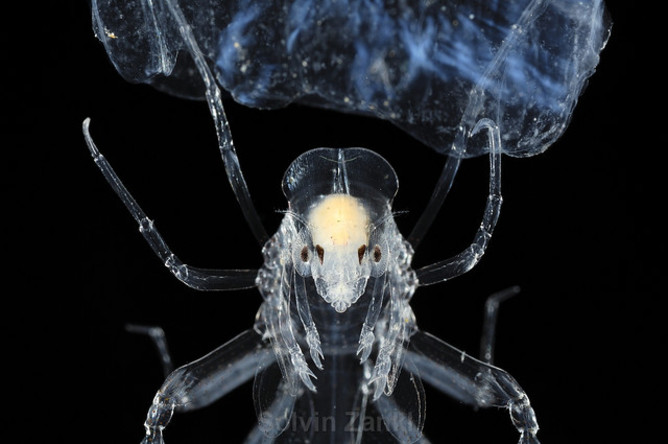
alien 1Take this parasite called PhironimaAccording to this article, it is thought to be the inspiration for the Alien monster.

And with good reason.

This tiny parasite lives in the ocean. It survives and thrives by attacking free-floating zooplankton. First it carves out the zooplankton’s insides. Then it climbs in and uses the hollowed out creature as its transport.

It’s not clear whether the Phironima kills the zooplankton, but the parallels to the Alien xenomorph are blood-curdlingly clear: a monstrous-looking creature alters and destroys another to use for its own benefit.

This is nature.

Time travel – from fiction to fact?

So far, the answer is no, unless the time travelers are hiding themselves really well.

It’s not too often that you hear of honest-to-goodness scientists searching for time travelers in a systematic fashion, but a few of them are. Richard Nemiroff, an astrophysicist at Michigan Technical University, and his team took a deceptively simple approach for tracking down time travelers: they did an Internet search.

They entered the following terms in the Internet: Pope Francis (there was no Pope Francis before March 2013) and Comet ISON (discovered in September 2012). Their theory — if they found mentions of either before the dates they were known, that would point to the existence of time travelers. They found only one mention of Pope Francis, but that seemed accidental.

Then they called for tweets using the hashtag #ICanChangeThePast2 or #ICannotChangeThePast2, specfically asking that the tweets be sent before the date issued. No responses.

Maybe there are no time travelers roaming among us. Or maybe they’re smart enough to not leave a paper trail.

So, for now, we’re stuck with time travelers existing only in TV, movies, and books. Maybe that’s a good thing. It’s complicated enough in imagination land. See my post on killing Hitler here for a good rundown. Also, check out io9.com’s complicated examination of the paradox-filled, twisted timelines of the Terminator franchise.

The bottom line? Time travel is hard stuff — hard to write about, and possibly too hard for us to ever achieve in reality.