Your life is an accumulation of choices you make along the way, small to large. Some you sense will be impactful. Others you have no idea. And then some things are beyond your control and they set you along a particular course. These things could be curses or they could be blessings.
In a sense, your fate—where you end up—becomes determined (preordained?) by all these choices.
This idea is captured by the six-episode TV show Half Man.
Before I get into describing and dissecting Half Man, a quick detour. I started the first episode blind. I got about ten minutes in and I was like, what the hell am I watching. I had to stop and do a little digging. Half Man is written by and stars Richard Gadd. He’s the guy behind Baby Reindeer, which came out a few years ago. I’d never seen it. Baby Reindeer was a huge hit, and I knew it was autobiographical, so rather than continuing with Half Man, I switched over to Baby Reindeer. I needed to know who the hell this dude was.
Baby Reindeer, which Gadd also wrote and stars in, is based on his real-life experience with a stalker. It was strange and great. Having dealt with a stalker myself, it left me unsettled. Like Gadd, I’d blamed myself for her actions, even though I deserved no blame, and I pitied her, even though she didn’t deserve it. In Baby Reindeer, Gadd shows pure human messiness. When I finished it I went back to Half Man.
Half Man is the story of star-crossed step-brothers—Niall Kennedy and Ruben Pallister, whose mothers are lovers. The first three episodes focus on younger Niall and Ruben (Mitchell Robertson and Stuart Campbell), and the last three focus on them as adults (Jamie Bell and Richard Gadd). It follows Niall and Ruben from their teenage years to adulthood. Along the way, they become enmeshed and entangled, for better and for worse. Mostly worse. They have a genuine filial love for each other, but they’re also toxic due to Ruben’s control and Niall’s envy, and as their awful life choices compound, this toxicity turns to poison. Their fates catch up with them.

First, the acting. I can’t say who among the four is best. They’re all gripping, and the transition from younger to older is seamless. Jamie Bell and Richard Gadd are an interesting pairing. Bell, who plays Niall, is slight and disheveled while Gadd as Ruben is hulking and full of swagger. It’s jarring to see Gadd in this role following Baby Reindeer. It’s such a physical transformation, and it’s more than him just bulking up. I don’t understand how actors can pull that kind of transformation off.
I’ve watched Half Man twice now. The first go-around was brutal. Niall’s the main character. We walk through the story alongside him. We meet him at 15. His father died when he was a child and he lives with his mother, Laurie and her girlfriend Maura. Niall is nervous and frail and gets bullied. When he learns that Maura’s son, Ruben, is getting out of juvy and will be living with them, he panics.
Soon enough Ruben bursts on the scene. He is imposing and controlling and magnetic. Niall, who is just beginning to realize he might be gay, is drawn to Ruben, though not just physically. He’s terrified of Ruben, rightly, but enthralled by his bravado and presence. He craves Ruben’s attention. Ruben, in turn, becomes protective of Niall, though he insists everything be on his terms. This dynamic sets the course of their lives.
Niall is one of the more difficult protagonists I’ve seen in fiction. He’s needy, desperate, self-serving, and conniving. I don’t particularly like him. I can’t relate to him. But I can’t turn away from him. And Ruben is an asshole. He’s brutal, both physically and verbally. He’s so wounded that all he knows how to do is lash out.
What’s fascinating is their bond. On a surface level it can be read as homoerotic, especially since Niall, throughout the show, struggles to come to terms with his gayness. But their bond is deeper. They complete each other in a sense; each has what the other lacks. They know this on some level, which leads to a magnetic pull for closeness that’s ruined by envy and control.
Like Romeo and Juliet, Half Man is a tragedy. My first time watching it was all I could to to keep my heart rate down. The rewatch let me appreciate how Gadd cleverly constructs this story. For example, when Ruben first appears, he struts into Niall’s classroom. What is the teacher lecturing about? Romeo and Juliet, a foreshadow of what fate has in store for them.
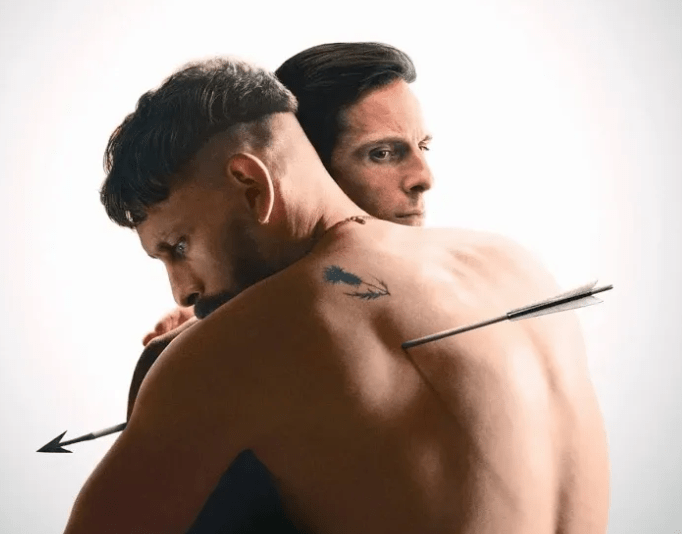
Gadd leaves hints throughout the series. Early on, you know that something is very wrong with Ruben. I figured it was either one of two reasons: he’s either gay and in full repression mode, or he was molested. Turns out it was the latter. Gadd dropped these hints here and there, subtle but unmissable, so that when the reveal comes, it all feels earned. During some of Ruben’s violent outbursts, especially at the climax, you can even see Ruben perpetrate elements of his own abuse. Gadd makes it all feel real. And, strangely, he makes you feel some sympathy for Ruben.
Niall, too, is not without sympathy. Yes, he is so incredibly selfish that it’s hard to root for him. Either consciously or subconsciously, he deviously undermines Ruben. He’s self pitying. An eternal victim. At one point Ruben calls him King Rat. It fits. But Gadd also shows us how utterly alone and terrified Niall is. His mother Laurie is a textbook cold fish. While not cruel per se, she’s lacking in maternal instincts. Having that as a mother, having lost a father at a young age, and being bullied at school would naturally leave Niall at a severe deficit.
This ambivalence is a hallmark of Gadd’s writing, and maybe why I connect with it. Even in the relationship between Niall and Ruben, Gadd weaves the good with the bad. On one hand, Ruben threatens violence on Niall (and inflicts it). Niall schemes and lies to get back at him. But they also share a genuine closeness. On a school test, Niall cheats for Ruben so he won’t get sent back to reform school. Ruben teaches Niall how to box. Later on when Niall is down and out Ruben pays for his expenses, In another world, they could have been good for each other. But then Half Man wouldn’t have been half as compelling.
The writing consistently is terrific, and while I won’t go through all of it (watch it instead and see for yourself), I’ll cover the ending.
Even though you know they’re poisonous together, you want them to work things out (they come so heartbreakingly close). But with Ruben’s rage and Niall’s self-destructiveness, it can only end tragically. I can’t say the ending left me sad. No. Strike that. It did leave me sad. It didn’t have to be that way, but with the shitty hands they were dealt compounded by the shitty choices each of them made over several decades, Half Man could only end the way it did. Not every story earns a happy ending.
That calls back to the common thread I see in Gadd’s writing—he’s not afraid to portray ambivalence and ambiguity. People aren’t always 100 percent right or wrong. They’re complicated. Motivations, actions, impressions, all can be inconsistent. People and life can be messy and confusing. Gadd shows all of this. There are no easy answers and very few easy people.
Some of the press surrounding this show framed it as an examination of toxic masculinity. I hate that term. It’s a dismissive blanket statement, dismissive not just of men but of human experience. Yes, Half Man focuses on men and masculinity, but it’s a human story about how fucked-up people can end up fucking up other people, and each other. Sex/gender doesn’t matter. If Ruben had a better childhood, maybe he wouldn’t have been so brutal. If Niall could’ve been more self accepting, maybe he wouldn’t have been so destructive. To say that their toxicity is connected to their maleness doesn’t make sense, because they are males, so that’s the frame in which they can operate.
A final thing about Half Man. One of the themes Gadd touches on is loneliness. He gives us two boys who’ve suffered abuse and abandonment and are isolated. A lot of us have felt lonely in childhood and adolescence in one way or another. Both Ruben and Niall did, for different reasons. And like a lot of us, they struggled to fill that void of loneliness. Unfortunately for them, they each filled it with the worst possible person. Despite the tragic ending, I appreciate that Gadd was able to present this loneliness in such a relatable way.
The writer in me is impressed by what Gadd created in Half Man. The brutal honesty, the subtlety, the complexity, even the subject matter of a close and toxic relationship between two men. The viewer in me was drawn to a story about the need for connection, and how even if it all goes so horribly wrong, that doesn’t negate the need. Half Man is dark, it’s difficult, and it’s human.