The horror world is full of tropes.
That’s not a criticism. Not in my opinion. You can make anything old and done before work as long as you nail the basics: storytelling, writing, characterization. Those are more important than whether what you’re writing about has been done before.
Undertone, a movie I recently watched, is a great update on a newish horror trope: found footage. The update was clever, the storytelling and mood were solid, but one thing was lacking.
Characterization.
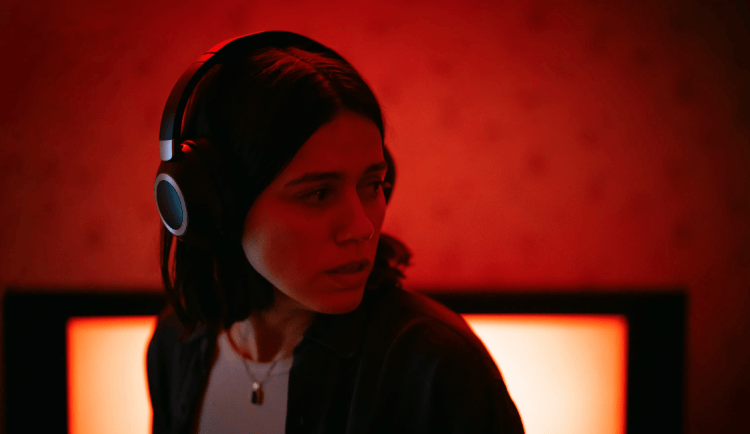
Undertone follows a pair of podcasters, Evy and Justin (who we never see), who focus on the paranormal. Justin’s received a cryptic email with ten files attached. As part of their podcast, they listen to each of the files. This being horror, strange things ensue.
But these strange things only happen to Evy, who is taking care of her dying mother. The entire movie is shot at this one location: her mother’s house. As the podcasters listen to the audio files, which contain nursery rhymes sung backwards revealing hidden messages of violence, demonic activity ensues. File after file, it all gets worse. Until it ends.
What I liked: the intentionally drab cinematography gave Undertone a claustrophobic air. And the concept itself. Summoning of demons is a cliché, but it’s one that endures. I also liked the idea of nursery rhymes as a secret vessel of evil. I don’t know if this an original idea; I can’t remember seeing it used before. And while I had issues with the pacing, there was a solid progression as the danger amped up.
What I didn’t like: the biggest flaw of Undertone was Evy. She’s the protagonist, and the only character we see for twoish hours (aside from her comatose mother), and there is almost no set-up for who she is as a human before the horror ensues. I really needed to see who Evy was, very briefly, before dropping us into the story. I needed some character development just so I could bond with her a little, get to know her, have some sympathy before she’s plunged into the depths of hell. I needed a connection.
Instead we get some care-taking shots and then her sitting down at a table in front of a computer and microphone as she has (meaningful) small talk with the disembodied voice of Justin. I really didn’t know who Evy was, I had no clue who Justin was, so I had almost no investment. And I needed it, because the pre-podcast conversation with the disembodied voice felt wholly unnatural to me. I didn’t believe them because I didn’t know them.
If only they’d spent the first ten minutes setting up a little of who Evy was. I know she’s taking care of her dying mother. Who is she aside from that? What did she set aside to uproot her life and care for her mother? Does she have a boyfriend? We don’t know, and that last question is really annoying because about an hour in, Evy (and the audience) discovers she’s pregnant.
Wait, what?
I suppose I understand why in part we don’t get too much of Evy’s life. Undertone was made for $500k, so the producers were limited (it looks really good for $500k). But still. Seeing as the movie grossed over $20 million, hopefully the director’s next budget will allow for some more character development.
I really wanted to like Undertone, and I do, to a point. There were things I definitely enjoyed, but to a point. For instance, I liked the podcasting idea. I liked that Evy and Justin were only playing roles in their podcast, he the believer and she the skeptic. But I needed something else in their interactions. I don’t know if getting to see Justin would help, or if it was a pacing issue, or if, as I wrote already, a lack of character development for Evy.
The last point to touch on is the issue of theme. Most horror movies are not really about the monster or the threat. They’re about some very human fear. I’m pretty sure Undertone was supposed to be about the fear of motherhood, The demon in question makes women kill their children, born or unborn. Evy was caring for her dying mother, Evy discovers she’s pregnant.
But none of this hit me on an emotional level. I didn’t really feel any of it. Again, I think it’s because I didn’t know Evy. I didn’t know her hopes or fears or what she liked or hated. None of that. Just that she was about to come face to face (or ear to ear) with a demon.
The moral of this tale: character development is vital to telling a good story. Don’t be terrified of it.