Nightmares reimagined

From sleep disturbances to disturbing art.

When I was younger I suffered through night terrors. I would be in the grip of a nightmare, screaming with my eyes open. It took a lot for my parents to bring me out of each episode. To this day I can still remember the theme and feeling of those nightmares.

I grew out of them. But I still have random incidents of what’s called hypnopompic hallucinations. Occasionally as I’m waking up I’ll see fantastical, otherworldly insects crawling on my bedside or dangling from the ceiling. The first couple of times it happened I scoured my bedroom looking for the centipede with a thousand legs and razor-sharp spines. I soon realized that they were leftover fragments of dreams. Now when I see these creatures I just close my eyes again.

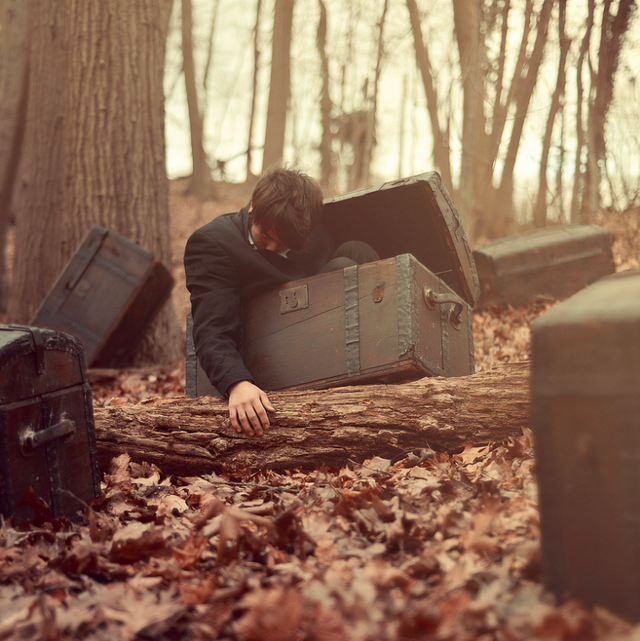
I’m not alone in my sleep issues. Nicolas Bruno is a photographer who has dealt with sleep paralysis since he was 15. Sleep paralysis is pretty much what it sounds like: the body is weak and immobilized either when drifting off to sleep or waking up, and the person experiences strange and terrifying dreams or visions. As Bruno told 1o9.com:

“I have experienced bone chilling hallucinations and extreme terror during these dreams. Faceless silhouetted figures, embraces from shadow-like hands, warping of reality around me – all while [feeling] completely paralyzed.”

What did Bruno do with these terrifying experiences? He turned them into art. He’s created scores of photographs that reconstruct the content and mood of these dreams. Below are two of my favorites. Check out his website here for more.

Image

Image

(Both images: Nicolas Bruno)


Fictional faces brought to “life”

One artist is translating writers’ descriptions of their fictional characters. The results are jarring.

For me, half the fun in reading a book is imagining it in my mind’s eye. Sometimes I get a clear image of the characters; other times the image is hazy as the action takes control. Either way, I’m engaged in creating this world in my own imagination with the blueprint that the writer provided.

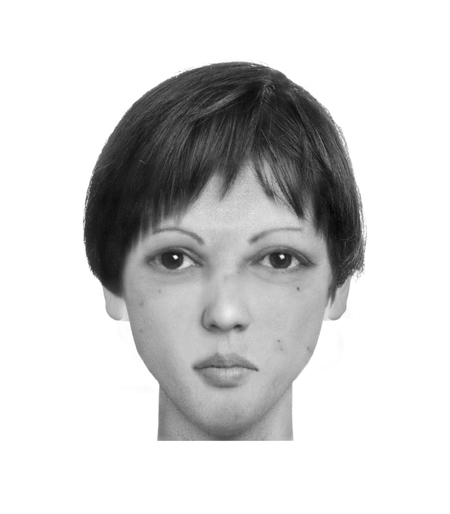
Brian Joseph Davis has taken some of the best known — beloved and infamous — literary characters and created sketches of them using law-enforcement composite sketch software. He’s compiled the sketches, and the original descriptions, on his website The Composites.

Take Mr. Wednesday, one of the major characters in Neil Gaiman’s classic novel American Gods.

As described by Gaiman:

Shadow looked at the man in the seat next to him…He grinned a huge grin with no warmth in it at all…His hair was a reddish gray; his beard, little more than stubble, was grayish red. A craggy, square face with pale gray eyes…The man’s craggy smile did not change…There was something strange about his eyes, Shadow thought. One of them was a darker gray than the other…humorless grin…Wednesday’s glass eye… He was almost Shadow’s height, and Shadow was a big man.”

And as visualized by Davis?

Image

That’s not how I pictured Mr. Wednesday in my head. To me he was older, craggier, beefier.

There’s more on Davis’ website. Here’s Marla Singer, from Chuck Palahniuk’s Fight Club, as Palahniuk describes her:

My power animal is Marla…Black hair and pillowy French lips. Faker. Italian dark leather sofa lips…Marla stares up at me. Her eyes are brown. Her earlobes pucker around earring holes, no earrings…She actually felt alive. Her skin was clearing up…Marla never has any fat of her own, and her mom figures that familial collagen would be better than Marla ever having to use the cheap cow kind…Short matte black hair, big eyes the way they are in Japanese animation, skim milk thin, buttermilk sallow in her dress with a wallpaper pattern of dark roses…Her black hair whipping my face…The color of Marla’s brown eyes is like an animal that’s been heated in a furnace and dropped into cold water. They call that vulcanized or galvanized or tempered.

And here’s Davis’ image.

Image

My favorite of Davis’ images is the one that captures a different view of a classic character. In Frankenstein, Mary Shelley describes the monster as:

Beautiful! Great God! His yellow skin scarcely covered the work of muscles and arteries beneath; his hair was of a lustrous black, and flowing… but these luxuriances only formed a more horrid contrast with his watery eyes, that seemed almost of the same colour as the dun-white sockets in which they were set, his shrivelled complexion and straight black lips.

And here he is:

Image

With all the Hollywood depictions of the Monster as monstrous, it’s easy to forget that he was not created to be hideous.

As a reader and a writer, I’m not a fan of over-description. In my book The Last Conquistador, I tried to be sparse but concise in my descriptions of the characters. For instance, the protagonist Randy describes his wayward girlfriend Lise as “solid and shapely, like the kid sister of a truck stop waitress.” I wanted to seed a broad image in the reader’s mind.

In Always Mine, Danny, the young hero, meets the stepfather of Tina, the mysterious girl next door that he has a crush on. How do I describe Bob? Using just a few key images:

“He shook Danny’s hand rough and hard. He was meaty with a walrus mustache, and he glared as if Danny harbored bad intentions for his daughter.”

While I prefer the less is more approach, after browsing through Davis’ website and comparing the writers’ words with the sketches produced, I have a greater appreciation for those writers who are meticulous in crafting their characters. It’s fascinating to see how writers shape the worlds we create in our minds.

Earth-bound monsters

When I was eight my parents took me to see the classic horror flick Alien in the movie theater. Little did they know what they were getting themselves–and me–into. They were sure I’d be terrified, but I barely flinched through the horror and gore Johnhurt(except for the iconic spaghetti scene, where the baby alien bursts through John Hurt’s stomach).

Maybe that’s because a few years earlier I was terrified by the flesh-eating zombies in George Romero’s Night of the Living Dead–and thus inoculated–from horror.

Nevertheless, the Alien franchise features some of the scariest, awe-inspiring monsters. These are creatures that use aliens.1humans not for food but as breeding pods, suffering through slow, agonizing deaths. Very much an H.P Lovecraft view of horror: the alien monster as a destroying force that gives no consideration to our humanity in pursuit of its destruction.

It turns out, once again, that nature parallels these horrors.

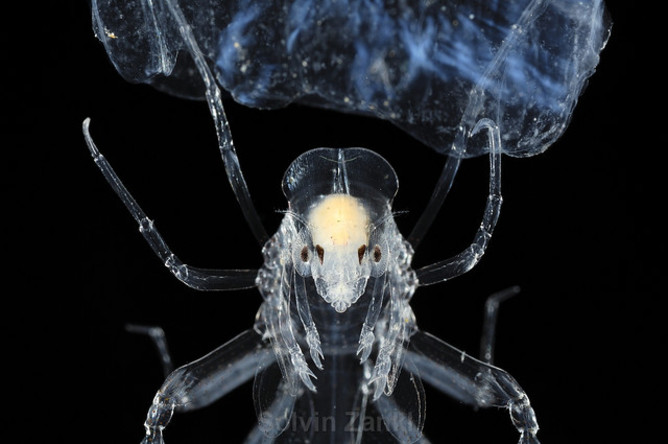
alien 1Take this parasite called PhironimaAccording to this article, it is thought to be the inspiration for the Alien monster.

And with good reason.

This tiny parasite lives in the ocean. It survives and thrives by attacking free-floating zooplankton. First it carves out the zooplankton’s insides. Then it climbs in and uses the hollowed out creature as its transport.

It’s not clear whether the Phironima kills the zooplankton, but the parallels to the Alien xenomorph are blood-curdlingly clear: a monstrous-looking creature alters and destroys another to use for its own benefit.

This is nature.

American Horror Story: Coven – the autopsy

Did the writers go astray, or was the whole show a goof?

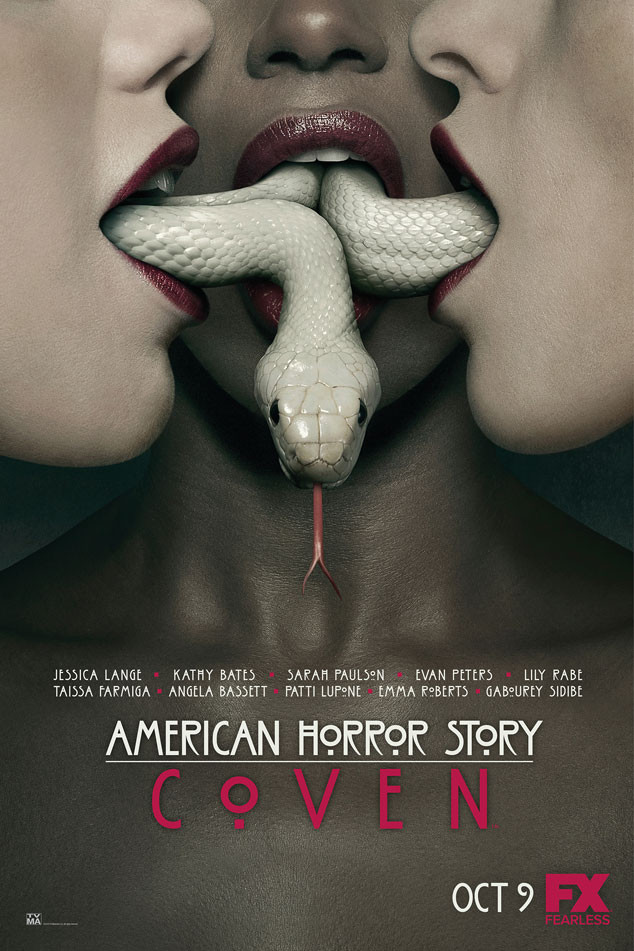
What was it with American Horror Story: Coven? I could never look away, as much as I wanted to. It was like driving past an accident where you hope to get a glimpse of the burning wreckage.
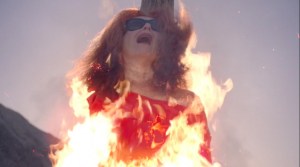
CovenThe show had a lot going for it. Top-notch cast. Heavy buzz. Solid premise: a coven of witches under attack in New Orleans. That premise alone is overflowing with possibilities.

But sadly it failed to live up to its promise.

The finale gave us a glimpse of what American Horror Story: Coven could have been. The finale involved the selection of a new supreme witch after the reigning supreme, the narcissistic and evil Fiona Goode (Jessica Lange), was supposedly chopped up by her demonic lover and fed to the swamp creatures. After the selection process, the new supreme turned out to be none other than Fiona’s weak-willed daughter Cordelia (Sarah Paulson).

In one of the final scenes Fiona returns. It turns out she faked her death to draw out the new supreme and then hopefully kill her. But Fiona was by then severely weakened. This scene between mother and daughter relayed a complicated, damaged dynamic. If only the show had focused more on this, it would have had a solid footing. It could have been a case study of power, family, good vs evil.

But what we got instead was some unholy mess that bordered on farce.

Exhibit A: next-door-neighbor Joan Ramsey, a religious cliche who gave her grown son bleach enemas (?!?)

Exhibit B: Madame LaLaurie, a sadistic southern slave-owning madam from the 1800s, lalauriecursed to eternal life, who at one point was just a severed head singing (the context doesn’t make it better). LaLaurie goes from rich woman to prisoner to maid to severed body parts, and is then magically reassembled by Queenie, only to have her immortality revoked by Big Bad Voodoo Daddy. Everything about this character was a fail.
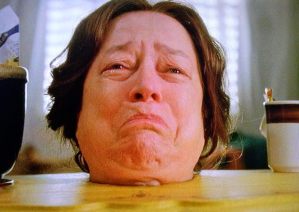
Exhibit C: Young witches Madison and Zoe resurrect Kyle after Madison kills him and his date-rapist fraternity brothers. Kyle spends the rest of the season moaning Frankenstein-style, eventually becoming the Coven’s attack dog/butler. What was the point?

Exhibit D: The previous butler, Spalding, collected dolls and likes to dress as a doll. Oh, and he was missing his tongue for the first half of the season. It was hidden in a box in a closet.

Exhibit E: Cordelia, the witch who became supreme, was so weak and pitiful throughout the eyescordshow that she stabbed her own eyes out (well, not her own eyes…long story) to regain powers that never materialized. Then, in the space of ten minutes she’s suddenly the most powerful witch.

Exhibit F: Death? What’s that?

–Madison: throat slit by Fiona, and resurrected by Misty, then strangled by Kyle

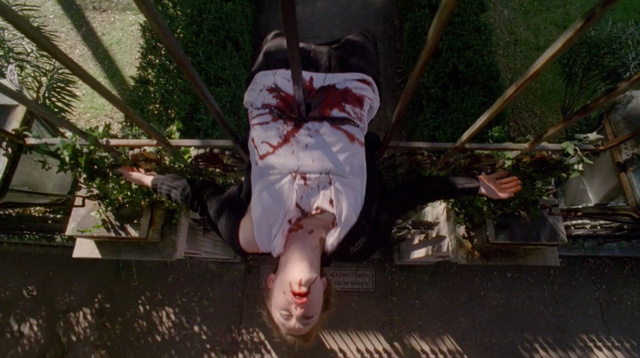
coven–Zoe: impaled on an iron fence and resurrected by Cordelia

–Kyle: killed in a horrific bus crash thanks to Madison and resurrected by Madison and Zoe

–Misty: burned at the stake and resurrected by her own self, then buried alive by Madison, then resurrected by Queenie (sort of — it was unclear how dead she was), then turned to ashes

–Queenie: killed by her own hand (long story), then somehow resurrected (she just shows up alive again and rattles off a 3-second explanation)

–Myrtle: burned at the stake by Fiona, then resurrected by Misty, only to be burned at the stake by Cordelia (after insisting on it (!?!))

–Joan Ramsey: gunned down as collateral damage by the witch hunters, then resurrected by Misty, then killed by mind-controlling Nan (forced to drink bleach) after smothering her enema-clean son (whose ashes told Nan what happened)

Exhibit G: Stevie Nicks showed up for a couple of episodes, as herself, a white witch. She sang and she twirled around. Whatever.

I could go on and on. I won’t. The bottom line: American Horror Story: Coven could have been great. It had an award-winning cast and a solid premise. But the most promising subplots (the witch hunting group, the Axeman) were pushed aside or minimized. Instead, the writers chose camp over coherence.

California: the muse of modern American sci-fi

I’ve only been to California a few times. The state didn’t leave much of an impression on me. But a dense and intriguing article makes the case that the development of California in the 1900s was fodder for some of the best sci-fi writing we’ve seen.

Ray Bradbury, Robert Heinlein and Philip K. Dick are titans of US sci-fi writers. Bradbury’s best known works include Fahrenheit 451 and The Martian Chronicles. Heinlein wrote Starship Troopers, among others, and Philip K. Dick is the author of Do Androids Dream of Electric Sheep?, which was adapted for the big screen as Blade Runner.

All 3 men were prolific, and according to this article by Michael Ziser that appeared on the website Boom California, they were often writing about the dramatic transformations that took place as California was turned from a sparsely populated harsh landscape to a lush multiethnic state powered by land management, urban planning, and the defense industry.

Bradbury, the writer states, “dramatizes the personal difficulty of adjusting to the radical novelty of West Coast civilization ray bradburycarved out of the desert.”

His evidence? Bradbury’s Martian Chronicles series of stories, which capture themes including development that alters an arid landscape, plagues that devastate native populations, societal makeovers, and a longing for a lost world.

In Bradbury’s classic short story There Will Come Soft Rains, which describes a fully automated house going about its business long after the family has been killed by a nuclear war, he may be reflecting the anxieties of mid-20th-century progress. Technology has outlived its creators.

robert heinleinLike Bradbury’s Martian Chronicles, Heinlein wrote about a transformed landscape in The Moon Is a Harsh Mistress. Heinlein merges technology and an alien world. Heinlein, the author writes, reflects the optimism of his era about the potential to remake civilization, while reflecting an unease with the technology that makes this possible.

Philip K. Dick, who wrote later than Bradbury and Heinlein, also told tales of colonization, but he also reflected a 1970s-era sensibility, as his stories often focused on infrastructure philip k dickand environmental threats. His story Survey Team includes a character who mourns for the lost world of his Californian boyhood.

“It was a lot different from the way he remembered it when he was a kid in California. He could remember the valley country, grape orchards and walnuts and lemons. Smudge pots under the orange trees. Green mountains and sky the color of a woman’s eyes. And the fresh smell of the soil…. That was all gone now. Nothing remained but gray ash pulverized with the white stones of buildings. Once a city had been in this spot. He could see the yawning cavities of cellars, filled now with slag, dried rivers of rust that had once been buildings. Rubble strewn everywhere, aimlessly….”

What a great piece of writing.

Science fiction is often derided as commercial and pulp. But this analysis shows that, like the best of literature, sci-fi can incorporate larger themes of our world and our humanity.

(Philip K. Dick image: Nicole Panter)

American Horror Story: Coven — the last gasp

Is it a good TV show gone bad, or was it never as good as the hype?

American Horror Story CovenOnly one episode left in this season of American Horror Story: Coven. I’ve seen every one. The first few game me some hope. The series had a top-notch cast, some clever ideas, and, most importantly, it is one of the few shows that focuses on horror.

But, the writing… boy oh boy. Sometimes you need to just give up on a TV show. I didn’t.

It’s not all bad. Jessica Lange’s Fiona Goode, the supreme witch, the head of the coven, is lucky. Her character has the best storyline. Her path through villainy is compelling, and Lange is skilled enough to underplay the camp that weighs down the series.

Fiona’s relationship with her daughter Cordelia, a witch who is much weaker than her mother, is compelling and complex. Watching Fiona battle cancer, the loss of her power, mortality, all the while remaining a villain is the highlight of the show for me.

There are several other characters on American Horror Story: Coven who are rich enough to keep my attention: most notably fellow witches Misty Day and Myrtle Snow, and Cordelia’s duplicitous husband Hank Foxx. Even the Axeman, a murderous musician, is 3-dimensional enough to keep me interested.

Most of the other characters, however, are either flat or downright annoying. There’s Madame LaLaurie, the psychotic noblewoman played by Kathy Bates (annoying), and Angela Bassett’s Marie Laveau (one-note). Though their final (joined) fates were well done.

The plotting is a lesson in absurdity. Characters die and are brought back to life. When death is not final it holds no power to shock or disturb. Fiona was supposedly killed. I’d be shocked if she didn’t reappear in the final episode.

American Horror Story: Coven is a show with no internal logic. From the beginning of the season it was emphasized that witches were in danger of dying out — they were being killed off. But in a recent episode, supreme witch Fiona claimed that the process to identify the new supreme would inevitably kill some of the girls. How does killing witches help strengthen the coven?

That is bad writing.

During the course of the season we got to meet the group responsible for hunting the witches down. With just one episode left, I would be rooting for them to kill every last one of these witches, even the so-called good ones. Unfortunately the writers screwed up again. An organization that spent centuries hunting witches had no way to protect themselves against witchcraft, and they were wiped out in the course of a single episode. you would think that such a group would know how to protect themselves.

Logic be damned. Then again, maybe I was expecting too much.

Five Fascinating Facts about The Hunger Games

This is a great blog post — short and succinct — that highlights some of the literary history behind The Hunger Games series. Take a look…

InterestingLiterature's avatarInteresting Literature

1. The idea for The Hunger Games came to author Suzanne Collins while channel-hopping between coverage of the invasion of Iraq and a reality TV show. The idea began to form in her mind of a narrative which concerned a televised fight to the death. The theme of the series has led critics to draw comparisons with similar works, principally Battle Royale, a 1999 novel by Japanese author Koushun Takami, but the idea of a dystopian future world in which people fight each other as part of a television programme is found in a novel by Stephen King (writing as Richard Bachman), The Running Man (1982).

2. The author of The Hunger Games, Suzanne Collins, was one of the writers on the 1990s teen TV show Clarissa Explains It AllCollins worked in television for many years during the 1990s; her other television writing credits included Clifford’s Puppy…

View original post 296 more words

Time travel – from fiction to fact?

So far, the answer is no, unless the time travelers are hiding themselves really well.

It’s not too often that you hear of honest-to-goodness scientists searching for time travelers in a systematic fashion, but a few of them are. Richard Nemiroff, an astrophysicist at Michigan Technical University, and his team took a deceptively simple approach for tracking down time travelers: they did an Internet search.

They entered the following terms in the Internet: Pope Francis (there was no Pope Francis before March 2013) and Comet ISON (discovered in September 2012). Their theory — if they found mentions of either before the dates they were known, that would point to the existence of time travelers. They found only one mention of Pope Francis, but that seemed accidental.

Then they called for tweets using the hashtag #ICanChangeThePast2 or #ICannotChangeThePast2, specfically asking that the tweets be sent before the date issued. No responses.

Maybe there are no time travelers roaming among us. Or maybe they’re smart enough to not leave a paper trail.

So, for now, we’re stuck with time travelers existing only in TV, movies, and books. Maybe that’s a good thing. It’s complicated enough in imagination land. See my post on killing Hitler here for a good rundown. Also, check out io9.com’s complicated examination of the paradox-filled, twisted timelines of the Terminator franchise.

The bottom line? Time travel is hard stuff — hard to write about, and possibly too hard for us to ever achieve in reality.