Battlestar Galactica Rewatch Part 1: History of the Reboot

Even when it first appeared in 2003, the reboot of the classic 1970s series Battlestar Galactica was considered an instant classic, and not just by me. Part of that success had to do with the megawatt casting of two Oscar nominees, Edward James Olmos and Mary McDonnell in the leads, and part had to do with the gritty writing and visual style that was all the rage in the early zeroes. Battlestar Galactica started off as a miniseries but quickly launched into a full-time series that lasted four seasons on Syfy, becoming one of that channel’s flagship shows.

I watched it faithfully when it first came out. At the time I loved it. I couldn’t get enough. I was obsessed by the original show as a kid (although it looks incredibly cheesy to me now). I wanted to be Dirk Benedict’s Starbuck! And I was definitely psyched by the prospect of a reboot.

Before I get too far I suppose I should tell you all what Battlestar Galactica (the reboot) was about. A human civilization called the Colonials creates robots called cylons, which rebel and launch a deadly war against them. Decades after a stalemate, human-looking cylons infiltrate colonial defenses, enabling the cylons to launch an overwhelming attack. Out of 20 billion humans, only about 40,000 survive aboard a handful of spacefaring vessels led by the battlestar Galactica. Chased by the cylons, they set out to find a legendary lost colony called Earth.

The miniseries came out as a standalone three-hour event in late 2003. It launched to strong acclaim, both critical (positive reviews, a Saturn Award, Emmy nominations) and audience (83% audience score on Rotten Tomatoes), and then came the series, which was also lauded.

The series was directed by Michael Rymer and written by Ronald M. Moore, who’d previously worked on various Star Treks as a writer and/or producer, and who went on to shows including Helix and Outlander.

All told, there were 76 episodes of Battlestar Galactica spread out over four seasons from 2004 to 2009, plus ancillary episodes, including a movie rehashing the entire series from the cylon’s point of view (The Plan), a webisode prequel featuring the young Commander Adama (Battlestar Galactica: Blood and Chrome), and a prequel series, Caprica, that lasted for a single 19-episode season. Caprica was kind of a mess, but it was interesting, at least.

Its strong writing and acting and imaginative plot earned Battlestar Galactica a ton of awards and nominations, including Saturns, Hugos, Emmys, and even a Peabody. Critics mostly praised the show, although some criticized it for being heavy handed (true) and straying too far from the premise of the original series (true).

I don’t know if it can be said that Battlestar Galactica cemented the Syfy channel’s place in the early 21st century cable ecosystem, but it definitely helped. One thing I can say for sure is that Battlestar Galactica has left a towering legacy in the sci-fi universe. Its lofty position in sci-fi lore is cemented, for good reason.

With all this in mind, I decided to rewatch the entire series 20 years on to see how it all held up. At first I thought I could fit everything I wanted to say about it in maybe a few posts, but honestly who likes to read three thousand words on a blog post? So I’ll spread this over several posts and let you all know my verdict.

Archie vs Predator?

Call this post mash-ups gone wild.

What are two things that should not go together? Two things that absolutely MUST go together.

The latest proof — there’s a new comic series coming out that combines that all-American wholesomeness of the Archie comics with…. the sci-fi horror classic Predator.

Predator Archie

Say what???

According to this link at io9.com, Archie and friends will be forced to battle the Predator aliens while on vacation in Costa Rica. Sounds good to me.

When I was young, I loved the Archie comics. There was something so normal, so ideal, about Archie and his life. It was an experience I wanted. And of course I loved Predator. Badass Arnold Schwarzenegger fighting badass aliens? What’s not to like?

I hope Hollywood (or at least SyFy or the Spike Channel) have optioned these books. I would love to see Jughead’s severed head hoisted aloft.

Archie Predator

Ascension — a fatal bait-and-switch

I have to give the SyFy network some credit. After taking a strange turn away from all things sci-fi several years ago, they’re making an effort to cultivate new sci-fi programming. Helix, for example, is a solid, if not great, show.

ascension_2560x1450_1280x725_369265219996

I was excited to see the promos for SyFy’s new miniseries (and possible series) Ascension. Not just because it stars Battlestar Galactica alum Tricia Helfer, though that’s a plus. Mainly I was ASCENSION-HELFERintrigued by its plot. This is what we were told Ascension would be about:

A spaceship is launched in 1963 to colonize the far reaches of space. Halfway through their 100-year journey, they’ve been isolated from Earth, yet continue on with their mission.

Wow. So many thematic possibilities. The obvious question, what would a society be like that never saw advances such as civil rights and feminism? And how would this society have evolved over a full generation with nothing to rely on but their faith in their mission? Space operas tend to focus on the larger mission, that is, surviving in space and getting to the planet. Few genre shows get into the nitty gritty of day-to-day survival. In my opinion, that’s one reason why The Walking Dead is such a successful show. When it comes to zombies, it is wholly conventional — nothing new to see there. But what it does different than every other zombie show we’ve seen is focus on the mechanics of survival. Ascension, based on its premise, seemed like it could be the sci-fi equivalent.

Ascension

Unfortunately it did none of this. Instead, what we got with Ascension was one of the biggest bait-and-switches I’ve seen on TV.

(SPOILERS BELOW…)

At the very end of the first night of Ascension‘s three night run, we discovered that the spaceship was not in fact traveling in space. It had never left the ground. The whole thing was a planned, covert experiment.

What???

So, you mean to tell me, the last two hours I’ve invested in these people and their mission was wasted? And there are four hours left?

Now, I’m all for dramatic twists, but this one undermined the whole premise of Ascension. I was lured to a show about space exploration, not a show about a Truman Show style social experiment.

I watched the remaining four hours of Ascension, though my heart wasn’t in it. I didn’t care about the power struggle among those running the experiment, and I no longer cared about what was happening on the spaceship, because their mission wasn’t real anyway. And all I could focus on were the flaws: the boring angsty teen subplot, the annoying child actor who played a girl with mystical abilities.

ascension_121714_1600

By the time the ending came — a convoluted, inexplicable mess of a thing — I was glad it was over, and I was also sorry that I never got to see the show that I was originally promised.

Helix: the autopsy

This unexpected SyFy show proved to be worth the journey.

Image

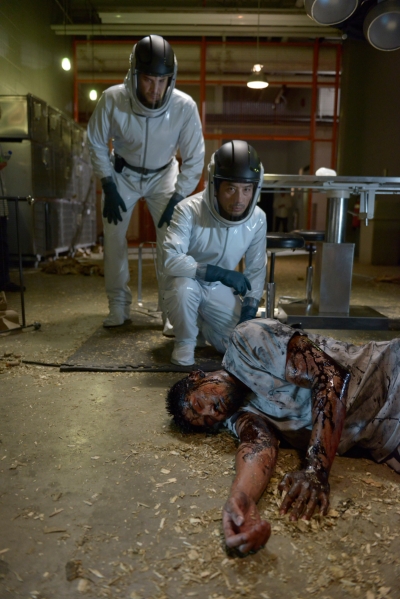
When I first saw the promos for the SyFy channel’s original series Helix I was intrigued. The premise: a group of CDC scientists travel to a remote arctic lab following a zombie-like outbreak. Initially what drew me were the zombies. What turned me off was the soap opera subplot: team leader Alan Farragut is joined by ex-wife Julia Walker, who slept with his brother Peter, who coincidentally is one of the infected.

It turns out I got it all wrong, and that was probably intentional on the part of the writers. (WARNING: spoilers ahead)

About the zombies. They were not zombies. By definition, zombies are the reanimated dead. Or, at the very least, they are not able to be cured, only destroyed. The writers kept us vague about the nature of the illness throughout, and once we saw the cure take effect, then I knew that these weren’t zombies. Instead they were a hive-like virus. Still damned scary.

Image

It turns out this whole zombie plot was nothing more than a MacGuffin. Simply put, a MacGuffin is a plot device that instigates the action, but in reality bears little importance to the story as a whole. One of the most famous MacGuffins is in Pulp Fiction. What was in that briefcase? We never knew, and its identity was irrelevant. Likewise, in Helix, the outbreak was a larger distraction from what the story was really about.

And what was it about? That’s hard to tell. On one level it was all about Julia Walker, the pouty, surly cheating scientist. She became the focal point of the storyline. And it worked. Julia was complex enough to be fully believable. She, along with Sergio Balleseros, a good/bad guy, were some of the more interesting characters in a show that suffered from weak characterizations.

Not only was Helix about Julia and her relationship with her estranged father Dr. Hatake, and missing mother (who showed up all too briefly), it was also about the cryptic Ilaria Corporation, which may not really be a corporation, but a collection of 500 immortals. It turns out that Ilaria, and not the outbreak, is the true focus of this show.

Image

So what does any of this have to do with that viral outbreak in an arctic lab? I’m not entirely sure. They hinted at population control, but that doesn’t explain the hive-mind of the infected.

Too many questions. Previously I doubted Helix would be renewed. It looks like I was wrong. In 2015 these questions may be answered (or not).

In the meantime, kudos for the writers for crafting a tightly wound puzzle of a show. There were no flashbacks, each episode consisted of a single day, and it was filmed in such a tight, claustrophobic way to keep you hooked. And it was not afraid of science. It was well worth my time.

Helix: the last spasm?

The SyFy original was more than I thought it would be, but will the lack of character (and viewers) be its downfall?

Image

One episode left for SyFy’s 13-episode sci-fi series Helix. No word yet on whether it will be renewed. Knowing SyFy, we may never see Helix again, which would be a shame.

When Helix was first launched, I was intrigued. Was it a zombie story? A medical procedural? Knowing it was produced by Battlestar Galactica‘s Ronald D. Moore was a plus, but so what?

Over the past 12 episodes I’ve been surprised. It was not at all what I expected. The writers of Helix have seeded intrigue steadily and consistently, with more than enough plot twists to keep me coming back.

–About those “zombies” – I would liken them more to vampires in the sense that the infected don’t die and come back to life, but turn. And what do they turn into? A sort of hive collective. Think bees, or ants – parts of a whole. A snippet of dialogue explained that the virus appears to be acting in concert, across the bodies of the infected. Kind of like Star Trek‘s Borg collective. It’s a cool twist on an old trope. I loved when one of the infected spit a mouthful of blood into the Keep Calm mug.

Image

–The writers have built layers of mythology, the most notable being the identity of the company that is funding Dr. Hatake’s research: the Ilaria Corporation. Their rep was Constance Sutton, overacted by Jeri Ryan, who didn’t fare too well against a desperate Hatake. Now we know that Ilaria is populated by 500 “immortals.” Like Hatake. And… his daughter.

–And that would be Julia Walker. Sure, it was a soap opera move reminiscent of Star Wars, but I bought it. The reveal of Julia Walker as Hatake’s daughter was telegraphed, and it made sense in terms of Hatake’s motivations and actions. It explained his preoccupation with her, as well as the fact that he rescued her from the infected-zombielike fate by making her “immortal” too.

Image

–But what about this immortality? Is it a fact? Why? Where did it come from? And what does it have to do with the Narvik A virus, the one that’s creating the hive-minded people? Could it be that Ilaria and the 500 want to rid the world of those annoying mortals forever? But is that the best way?

–Speaking of pesky mortals, we’ve got a mixed bag of semi-developed characters, which is Helix‘s glaring weakness. Crusading CDC researcher Sarah Jordan has been on death’s door for a few episodes now, and honestly I don’t care. Peter Farragut was healed, but he was more interesting as a viral. Alan Farragut is noble but cardboard. The only characters who have moderately interested me are Julia Walker, Hatake, his stolen/adopted son Daniel, and the evil-but-trying-to be good Sergio Balleseros. Compare Helix to Lost: Lost made you care about the characters, whatever nonsensical craziness happened on that island. Helix struggles to make us care.

Image

–But then there’s the storytelling. While Helix fails in characterization, it excels in plot and pacing. It is consistent in giving me just enough to hook me. The plot twists keep me off-balance. The visuals are stilted and creative. The music is moody and disturbing. Helix is a quickly moving story. Each episode spans single day, and it’s told with no flashbacks. The structure is bound and wound.

There is something subtly different about Helix. It’s not perfect, but few TV shows are. There’s only one episode left, I suspect not just for this season but for good. If this is the case, then Helix was a great experiment in tight, daring storytelling.


Helix spins a tantalizing, twisted tale

The SyFy Channel’s latest original series Helix, which airs Friday nights in the US, is turning out to be a multilayered labyrinth of a show.

When SyFy first began promoting Helix, I was captivated by the (literally) mind-blowing poster.Since then, I tried toHelix- 1 unravel what exactly it was about. Zombies? Scientific procedural? Lost-style isolation tale?

Several episodes in, I’m still not sure exactly what this science-heavy show all about, and that’s half the fun.

To recap the set-up, a team of CDC scientists is flown in to a Helix - Season 1remote Arctic lab to contain a mysterious viral outbreak. Once there, they are trapped. Alan Farragut (Billy Campbell) is the lead scientist, and his brother Peter is one of the Arctic lab’s scientists, who also happens to be infected. Alan Farragut’s team includes his ex-wife Julia Walker, who had an affair with Peter. Soapy and confusing. Luckily this aspect of the story has taken a backburner as the plot churns on.

The series is getting a lot right.

–We know the outbreak was engineered by lab head Hiroshi Hatake (Hiroyuke Sanada, a Lost alum), but we’re not sure what exactly it is, or why it was created.

–The writers on Helix aren’t afraid to play rough with the characters. No one is safe. Farragut and Hatake isolated scores of researchers they suspected were infected, giving them essentially a death sentence.

–Major characters are also at risk. I was shocked what happened to Doreen Boyle, a member of Farragut’s team. Likewise, big bad Constance Sutton (played by Star Trek: Voyager‘s Teri Ryan) proved less threatening in the end than she seemed. (And I loved the scene of her filing her own teeth down. Why??).

Helix_teeth

–Julia Walker, Farragut’s ex-wife, could have been an annoying distraction. Instead she’s become fascinating. Infected by the virus, then mysteriously “cured” by Hatake, Helix eyesshe’s revealed depth and determination. Adding to the mystery – is she really Hatake’s daughter? And what exactly has she become?

–One of my favorite characters on Helix is Major Sergio Ballaseros (Mark Ghanime). He’s duplicitous, murderous, and maybe even a touch remorseful. It’s a great portrayal of a mostly bad, complex character.Helix - Season 1

–Likewise, Hatake isn’t quite the villain he seemed. He reminds me of Lost‘s Ben Linus – a flawed man for whom the ends justify the means. His motivation is still unknown. It’s compelling to watch.

Another interesting aspect of the show is technical: the editing and the music. The scenes often seem a little off. They cut away too early, or they come in and out of focus, which keeps you slightly disoriented. It’s hard to understand without watching it;  this article at TV.com explains it better than I can. And the music choices, well, just watch the opening credits, with the 1960s bossa nova soundtrack.

I’ve referenced Lost a few times. That’s because Helix is similar to Lost in key ways. The mysteries unfold gradually, and the layers are onion-like. Character motivation is always in question, and the isolation heightens the drama. While it doesn’t have the emotional impact that Lost had, Helix is proving to be a fun addition to the sci-fi universe.

Helix: so much for zombies

Helix is Lost meets 28 Days Later with a little CSI thrown in. I’m in.

I was skeptical after seeing the previews. It seemed as if SyFy was trying to craft a CSI-style drama by grafting some vague sci-fi elements. The 15-minute preview wasn’t exactly encouraging. It relied heavily on a complicated backstory exposition involving lead Alan Farragut, his infected brother Peter, and his ex-wife Julia Walker (who became his ex because of Peter). Too soapy.

But… the premiere and the following episode delivered more than I expected.

The basics: Helix, which airs in the US on SyFy Friday nights, follows CDC scientists who travel to a remote Arctic lab to contain and identify a mysterious viral outbreak. This being TV, not everything is what it seems, and you never know the true identities/loyalties of the characters.

The big question: is this about zombies? Well, not in the dead-then-brought-back-to-life-to-eat-brains sense. Instead, think 28 Days Later, the great British horror flick (that also featured Doctor Who’s Christopher Eccleston). In Helix, as in 28 Days Later, the “zombies” are people who have been infected with some sort of pathogen. It doesn’t kill them. Instead, it makes them not quite themselves, as well as violent, aggressive, quick. There’s more, of course, which we’ll understand as the show goes on.

As for the rest of it, the soapy aspect that showed up in the first 15 minutes was quickly quarantined as subtext. After 3 hours of Helix, we’re already on Day 3. There simply isn’t enough time in the story for that type of boring drama. Good move by the writers.

The characters: We’ve got some complexity here, which is a requirement in books but seems to be optional in film and TV. The villain is nearly mustache twirling (and something else too…), but there are plenty of characters in Helix who are not as good (or bad) as they seem.

The setting: An undetermined number of people are trapped in an isolated, mysterious location. Sounds like Lost. I loved Lost, mainly because the writers focused on character. The writers of Helix have incorporated many of the best elements of Lost: the claustrophobic isolated location, unknown motives, mystery upon mystery. Let’s hope they don’t bog it down with crazy mythology too.

Bottom line: I’m hooked. Helix is fast paced, intriguing, and geeky enough to appeal to my science side. I raised an eyebrow at the angry black woman trope in one scene, but I’ll give them a pass on that one. Watch and enjoy.


Helix: sci-fi or scientific procedural?

If the first 15 minutes are anything to go by, with their new series Helix, SyFy is trying to blend the procedural with science fiction.

Zombies? Not zombies? Hard to tell based on the previews released by SyFy. Here’s what we know for sure:

–It follows a group of CDC officials who travel to a clandestine Arctic lab following reports of an outbreak

–The pathogen is a retrovirus (maybe)

–The side effects are black blood and enhanced strength (maybe)

–The side effects may have been intentional

–It was developed by Ronald D. Moore, the genius who tortured us with Battlestar Galactica

As far as the characters, the preview that SyFy has up throws a good chunk of expository back story at us, including a broken marriage. Conveniently the lead, Alan Farragut, is not only the ex-husband of fellow scientist Julia Walker, he is also the brother of infectee Peter Farragut (who slept with Julia). Kind of soapy. Hopefully that won’t be the focus.

And, it seems to be a sort of CSI: Arctic Circle, with a crack team of scientists battling a mystery illness (or is it a crime?).

So based on what little is out there, it’s hard to tell what the hell is going on. But, if the reviewers at io9.com are right (and they’ve screened the entire pilot), Helix marks a strong return of the dark horror to SyFy. In fact, they call it SyFy’s best new show in years. Then again SyFy has produced very little worth watching in years.