The Girl and The Boy: local paranormal thrills

I’m a fan of supporting my local community, and that doesn’t just mean going to the local bars. I’ve become involved in my writing community here in Jersey City, and one of the girlwriters I’ve met is Madhuri Blaylock, a woman with a penchant for fantastical stories of page-turning urban paranormal fiction.

Her first book, The Sanctum: The Girl, follows our teenage hero Dev, a demon-angel hybrid. She’s targeted for death by a shadowy organization called the Sanctum, a worldwide group of families that monitors all the paranormal activity in our world. Dev, however, proves difficult to kill. Not only that, but she falls for one of he Sanctum’s best killers, Wyatt.

This was a fun book, full of relatable characters that ranged from stalwart best friends to seductive vampires, as well as The_boy_finalmustache-twirling villains I loved to hate.

Now Madhuri has released the second book in the trilogy, aptly titled The Sanctum: The Boy. Check it out, help me support my local community, and have some fun in the process.

Playing the Game of Thrones

I love this TV show, and I’ve read book 3 (mainly because I’m a sucker for spoilers) but I game-of-thrones-iron-throne-1024x576hesitated writing about Game of Thrones for two big reasons.

1) It’s more in the realm of fantasy (though with strong supernatural elements). I’ve never been big into fantasy — I struggled with the Lord of the Rings series.

2) Game of Thrones, both the print and TV versions, are deep and intricate. I don’t think my analysis, on an episode-by-episode basis, could do it justice.

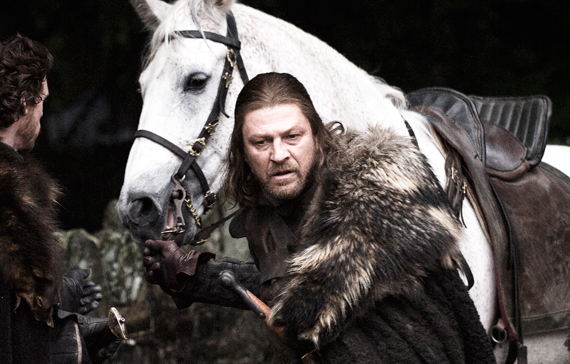
Nevertheless I’m a big fan of all things Game of Thrones. I think it’s brilliant storytelling. ned starkThe show hooked me late in the first season, when Ned Stark, played by Sean Bean (the biggest name in the cast), met his fate. I knew then I was in for a wild and unpredictable ride.

On TV, the production values are excellent, the pacing is consistently solid, and the actors are all pros. My favorite, and I’m not alone in this, is Peter Dinklage’s Tyrion Lannister. Tyrion as played by Dinklage is the complicated heart of a complicated show. Catelyn Stark, played by Michelle Fairley, a woman who is smart and tough and willing to do whatever it takes to protect her family, is/was a close second.

TyrionIn the books, writer George RR Martin alternates character viewpoints as he bounces around the fictional world of Westeros and beyond — Daenerys, Jon Snow, Sansa Stark, Catelyn Stark, Jaime Lannister, and Tyrion Lannister. Each of these viewpoints is utterly unique and fully formed.

But neither book nor TV show is perfect. The books are rambling. No, I don’t need listings of every Ser who fought in a certain battle twenty years earlier. And the TV show revels in gore and violence to the point of overkill. One blogger commented that the show uses rape as a set piece. Okay, I get it — this world is brutal.

These are minor points. Game of Thrones is great entertainment. Very few moments in recent TV history can top when Daenerys ordered her dragon to burn the evil Kraznys.

Game_Of_Thrones Daenerys

And then there’s the infamous Red Wedding episode, where Catelyn, Robb and his pregnant wife weren’t treated very well by their hosts (huge understatement). Check out this link for some great reaction videos.

red2

Watch/read Game of Thrones if you’re up for some excitement. And for great postgame reading, the best I’ve found on the Internet comes from the A.V. Club. Their website has intelligent commentary, with articles geared toward those who haven’t read the books and those who have.

pimpsmall-270x300

Read this book: Dark Matter

This moody haunted tale takes its time, but delivers a solid scare.

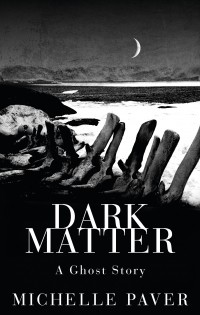
Dark-Matter-jacket-200x315While writing my latest supernatural work I wanted a good ghost story to read. A google search brought me to a Guardian review of Michelle Paver’s novel Dark Matter. After a few false starts I got to reading it. The woman knows how create a chilling world.

The plot: In 1937 pre-war London, bored clerk Jack Miller signs up to a months-long Arctic expedition run by rich guys Gus, Algie and Hugo. But the isolated expedition site turns out to be haunted. Jack must battle loneliness and isolation as he struggles to survive both the elements and the supernatural force.

First, the positives.

Setting: The setting of Dark Matter is great. She describes the landscape beautifully, and the particulars of the mission confidently, transporting me to the Arctic. It’s obvious that Paver has done her research.

Foreshadowing: Several of the earlier scenes involve Eriksson, a grizzled Norwegian ship captain. His demeanor alone lets us know that nothing good will come from this expedition. And, as in many great horror tales, the neophytes don’t listen to the veteran’s advice.

Mood: Paver is a wordsmith, and she uses her words to spin a claustrophobic, isolated mood. Her writing is deceptively simple. Her language and descriptions are straightforward and powerful.

Jack Miller: he’s the main character of Dark Matter, and the story is told from his point of view. While he’s not the most forthcoming narrator, he is likeable. We root for him, early on, even as he remains hidden from us.

Isaak: Jack befriends one of the huskies, a playful pup named Isaak. I’m not an animal person (I once had a hermit crab that disappeared), but the dog gives the story some much-needed humanity. Animals are powerful in fiction; I learned that in my story Always Mine. My hero Danny has one loyal companion, his dog Rocky, who plays a key role in keeping Danny sane and safe. Their relationship led to some of the strongest feedback from readers. I can see why now. At some points I was more worried for Isaak than Jack.

And the negatives.

The story doesn’t kick in until well over 100 pages. Dark Matter is only a 250 page book. Much of the first 100 pages is setting up the story. I was tempted to put it down for good several times. But once it gets going it’s on fire.

Jack Miller, the hero, is underwritten. The most glaring omission: there’s no mention of any kind of sexual/romantic aspect to his character, inner or outer. Jack is in his mid 20s. There would be some small reference to that aspect of himself, or lack of. Paver previously wrote children’s books. She seemed hesitant to write a fully formed adult.

Perspective: A major flaw is how Dark Matter is told. It’s first person — Jack’s journal entries. But he’s an unreliable narrator, not just about the events but also his own self. I would have loved to see the wider story. We do get a glimpse of it when Jack reads the journal of one of his companions, and what we see is a starkly different version of Jack. I wonder what this story would have been like if written in the 3rd person.

Dark Matter is a flawed book, and I was torn for a while as to whether it warranted a recommendation. In the end, despite these flaws, Paver succeeded in crafting a haunting, disturbed world. Hopefully she will embrace adult fiction more fully.

Interview with Indie Author Kevin Singer

This woman knows a thing or two about writing compelling characters. Dev, the lead in Madhuri Blaylock’s book The Girl (The Sanctum), is a teenage half angel/half demon powerhouse. Recently Madhuri interviewed me about my story Always Mine. It was a great experience. Check out the interview, and check out Madhuri’s book too.

mpavamani45's avatarMadhuri Writes Things

Back in January the book club at 9th & Coles Tavern in downtown Jersey City read THE GIRL and invited me to attend their discussion session. It was loads of fun hanging with Greg and the gang and was where I met fellow author and neighbor, Kevin Singer.

He’s very cool and it was fun talking about my book with another writer so when I had the chance this past March, I returned the favor and picked up his book “Always Mine”. It’s a little gem of a story and if you have a chance, I highly recommend snagging a copy and getting lost in its pages. You won’t regret it.

AlwaysMine_final

After reading “Always Mine”, I thought it would be fun to interview Kevin and see what goes on in his writer’s mind. Here’s what I discovered about Mister Singer:

Tell us a little about yourself.

I’ve been in love…

View original post 1,174 more words

Ultimate Dystopian Showdown: Battle Royale vs. The Hunger Games

I loved both The Hunger Games (books and films) and Battle Royale (the great Japanese movie long rumored to have inspired The Hunger Games). This blogger, The Spectatorial, has a great comparison of the two. What I’d add: while The Hunger Games is great, Battle Royale is better in two ways — it’s not as cartoonish as The Hunger Games, which makes it even scarier; and the “contestants” in Battle Royale have known each other all their lives, which makes the deaths that much more impactful.

The monsters in our family tree

Scientists have discovered a startling fact — compared to our not-too-distant ancestors (5000 BC), we are weaklings. Or as one of the researchers said, “the people back then were monsters by comparison. what you see today is quite pathetic.”

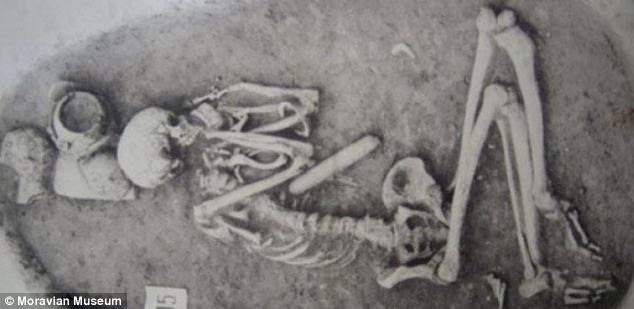
skeletonBritish researchers examined human bones from time periods spanning 5300 BC through the present day. What they found was that the oldest of the bones were comparable to those of today’s elite athletes. The average guy of today wouldn’t stand a chance in one-on-one with the average prehistoric man. You can read the original scientific study here, or try these summary articles in Outside magazine or the Daily Mail.

Why were people so much stronger back then? Because their lifestyles demanded it. There was no agriculture. Food had to be foraged and hunted. The humans back then had to have the physical stamina to roam—and run—great distances, all the time.

With the invention of agriculture, obtaining food became much easier, so we didn’t have to work as hard as a result. And, some speculate that our diets became poorer as a result.

side by side

So what’s the main takeaway? If you plan on travelling back in time several thousand years, you’d better be well armed.

But what about the future? As our world becomes more mechanized, as the physical demands on our bodies lessen, will we shrivel even further?

(Image source: Daily Mail)

Read this book: The Last Policeman

Apocalypse stories are divided into two camps:

1. The impending doom, where we see the event plus its aftermath (or see it thwarted)

2. The post apocalyptic, where a remnant of survivors has built a new and dangerous world from the wreckage of the old.

Ben H. Winters, in his novel The Last Policeman, gives us what should be a new sci-fi subcategory all its The Last Policemanown: the pre-apocalyptic world.
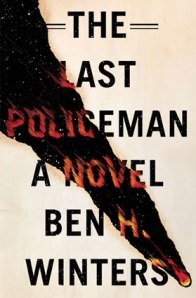
Hank Palace, the hero of The Last Policeman, has always wanted to be a detective (a desire that in part stems from the fates of his parents). A rookie cop with the Concord, New Hampshire Police Department, he gets his wish, but only because an impending cataclysm has opened up a detective slot.

This impending cataclysm? A kilometers-wide asteroid named Maia heading straight for Earth.

In the world of The Last Policeman, everyone knows that Maia will arrive in several months to end life as we know it. Several months of knowing that doom awaits. Imagine that.

Winters does a stellar job in describing what life is like in this world. And he does so mainly through the eyes of Palace, a solid, tenacious, and kind protagonist who the reader quickly grows to like.

Hank Palace is not a man trying to save the world. He’s just trying to do his job.

The plot is simple enough: a man is found hanging by his neck in a McDonalds bathroom. Suicides are rampant in this world, but Palace isn’t convinced this is a suicide. He doggedly investigates while others tell him not to bother. What he gets is apathy and stonewalling. But he never gives up, even as many in the world around him (literally) do.

In many ways this is classic crime noir. Think Raymond Chandler, with his misdirection (and even a femme fatale). This element of The Last Policeman hooked me. I’m a big fan of Chandler — he inspired me to write my novel The Last Conquistador, and I proudly employed his techniques.

Winters amps it up, though, in that he throws us a sci-fi curveball in Maia. On a technical level, I admire the way Winters uses newscasts, media reports, and recollections to tell us about Maia — how he effectively intersperses the info without giving us a data dump.

He also peppers The Last Policeman with fascinating details of life on a doomed planet. For instance, that McDonalds where the body was found? It wasn’t really a McDonalds. Corporate HQ closed, and the remaining stores were run by whoever wanted to sell their own food. All over the world people are abandoning their old lives to pursue a final dream. Or, they’re just giving up.

The Last Policeman is part of a trilogy. I’ve read the second, Countdown City (also great), and Winters does an even better job in describing a society desolate, dejected, but still clinging to threads of hope. In fact, he just won the Philip K. Dick award for best sci-fi book for Countdown City.

Life on a doomed planet: it’s not a cheery topic, but it’s rich with dramatic possibilities.


Why were killer insects so popular in sci-fi?

I loved cheesy horror/sci-fi movies as a kid, everything from The Blob to The Thing.

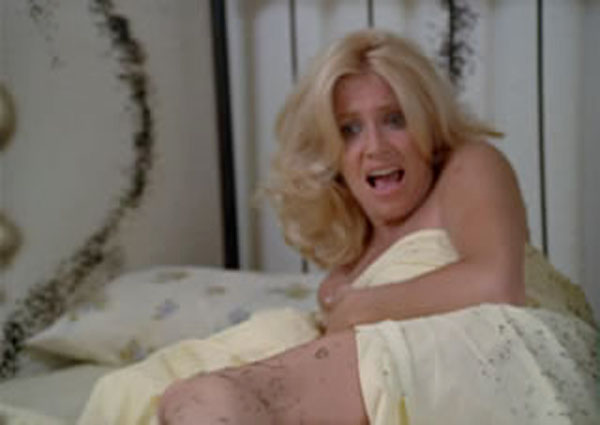
But what always freaked me out were the movies about bugs. I remember watching the 1977 film Ants, about swarming, poisonous ants, and being terrified there were ants crawling under my bed. I’d have to check carefully every night, and still I was never sure I was safe.

ants

io9.com has an article up analyzing why insects were a sci-fi staple, especially in the atomic age of the 1950s (with giant bugs such as those memorable monsters from Them!), but even later, through the ’70s.

them-ant-on-hill1

Some think that the fascination—and popularity—had to do with:

–fears of Communism and the reinforcement of trust in an all-powerful US government

–fears of radiation from nuclear fallout

–mistrust in science

–overreliance on chemicals that pervert our natural world.

The article’s conclusion? The popularity of insects as villains was much more simple. That’s when we as a society became more aware of germs and diseases. And pesticides—bug spray, etc—were promoted to get rid of the vermin that were invading our homes.

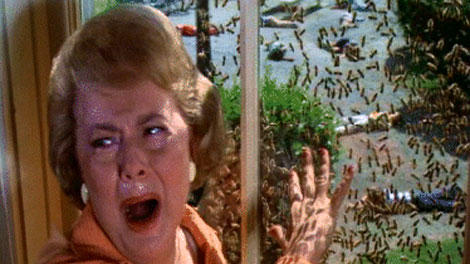
killer-bees

We were constantly on the lookout for roaches and ants and mosquitoes in our homes and backyards, so naturally they’d morph into something even more insidious.

Whatever the reason, it made for fun and creepy horror stories.