Anatomy of a Story: The Two Burials of Francisco Collins

Story ideas are all around. You just have to open your ears. You can find them in all manner of places, including a pub in Ireland in a town called Renvyle on the Connemara coast, a pub called Paddy Coynes, small and dark and warm, which would’ve been smoky in another era, over a pint of Guinness, naturally.

That’s where I first came up with the idea for my story, The Two Burials of Francisco Collins, recently published in Folklore Review.

I was in that pub with my cousin and his wife. We were spending the weekend in Renvyle celebrating their tenth anniversary (they were married there, not the pub but the town), and that night over that pint my cousin’s wife told me of an Irish documentary about a man in Ireland whose body was buried twice. The documentary is called Con Carey and the Twelve Apostles, and I never got around to listening to it (probably will today after I write this) but it gave me a hell of an idea for a story.

An idea that stuck. That’s what good ideas do. They stick. Often I’ll tell myself I’m going to use something I hear or see in a story, but oftentimes it doesn’t stick. This one did. The premise was simple enough, but the question I needed to confront was this: why would a person be buried twice?

For that I went to one of my neglected literary loves: magic realism. The king of that is Gabriel Garcia Marquez, and truth be told I’m woefully deficient in my knowledge of magic realism, but to me it’s a close cousin of speculative fiction. It deals with events that are fantastical and improbable or impossible in our world, but totally in keeping with the fictional world in which they occur.

That’s my baseline for this story. In it, an old man recounts the true story of the events surrounding the two burials of the title character, a patriarch of a ranching family, and what led his son, Xavier to do what he did.

So the documentary gave me the idea, the genre gave me the vehicle, and for the heart of it all (every story needs a heart) I went to my own.

It’s been several years since my own father was killed in a plane crash, so I drew up my own personal experiences and feelings around his life and death, our relationship, and I funneled them into this story. Sometimes things get complicated. Sometimes people are complicated. Sometimes relationships are complicated. And truth be told it’s not always easy to reveal some personal things. But that’s my job as a writer: to put it all on the page, to leave a piece of myself behind, for the reader to see, for the world to witness.

Just as Xavier Collins needed his own witness.
Anatomy of a Story, or How I Came to Create the Tale of Poor Nori

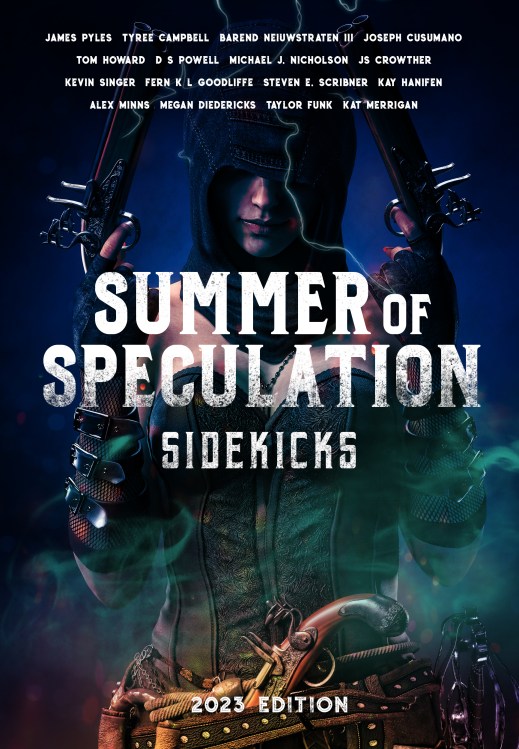
Self-promotion time: one of my stories has been picked up for inclusion in the now-available anthology Summer of Speculation: Sidekicks.

My story is called Champions of the Nereid, and it’s a story about a rudderless woman named Nori who falls under the spell of Hyacinth, a charismatic woman whose mission it is to cleanse the rivers. Nori assumes Hyacinth’s intentions are noble. I won’t spoil it, but it’s a horror story, so you can guess there’ll be trouble brewing for Nori.

This story came to me in a viral video that circulated a few years ago. By now everyone knows about those well meaning yet supremely annoying anti-oil protesters who block traffic and only end up alienating people from their cause. When I watched this video I sided with the angry doctor, and a kind of battle rush hit me.

But later I began to think about the screaming girl. And I couldn’t stop thinking about her. I had this curiosity as to how she got there, how she felt during the incident, and what happened to her after the incident. How did it change her? Instead of mocking her, as I initially did, I came to this place of sympathy. Not with her actions, but with her reaction. I felt something for her. So I decided to write about someone in a similar situation.

That’s how Nori, one of the champions of the nereid, was born (nereids are mythological mermaids, by the way. Hint hint).

From there I knew it would be a horror story.

While Nori’s story was fun to explore, it was tough to write. It’s a slow burn, and those types of stories are hard in terms of maintaining tension and momentum. I did several rewrites and workshopped it. A lot of the backstory had to be cut because it cluttered up the piece (too distracting). To be honest, I’m still not 100% sure I nailed it. But I must have done something right, because now it has a life out there in the world.

As for Nori…

Trope or Choke: Episode 6

The challenge: write a complete story in 500 words or less following these guidelines:

Setting: A deep freezer

Genre: Horror + ’90s redux

Trope: Wai-Fu (tiny girl who kicks ass)

Characters: Cleopatra + absent-minded professor

POV/tense: 3rd person/present tense

The result:

Mister Pointy Returns

It reads: Do not open.

Professer Wentworth purses her lips.

“What’s that awful odor, Stuart?”

Her assistant sighs. “You left yesterday’s salmon dinner on your desk.”

“It must’ve tasted atrocious,” she says. “Now, about this “do not open” situation. A deep freezer arrives from the estate of a murdered FBI agent. Dana Scully, right? With no other instructions. What do you suppose we should do?”

“Not open it.”

“You pathetic man. Where’s your curiosity?”

“I don’t want to end up being the cat.”

“Well it’s my laboratory,” she huffs. “I say open it.”

He sighs. “Fine. I’ll remove the padlock.”

He cuts the lock off and motions to the door. “Would you like to do the honors?”

She scoffs. “Grunt work? That’s why I have you.”

He tugs the handle. It refuses to give.

She snorts. “What a waste of testosterone.”

He gives it an angry yank. The door releases. Cold mist fills the room. Wentworth holds her nose. “It reeks worse than that blasted salmon.”

“It said do not open.”

She shoves Stuart aside. “Let the professional have a look.” She wipes frost from her bifocals and peers into the mist. “It appears to be two sarcophagi. There are name plates. Hard to read. This one reads B Summers. The other. C something. No other artifacts.”

An alarm sounds on her phone. Wentworth perks up. “I forgot. Tonight is Mister Fuzzykins birthday. We’ll pick this up in the morning.”

On the way out she trips on the freezer’s power cord, curses her clumsy shoe and dashes out the door.

The next morning Stuart notices the cord free of the outlet. As he plugs it in, Wentworth catches him on his knees.

“What now, boy?”

“It thawed out.”

“Providence indeed.” She orders Stuart to pry free the first sarcophagus. Inside is a woman, olive skin, long black hair. He opens the second. Another woman. Petite. Young.

“So this Scully collected women,” Wentworth says. “Odd.”

Stuart leans toward the first woman. “I think she moved.”

“Preposterous.” Wentworth shoves him away. The woman opens her eyes and parts her lips to reveal fangs, which rip the skin of Wentworth’s neck and lock onto an artery. Wentworth screams. Her blood splatters. The woman drains Wentworth and tosses her dead husk aside. “A bitter offering for Egypt’s Queen.” She eyes Stuart. “I trust you will taste better.”

Before he can move the second body sits up. “Bad girl, Cleopatra. Rude much? You’re barely awake and already killing people.”

Cleopatra turns. “The foul slayer.”

“I prefer Buffy. Hey cuddlemonkey,” she tells Stuart. “Throw me that broom-handle.” She catches and breaks it. “Hey, Cleo. Mister Pointy needs some love.”

Buffy roundhouses Cleopatra, pins her down and hovers the broomstick above Cleopatra’s heart. “This is for murdering my friends. And for baiting me to that lame FBI agent. And for getting me iced as a threat to the government.” She smirks. “Nah, I just like killing vamps.” She plunges Mister Pointy into Cleopatra, who turns to dust.

Image: (C) Ash Carli

Wait…Gendercide Is a Thing?

I like to consider myself a fan of all things speculative–horror and supernatural and sci-fi books, movies, TV shows, etc., and I believe I know a ton about these genres.

Apparently I don’t. The other day I was rabbit holing into the latest of a long line of literary controversies (I won’t go into it here) and I read this article asking whether it’s time do do away with the gendercide trope, a trope I’ve never heard of before.

What is gendercide? It sounds nasty, because it is. Gendercide is where either the men or the women in any given story are killed or die off from some nefarious or mysterious or viral reason. The book that inspired the article introducing me to gendercide is The Men by Sandra Newman. I haven’t read it yet, but it’s about a world where all males suddenly vanish. The remaining women adjust to this disappearance, while videos online depict the men living in a hellish landscape.

There are others, too, such as Y: The Last Man, a comic turned TV show where (almost) all men die of a virus. One of my favorite books, The Knife of Never Letting Go by Patrick Ness, is a variant of the gendercide trope; the novel opens in an all-male society where the women have mysteriously died off.

According to TVtropes.org, gendercide isn’t super popular, and most of the time only a variant is used (only some or most of either men or women die or disappear). Stories where the men disappear are more in line with the theme of feminist utopia, and stories where the women vanish are considered dystopic.

In reading about Newman’s book, I found it disturbing that all the men were sent to a hellscape ruled by demons. Oddly, the writer of the article critical of gendercide (and Newman’s book), didn’t write about that disturbing aspect of it. From me, though, disturbing is not a criticism. I want to learn more about this trope, and see how different writers explore it.

Genre TV: a golden age or too much of a good thing?

It is a sad fact that there are too many great books in the world, of all genres, that I will never have time to read. I’m sure that I’m missing out on some life-changing classics, but there’s nothing I can do about that.

Star TrekWhen it comes to TV, though, there used to be a time when you could be up on all the great TV shows. For fans of all things sci-fi/supernatural/horror like myself, it wasn’t that hard, because there were so few TV shows that had a sci-fi or supernatural theme. Back in the 1950s you had The Twilight Zone and in the 1960s came The Outer Limits, Star Trek, and in England, Doctor Who. Along the way there were a smattering of other TV shows, notably the X-Files and Buffy the Vampire Slayer in the ’90s, but with only a handful of networks (and the BBC in England) the options were severely limited.

Buffy the Vampire Slayer

That’s all changed. Now there seems to be a new network popping up every week, along with new TV shows. When Lost premiered, it reinvigorated the genre by making it commercially and critically viable. As flawed as Lost was, the emmy-winning series showed the powers that be that genre shows could make money and win awards.

Lost

Since then, there’s been an explosion of genre shows. A few decades ago, who would have predicted that two of the most hyped television shows would include dragons and zombies? These two shows, Game of Thrones and The Walking Dead are worldwide cultural events. Game of Thrones and The Walking Dead bring more than just supernatural/fantastical/horror elements: they have high production values, are well acted, and have great writing.

Walking Dead

And these are just two of the latest and greatest. The past couple of decades have given us so many great genre shows, from SyFy’s Farscape and the Battlestar Galactica reboot, to BBC’s relaunched Doctor Who and BBC America’s Orphan Black. I should be happy, right?

Orphan Black Tatiana Maslany

In a way, I’m not. There are SO MANY genre shows out there I can’t keep up. And neither can the people who are writing them. The Walking Dead has given us the derivative Z Nation. The second season of SyFy’s Helix was a mess (a glorious, batshit crazy mess, but still a mess). And Netflix’s Hemlock Grove was half-baked camp. We’ve got a glut of genre shows out there, some of which should have never been made, and others that could have used a little more seasoning.

helixNot to mention that I don’t have the time to watch the vast majority. I’d love to watch The Strain, and there’s a new Salem TV show with Lucy Lawless that looks interesting. But between work, writing, play, family, how could I possibly fit all these shows into my life?

Maybe Hollywood needs to scale back a little — if not in the number of shows, then at least in the number of episodes. In the UK, it’s a common practice for TV shows to be short runs. Each season is perhaps six episodes, and the TV shows only run for a few seasons, if that. What you get is concise storytelling that does not require a lifetime commitment of the viewer. I’d fully support this idea; even the best shows suffer from episode bloat and could use some trimming (I’m looking at you, Walking Dead).

The strange case of Hemlock Grove

A few weeks ago, I started watching the Netflix supernatural series Hemlock Grove on a whim. Somehow I managed to get through all 13 episodes of the first season. Still, I’m not sure if the show is a brilliant mess or a well-meaning failure.

Hemlock-Grove_keyart

Hemlock Grove, based on a book by Peter McGreevy (who also created the show), is a riff on the vampire and werewolf takes we all know by heart. It’s set in a fictional Pennsylvania town that is typically mid-America in all ways (with a touch of Twin Peaks), except for the monsters that roam its streets and woods.

The action begins, harshly, as a girl is brutally attacked and disembowled on her way to rendezvous with her high-school teacher. From there we meet the locals. There’s the powerful Godfrey family, headed by matriarch Olivia (played by X-Men’s Famke Janssen), and her teenage children: brooding, spoiled Roman (Bill Skarsgard), and the awkwardly disfigured Shelley. And we also meet the Rumanceks: Lynda (Lili Taylor) and her teenage son Peter (Landon Liboiron). And then there’s Norman Godfrey (Dougray Scott), his teenage daughter Leetha and his wife (no name; she doesn’t matter). Norman is Olivia’s brother in law, and Roman and Shelley’s uncle.

hemlock_grove kiss

So that’s the basic setup of Hemlock Grove. Simple enough, except that none of it really makes sense. Everything about the show — from the acting to the writing to the basic plotting — seems off. I could write several blog posts about the strangeness of this show, but here are just a few examples.

–The locals quickly tag Peter as a werewolf because of his “excessive body hair.” The actor who plays Peter, however, has not that much body hair at all. But he really is a werewolf after all (!)

HG transform

–The wildly over-the-top Olivia Godfrey is supposed to be English, but her accent slips and slides all over the place. And Roman’s accent as well is bizarre (it turns out the actor is Swedish)

–Dougray Scott must be pissed off at having to play on this show. He mopes through every scene, as if all he’s thinking of is cashing the next paycheck. At least Famke Janssen gets the joke; she camps it up in every scene she’s in

–There’s some seriously strong gay subtext in the friendship between Peter and Roman. It is not at all subtle, though it doesn’t do much in terms of developing their characters. It’s basically pointless

Peter Roman

–The high schoolers are written way more adult. Roman, for example, zips around in his classic sportscar as he hires hookers, chain smokes, and drinks in bars. And school seems optional

It took me a while to figure out what the hell was up with Hemlock Grove. It’s weird and surreal. It’s badly written and unevenly acted. But I couldn’t stop watching. Then it clicked. It’s produced by Eli Roth, the man behind Hostel. I remember watching Cabin Fever, directed by Roth, years ago. Cabin Fever was a grade B horror flick, nothing groundbreaking about it. But it was so damned weird. And Hostel likewise was just plain bizarre. Apparently Eli Roth has developed his own freaky genre.

Hemlock Grove did manage to wrap up its main story lines by episode 13 in a mostly satisfying way. And it was definitely entertaining as I felt whiplashed between the weirdness and the awfulness.

So would I recommend watching Hemlock Grove? My advice would be to proceed with caution.

Read this book: Bitter Seeds

Ian Tregillis’s alt history/sci-fi mashup scores big on imagination, even if many of his characters are flat.

bitter seeds 1

Aside from the supernatural/horror/sci-fi, another thing I’m a fan of in pop culture is alternative histories. The “what if” has always fascinated me, mainly because it lets the imagination run away.

In his book Bitter Seeds, Ian Tregillis combines not only sci-fi, but also horror, with alternative history. Add nazis, arguably one of the best villain groups of all time, to that mix and you’ve got a recipe for a great story.

bitter seeds 3The plot: in Germany, a mad scientist is creating his own band of supermen, soldiers capable of such things as turning invisible, starting fire, and predicting the future. As war looms between Germany and the rest of Europe, the British government forms a group called Milkweed to investigate these reports. Soon a covert battle ensues as the British group use warlocks to summon dark forces to battle the nazis.

It’s actually a complicated plot to explain in a few tight sentences. Our hero is Raybould Marsh, a pugnacious British secret agent who is sent to investigate the reports of these supermen. Soon he summons his college friend Will, a warlock initiated in a blood rite that allows him to communicate with beings called Eidolons. When you think of Eidolons, think Lovecraft. These mysterious beings are not kindly or benevolent. They see humans as no better than ants. They would gladly destroy us but they exist in a different plane, and can never pin us down. Blood helps them get closer. Tregillis doesn’t fully explain what the Eidolons are, but he doesn’t need to. My imagination filled the gaps just fine.

Meanwhile, the German team of superheroes is on the verge of falling apart. They were Bitter-Seeds 2created when they were just children, bought by a scientist who experimented on them (horribly, one would assume, judging from the body count) until he had his team in place. They wear batteries that are hooked to wires embedded in their skulls, which allows them to access their superpowers. This is one of Tregillis’s strengths — he employs, simple, believable technology suited for the era. Think steampunk circa 1930s.

The German story centers on two characters: Klaus, who can dematerialize and move through walls, and his sister Gretel, an enigmatic sociopath who knows the future (though she rarely reveals it). Gretel is perhaps the most compelling character. Why? She is always a mystery, always unpredictable, and always uncontrolled. She’s fascinating to watch.

The breakdown. What was good about Bitter Seeds?

–The concept was fun. Who doesn’t love watching nazis get beat?

–As mentioned above. Gretel was by far my favorite character, though Will, the aristocratic warlock, was a close second. Tregillis convincingly drew a man who grew more and more tortured, especially as the Eidolons demanded higher blood prices as the battle continued.

–The Eidolons themselves were a fantastic creation. Thoroughly dangerous, extremely powerful, callously indifferent. I want more.

–Tregillis is a skilled writer. As a writer myself, I’m always appreciative of someone who takes great care in the writing of a story.

And the not so good:

Bitter Seeds suffers from something I see a lot in fiction. I call it the running in circles plot. Maybe the writer isn’t sure what to do next. Maybe the writer needs to up his page count. But sometimes a story starts running in circles, where the characters are going back and forth (sometimes literally) and not really getting anywhere. Not much plot movement, maybe a little character development. There were several times when I could feel the story lapsing into this.

–Aside from Gretel and Will, I cared little about any of the other characters. Our hero, Marsh, was fine, but he never made the leap off the page for me. Similarly, Klaus was very one note. His whole role was to protect his sister Gretel, and that’s all he did. The Germans, especially, were largely forgettable.

Nevertheless, Bitter Seeds (which is book one in a trilogy) is inventive, imaginative and thrilling. I’m looking forward to discovering where Tregillis will take us next.

Secrets of the Ouija board

Are Ouija boards dangerous? A comprehensive article traces its history, and the answers aren’t quite conclusive.

ouija 1

A Ouija board is a game that allows users to attempt to contact the spirit world. The board consists of letters and numbers. The player asks a question, and using a pointer, the spirit world will supposedly guide the pointer to letters that spell out an answer. Simple enough, right? Not really.

AlwaysMine_finalOuija boards have a bad reputation. Many consider them a gateway to evil. If this latest news report is to be believed, three young Americans in Mexico fell into convulsions after using a Ouija board (the local priest refused to perform an exorcism because none were parishioners). I used a Ouija board as an element in my horror story Always Mine, and from reader response, it struck a nerve.

But what’s the truth behind this game?

This long Smithsonian article breaks down the history of the Ouija board. It turns out that Ouija boards are a uniquely American creation. In the mid 1800s, a wave of spiritualism swept the US. People believed they could contact the spirit world, which would deliver messages. This belief dovetailed neatly with organized religion, which more or less sanctioned this practice.

Then, in the late 1800s, a canny investor caught wind of a “talking board” and formed a company to manufacture these boards.

Among the interesting facts about the Ouija board:

–The name Ouija supposedly came from the board itself.

–The US patent office approved its patent after the board revealed the patent official’s first name (proof that it worked).

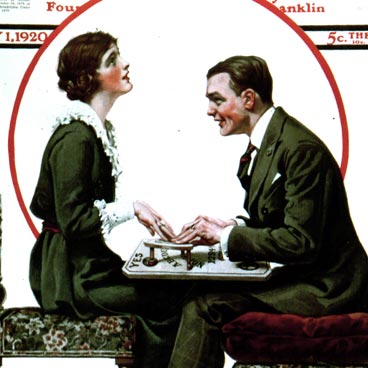
–It quickly became a best-seller, marketed as both a way to contact spirits, predict the future, and as wholesome family fun. Even Norman Rockwell got into the act.

ouija

But there was a dark side to it as well:

–One company head died after falling from a factory building, which he built based on advice from the Ouija board.

–In 1930, two women killed another based on the advice from a Ouija board.

And a quirky side:

–Writers have claimed that their works were written via Ouija board. One poet, James Merrill, won a major award for a poem that was “magnified” by his Ouija board.

So why have Ouija board become linked to evil?

Blame The Exorcist. Since that 1973 groundbreaking horror movie (which was supposedly inspired by actual events), Ouija boards lost any wholesome status they enjoyed. Following the phenomenal success of The Exorcist, Ouija boards have been denounced by religious groups and have become a staple for horror writers (guilty as charged). Interestingly, the board is still a hot seller.

The Smithsonian article delves in to the “why” of the Ouija board. In the simplest of terms, scientists believe Ouija boards tap into our unconscious mind. We may think we are talking to spirits, and in a sense, we are: our own.

But is this all there is to it? Maybe not. Check out these supposedly true scary stories of Ouija board freakiness.

To be honest, I’m not as concerned with how Ouija boards work. Don’t get me wrong: I love science. But when it comes to something like Ouija boards, I’d prefer to keep that element of scary suspense alive.