American Horror Story: Coven – horror or camp?

There’s a scene near the opening of the first episode of American Horror Story: Coven that is the definition of horror. The year is 1834, and a society madam, played by Kathy Bates, is a vain, sadistic woman who keeps a collection of slaves chained and tortured in the attic of her New Orleans mansion. The camera fixes on the mutilated people. You hear their moans and screams. It is pure horror.

But why?

Because it is grounded in the very real horror of slavery.

I’ve seen 3 episodes of this series so far (I haven’t seen the first or second seasons), and nothing else has compared to this one scene.

Don’t get me wrong, American Horror Story: Coven is entertaining and compelling. It follows a coven of witches in New Orleans (with roots in Salem) as they battle each other and the outside world. But it doesn’t know whether it wants to be a campfest or a gory/horror thriller. Too often it slides into camp.

The actors are big names. Jessica Lange is a great fit for the role of a witch obsessed with holding on to her fading looks and power. But there are times when Lange, Angela Bassett, and Kathy Bates play it way over the top. There’s not much subtlety going on. Or maybe they’re just too big for the small screen.

The best horror is rooted in real-life tragedy, both small and large, because it gets us where we live. Case-in-point: the slave/torture scene. And American Horror Story: Coven has more of this. There’s an infertile woman desperate to get pregnant, and there’s a young man who is revealed to have been molested — both are great set-ups for horror. In the latter, you get the payoff (the pregnancy storyline is developing).

So there is potential. The writers are highly skilled in keeping you watching (and I”ll definitely watch on). I just wish they wouldn’t rely on lazy tropes like the rapist fraternity brothers or Jesus freak neighbor, scale back the camp, and stick with the horror.

Watch this movie: Attack the Block

British horror done right…

 
attack_the_block_ver4_xlg

The British are known for many things: great music, bad food and teeth, and their one-time love of controlling the planet. But they’re not as well known for horror movies. Maybe this is good: they have little to prove, so there’s no pressure.

Case in point: two of the best horror movies of the past decade: 28 Days Later, a zombie-ish movie that starred Irish actor Cillian Murphy, and one of the coolest, underrated, most bad-ass and too-short-lived doctors from Doctor Who, Christopher Eccleston. It’s a hard-edged, smash-bang-fun time. Whatever you do, avoid the sequel (which shall remain nameless), as it nearly ruined the whole thing.

The second film is a horror/comedy, Shaun of the Dead, with Simon Pegg and Nick Frost. Couple dry British humor with gore and you have a classic. 

And then there’s Attack the Block, a low budget (I’m assuming) indie-style horror. Why low budget? Well, the monsters are kind of… rough. And the movie features the classic horror fail: the empty city streets. 

Get over it. I did, and it was worth it.

So here’s the plot in a nutshell, ripped straight from IMDB: a teen gang in South London protect their block from an alien invasion. There you go.

First, it’s great fun. The action starts pretty early, and once it starts, it rolls along, not too slow, not too fast. It lies somewhere between 28 Days Later (super serious) and Shaun of the Dead (tongue-in-cheek), though more toward the 28 Days Later end of the horror spectrum.

What stood out for me, most of all, was the unique set-up. You meet the teenage hero, Moses, as he, along with his juvy gang, are mugging Sam, a nurse on her walk home. Moses is cruel, someone who you would not choose to identify with, but over the course of the movie, he morphs into the hero of the story, in part because the other characters (drug dealers, vicious aliens) are so much worse, and in part because the extreme situation he finds himself in (battling aliens), forces him to grow as a person.

Rent this movie. It’s worth it, not just because it’s fun, but because it’s a great example of the anti-hero in drama, and it also shows another of my favorite literary conceits: the ordinary man (men and women in this case) forced to confront extraordinary circumstances. None of these people are Jason Bourne or James Bond, and their fight scenes reflect that, which makes it all the better. 


Lovecraft leftovers

Image

I was young and impressionable when I first saw the 1985 horror flick Re-animator. The best way to describe is as a Frankenstein story, with the heartwarming parts hacked out. The source for this story? Providence, Rhode Island’s own H. P. Lovecraft.

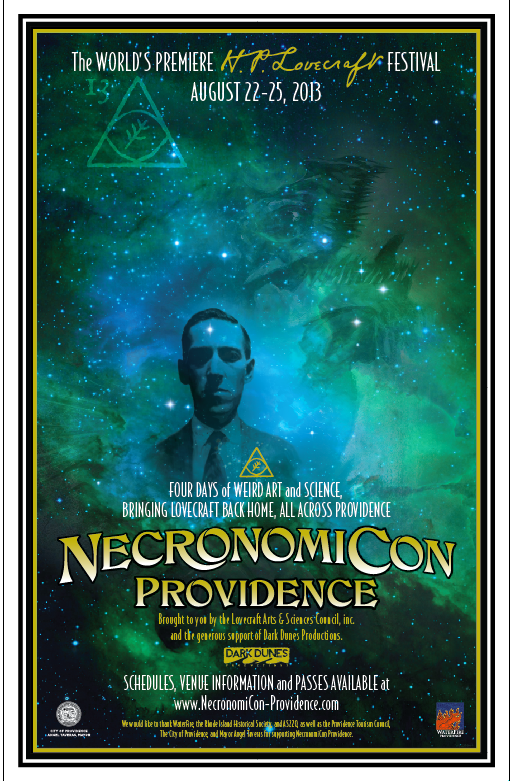
This Sunday I got to re-live this part of my adolescence at NecronomiCon, a convention devoted to all things Lovecraft, in Providence, of course, where I sat at a table selling copies of The Last Conquistador.

I don’t pretend to write pure horror in the Lovecraftian form. First, what exactly is that? In my take, Lovecraft’s horror is ultimately bleak, There is no hope – not even a thread. This makes it all the more chilling. The creatures who populate his tales aren’t so much malicious as uncaring, and pretty much unstoppable. Lovecraft excels in mood, and there is only dark.

Edward Lee is a writer in the Lovecraft style. City Infernal, about one girl’s journey through (literal) hell, rivals Lovecraft for darkness, though his heroine, Cassie, is tough and modern (in other words, there is a thread of hope). It is an exciting book that I tore through. And not only is there’s a great sequel – Infernal Angel, but another related book, Lucifer’s Lottery, which features as a character none other than Mr. Lovecraft.

Even bleaker? Try Brian Keene‘s zombie horror The Rising, where it’s not only humans turning into zombies. Don’t even bother uttering the word ‘hope’ on this thrill ride.

I’d say Lovecraft would be proud of these guys.