Battlestar Galactica Rewatch Part 3: Major Themes

(For Part 1, see here; for Part 2, see here.)

Some years ago I wrote a post asking if Battlestar Galactica was too religious. To this day it remains one of my most popular pieces. Controversial, too. Not because of the meat of the post itself but because some people just don’t like religion. At all.

But let’s put aside whether or not religion is good or bad or whatever. Let’s instead focus on religion in Battlestar Galactica. After rewatching the entire series I can say with 100% confidence that one of the major themes of the series was in fact religion. Not just religion, but God and our place in the universe.

In my opinion, Battlestar Galactica was one of the most overtly philosophical television shows of this century.

In the series we had two separate camps when it came to religion. First were the 12 colonies, each named after a zodiac sign (astrology—a quasi religion in my view). The colonists paid reverence to the gods. Not a single god but a collection, patterned off of the Roman gods. Devotions, sacrifices, all of that.

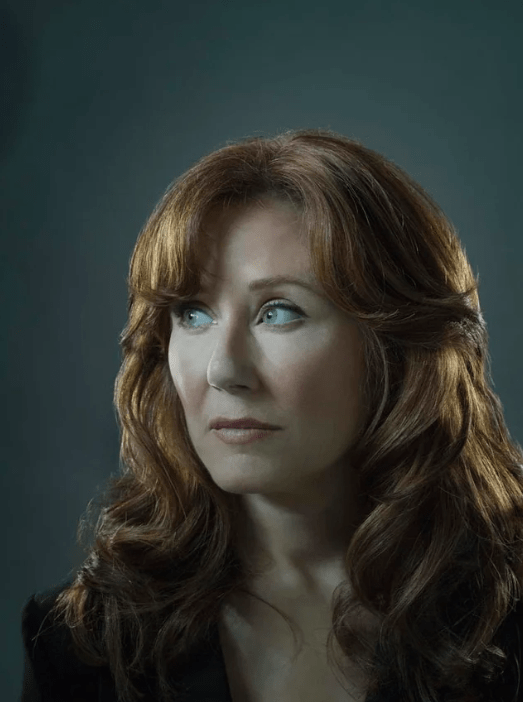
One of the most religious characters among this religion was President Laura Roslin. I can’t say for sure what her level of faith was before the events in the story, but when we meet her, she’s just been diagnosed with terminal cancer. She turns to the gods and takes solace in the scrolls of Pythia, which foretell of a dying leader who will take her people to safety. She’s beset by dreams and visions (drug induced?) that she takes for messages from the gods. Her faith, whether or not conditional, is in the forefront of the storytelling.

And then we have the cylons. The Caprica who appears to Gaius Baltar talks of one true God, a God who had a plan for everyone. It’s obvious what the writers were doing here: contrasting a pagan faith of offerings and visions against the Judeo-Christian singular God who had an individual connection with each of his creations (children).

The show ping-pongs between these two world views. It also provides an interesting commentary. For both camps, the colonists and the cylons, their religions/faiths don’t necessarily make them better or more virtuous. If anything, they use their religions to justify their actions. It’s pretty convenient that at first, the cylons view killing billions of colonists as part of God’s plan.

That’s a pretty dark view of religion.

But Battlestar Galactica is suffused with religion, with belief, with gods or God, and that’s part of what makes the show so interesting, even 20 years on.

The second major theme of the series is one that’s become a sci-fi trope: what is the definition of personhood? Are the cylons persons? In the series this question arises with the twelve humanoid-looking models. And no character best represents this than Sharon.

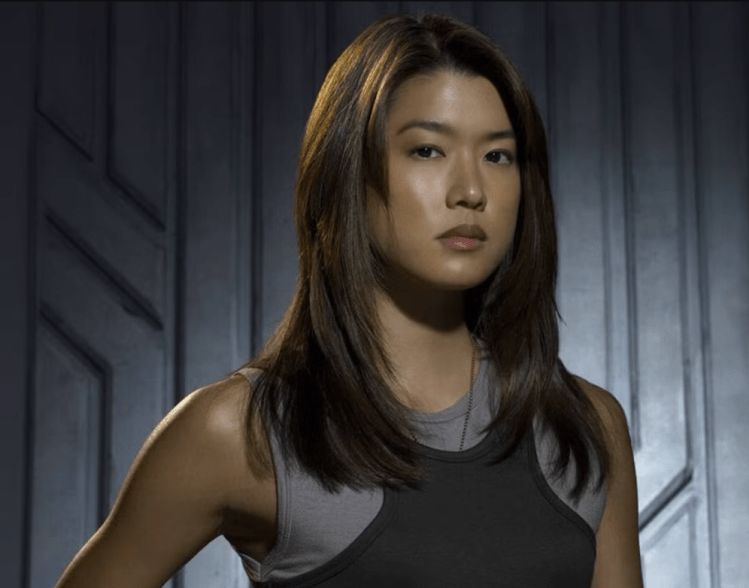
There were two significant Sharons in Battlestar Galactica. The first was Boomer, an ace fighter pilot in the Galactica. What Boomer did not know was that she was a sleeper agent. She believed she was human. She’d had memories implanted. She was in love with Galen Tyron (who turned out to be a sleeper cylon himself, though not one of the baddies). Then she was activated and shot Adama, nearly killing him. The series portrays her struggles to retain her humanity even as she loses her world.

Then there’s Athena, the other Sharon. On the cylon-controlled Caprica, this one pretended to be Boomer in order to trick a stranded Karl Agathon. She always knew just what she was. But somewhere along the way she fell in love with Agathon. They return to the Galactica and she dedicates herself to fighting her fellow cylons, along with having a daughter, Hera, the first human/cylon hybrid.

The series made a strong case for the humanity of both these Sharons. And there were other models thrown in there too. When colonists brutalize one of the Sixes, for instance, who’s the monster? On the flip side, let’s go back to the miniseries, when Caprica snaps the neck of a baby. Monstrous. Inhuman. But…she changes and grows and eventually leads a faction of cylons to seek another path with the colonists.

There’s a third major theme of Battlestar Galactica, and in my view, it’s the weakest. Keep in mind when the series first aired: 2004-2009. America was coming off 1) a major terror attack, 2) paranoia about sleeper agents, 3) critiques of blowback from decades of botched foreign policy, and 4) not-successful invasions and occupations of Afghanistan and Iraq.

At the time I remember reading commentary stating outright that the series was a response to the GWOT, and if you look closely at the storylines you can definitely see it. We’ve got an angry foe seeing revenge, a clash of civilizations, rampant terrorism, sleepers (cylons), and then the cylon occupation of New Caprica (one of the weaker storylines). We’ve also got brutality and torture galore.

As a larger commentary on American society of the zeroes, this comparison leaves me kind of flat. Don’t get me wrong, within the confines of the show, this all worked. But maybe I’d just not rather relive those dark days.

Next up: the hits.

Trope or Choke: Episode 11

The challenge: write a complete story in 500 words or less following these guidelines*:

Setting: Outer space

Genre: Solar punk + Reddit comment thread

Trope: Sweating like a whore in church

Characters: Morally bankrupt real estate agent + Used tire saleswoman

POV: 3rd/past

*Note: writer’s choice to ignore two elements.

The result:

Everyone Has Their Price

“Listen, I just need to get this bucket of bolts over to the Taurus nebula. I’ve got these new colonists fresh from Europa and there’s this asteroid field that I know they’ll pay top dollar for. Bunch of useless rocks, but between you and me, they don’t need to know that.” Saul Treppingham told the bulk of a woman in grease-stained overalls.

She sipped her energy drink in long, slow draws while eyeing his expensive-looking suit. Her name tag read Dervish. “Looks like your little baby here’s about to blow a couple of space tires. I don’t know how you even managed to land her on this runway in one piece without blowing her all to bits.”

“What? These tires?” Saul kicked one with a shiny wingtip. “I just got them replaced on my last turn around the old sun. Supposed to be good for five million miles.”

Dervish took a long slurp from her energy drink. “You ask me, my tires will take you even further than five million miles. Ten. At least.”

“It’s not the tires. I swear. The dome light came on. All blinking and flashing. Danger. You know.”

“Oh, yeah, I know,” Dervish said. “That means the tires are about shot. Like I said you’re lucky you even landed here. I have some of the finest used rubber. No better secondhand tires for nearly a light year. Honest.”

Saul sighed and took stock of the mostly deserted landing strip, some godforsaken bit of real estate on an out-of-the way asteroid. “You know what you need here? Some development. Surely there’s some ore to be mined in the belly of this baby. Say, who’s the owner?”

Dervish squeezed both fists around the bottom of her energy drink. She slurped the last of the dregs like a hungry camel. Then she ripped open the pouch, jammed grease-stained fingers inside and licked them clean.

“God, woman. You act like you were raised among space pirates. Tell you what, why don’t you relay a message to your overlords. I’ll offer them a cool million for exclusive development rights. Really, I’m being generous.”

She watched him rake a hand through slicked-back hair. “My people settled this little old asteroid generations ago. It’s been our claim ever since.”

“Come on,” he said. “Everyone has their price.”

“Tell you what, I’ll give you replacements, half price. Beam back an offer, and I’ll see that my overlords get it.”

Saul unbuttoned his blazer. “I don’t really think the tires are the issue.”

“You want me to relay your offer or not?”

He chuckled nervously, then boomed a laugh. “Alright, as long as you promise.”

She slapped his rear. “I swear, sweetcheeks.”

An hour later she watched Saul Treppingham’s spacecraft zip away. She laughed as loud as she wanted, because there was no one to hear.

Those used tires were too used to be of any good. Scrap rubber, actually. No way could he land without a catastrophic wreck. She could already smell their burning.

Battlestar Galactica Rewatch Part 2: Old vs New

(For Part 1 in this series on the Battlestar Galactica reboot, click here)

When I was a kid I hated Jimmy Carter for one reason: he got the Israelis and the Egyptians to sign a peace deal, and the televised signing of that peace deal interrupted the 1978 premiere of the original Battlestar Galactica. I still haven’t forgiven him for this.

The first incarnation of Battlestar Galactica, created by Glen A. Larsen, lasted just one season with 24 episodes. There was a short-lived resurrection called Battlestar 80 that expired after ten episodes. I forget a lot of the details of Battlestar 80 but reading the synopsis it sounds like the writers were heavily into whiskey and cocaine.

I won’t get into how the original compares to the reboot overall. I don’t think that’s a fair comparison for a couple of reasons. First, television technology—special effects specifically—has improved vastly over the quarter century between the two shows. Second, although they’re essentially the same stories with a bunch of the same characters, they’re from different writers who had different visions.

Also, I’m not going to go through a detailed list of the differences. But there are three differences I want to highlight.

The first, in the scheme of things, is relatively minor.

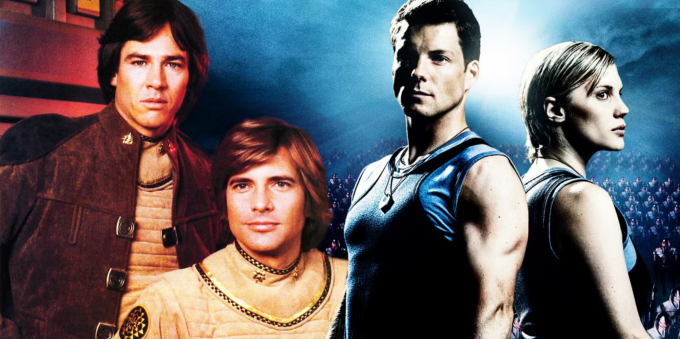
Seven-year-old me wanted to be the ace fighter pilot Starbuck. Played by Dirk Benedict, he was brash and wisecracking and cigar chomping and a good time. When news of the reboot came out, I learned that Starbuck was getting a sex change. He’d now be a woman, played by a woman (Katee Sackhoff). Seven-year-old me was not happy. Adult me considered it a cheap PC stunt. Nowadays sex-swapping characters is so commonplace it’s almost a cliché, if not a joke. But back then I can’t recall it happening all that much.

So, yes a stunt. Yes, odd. Yes, annoying. But…

…thanks to the writing and Sackhoff’s portrayal, it worked. Kara Thrace, aka Starbuck, was gritty and brash and complex and messy and fun, and while, in my opinion she could have remained a he (we didn’t really need that forced romance between her and Apollo), Sackhoff helped make the show what it was.

The second difference between the two series was a major change. In retrospect it seems like such an obvious idea I’m surprised it wasn’t in the original. In the original, the cylons were these hulking and bulky metallic toaster-looking robots.

The reboot had these steel cylons in spades, plus another type of cylon, a type that looked human, 12 models with many copies, to be exact, models with different personalities, and the reboot introduced yet another twist: some of these humanoid cylons didn’t even know they weren’t truly human.

This opened up a universe of tension. Who is a cylon and who isn’t? Who is a sleeper agent? Are cylons redeemable? Do they have a sense of self? A soul? All these questions are great plot fodder, and they’d be much harder to pull off with robots that look like toasters.

Another major change had to do with tone. Seventies sci-fi in general was fun and colorful, unintentionally campy even when trying to be serious. And the special effects were definitely underwhelming. The original fit this profile.

The reboot, in contrast, was darker. Literally. Early episodes employed the shaky camera technique that was trendy back in the zeroes (I hate it).

The tone was darker, too. It had a sheen of noir, which totally fit a series about the nearly total holocaust of the human race. No, you can’t necessarily call a show about robots massacring humans lighthearted, but compared to the original, the reboot went a thousand times darker. Torture of all kinds. Lots of violence. Lots of sex (censored). Humanoid cylons acting monstrous and humans acting monstrous.

It might all sound too heavy, but this is a heavy premise. Taking out the camp and throwing it away worked.

Next up, a look at the major themes of the Battlestar Galactica reboot.

Trope or Choke: Episode 10

The challenge: write a complete story in 500 words or less following these guidelines:

Setting: Australia when it was a penal colony

Genre: True crime + middle grade

Trope: Up shit’s creek without a paddle

Characters: Conspiracy theorist + World’s most annoying superhero

POV: First/Future

The result:

One Last Cigarette

I’ll be on my way to the bodega for what I swear will be my last pack of cigarettes when I’ll hit a brick wall.

Literally.

All of a sudden in the middle of the sidewalk there’ll be this brick wall out of nowhere. What the actual fuck I’ll say to the guy next to me, this white-haired ponytailed dude with a potbelly and dandruff on his cardigan.

“This, my inquisitive friend, is evidence of the illuminati,” he’ll say as he runs his sausage fingers along the bricks.

“Aw, shucks,” a twerpy voice says. “Ain’t no illuminati. It was me.”

I’ll turn to see a kid, twelve max, in a silver cape.

“I am Turbo Boy. It was supposed to be a portal.”

“Listen, son,” the man will say. “I am Donovan Corduroy, foremost expert on conspiracies. “Perhaps you’ve read my wikipedia page.”

We’ll both shake our heads.

“No such things as superheroes. Only conspiracies not yet uncovered.”

“Listen mister, I’m a fourth-generation superhero,” the kid whines. “That’s what my mom said.”

“And where is this so-called mother?”

“Murdered. And I’m using my portal-making powers to catch her killer.”

“Shouldn’t you leave that to the police?”

“They’re useless.” He’ll lift up a blood-stained shirt. “This here’s the killer’s blood, and I intend on using it to create a portal to catch the son of a bitch.”

“Don’t swear,” Corduroy says.

“Piss poop fart butt dick ass!”

“How about you just unmanifest this wall? I need a Marlboro something bad.”

“Smoking’s bad for you mister.”

“I’ve never kidney-punched a superhero,” I’ll say.

Of course I wasn’t planning on punching a kid. But god I needed that nicotine. “Just pull a Gorbachev and tear down this wall.”

“No!” Corduroy will throw his body against it. “This is evidence. I must study it.”

Turbo boy smirks. “Step away from it, dork. I’ve got a murder to solve.”

The kid’ll shoot both arms out. The brick wall trembles like a mother rocking her baby, then like a drunk shaking a toddler.

And the wall will crumble like it’s Berlin 1989.

Then a blinding flash and a sound like an oncoming train. I’ll smell sulfur, which only makes me jones harder for a smoke.

Finally it’ll end.

And my feet’ll be soaked.

“What the heck.”

When I open my eyes it’s not night but light. Blue skies. Scrubby desert. And me ankle deep in a creek.

“What deception is this?” Corduroy will say. “Must be some kind of illuminati mind control. We’ve got to uncover their deception.”

Just then a man’ll ride up on a horse holding the longest rifle ever, aimed at me. “What’re you doing out here?”

“Are you the man who killed my mom?” Turbo Boy will say.

“No, but you,” he points to me, “fit the description of John Wesley Rotheram. The most wanted man in Australia. Escaped in the year of the lord 1804.”

“Time travel, you little bastard?” I’ll hiss. “And all I wanted was one last cigarette.”

Battlestar Galactica Rewatch Part 1: History of the Reboot

Even when it first appeared in 2003, the reboot of the classic 1970s series Battlestar Galactica was considered an instant classic, and not just by me. Part of that success had to do with the megawatt casting of two Oscar nominees, Edward James Olmos and Mary McDonnell in the leads, and part had to do with the gritty writing and visual style that was all the rage in the early zeroes. Battlestar Galactica started off as a miniseries but quickly launched into a full-time series that lasted four seasons on Syfy, becoming one of that channel’s flagship shows.

I watched it faithfully when it first came out. At the time I loved it. I couldn’t get enough. I was obsessed by the original show as a kid (although it looks incredibly cheesy to me now). I wanted to be Dirk Benedict’s Starbuck! And I was definitely psyched by the prospect of a reboot.

Before I get too far I suppose I should tell you all what Battlestar Galactica (the reboot) was about. A human civilization called the Colonials creates robots called cylons, which rebel and launch a deadly war against them. Decades after a stalemate, human-looking cylons infiltrate colonial defenses, enabling the cylons to launch an overwhelming attack. Out of 20 billion humans, only about 40,000 survive aboard a handful of spacefaring vessels led by the battlestar Galactica. Chased by the cylons, they set out to find a legendary lost colony called Earth.

The miniseries came out as a standalone three-hour event in late 2003. It launched to strong acclaim, both critical (positive reviews, a Saturn Award, Emmy nominations) and audience (83% audience score on Rotten Tomatoes), and then came the series, which was also lauded.

The series was directed by Michael Rymer and written by Ronald M. Moore, who’d previously worked on various Star Treks as a writer and/or producer, and who went on to shows including Helix and Outlander.

All told, there were 76 episodes of Battlestar Galactica spread out over four seasons from 2004 to 2009, plus ancillary episodes, including a movie rehashing the entire series from the cylon’s point of view (The Plan), a webisode prequel featuring the young Commander Adama (Battlestar Galactica: Blood and Chrome), and a prequel series, Caprica, that lasted for a single 19-episode season. Caprica was kind of a mess, but it was interesting, at least.

Its strong writing and acting and imaginative plot earned Battlestar Galactica a ton of awards and nominations, including Saturns, Hugos, Emmys, and even a Peabody. Critics mostly praised the show, although some criticized it for being heavy handed (true) and straying too far from the premise of the original series (true).

I don’t know if it can be said that Battlestar Galactica cemented the Syfy channel’s place in the early 21st century cable ecosystem, but it definitely helped. One thing I can say for sure is that Battlestar Galactica has left a towering legacy in the sci-fi universe. Its lofty position in sci-fi lore is cemented, for good reason.

With all this in mind, I decided to rewatch the entire series 20 years on to see how it all held up. At first I thought I could fit everything I wanted to say about it in maybe a few posts, but honestly who likes to read three thousand words on a blog post? So I’ll spread this over several posts and let you all know my verdict.

Watch This Movie: Pearl

I got into a horror kick recently. Why do I love horror? The thrills, the inventiveness, the over-the-topness, the almost cartoonish quality that stylized, fake horror, when done right, can have. Pearl came up on my Amazon Prime feed. The promo image was a Wizard of Oz riff, a Dorothyesque girl climbing a Scarecrow mount. It honestly confused me.

I almost passed it by. So glad I didn’t.

Pearl falls into the category of what I call Sunlit Horror (I don’t know if that’s a real genre. Now it is). Like Midsommar, the bulk of the action and the terror takes place in the daytime on perfectly sunny days. Instead of Be Afraid of the Dark it’s just Be Afraid.

Here’s the basic plot: It’s 1918 rural Texas. Pearl is a farmgirl with a stern German immigrant mother, a disabled father and a husband off in Europe fighting WW1. Pearl hates her dreary life. She dreams of being a star in the new film industry.

Sounds like a fun movie, right?

Well, it is, but not the way that that summary implies. Add to the plot some crushed dreams, a hungry alligator, and we’re off in a wholly different direction.

There are so many great things about Pearl. First, the visuals. Pearl such a beautiful movie, filmed in bright colors like old Hollywood classics on acid. It plays with the Wizard of Oz allusions but twists them and even perverts them in one of the weirdest and best scenes in the movie. Just for the visuals alone, Pearl is worth your time.

Another great thing about Pearl is the entire cast. The director Ti West assembled a strong ensemble to play characters who are well written to fill the tropes we love and expect in horror films (yes, tropes can be a good thing). The standout for me was Pearl herself. I’d heard of Mia Goth but never seen her in movies, only knowing her as the girl with no eyebrows. Turns out she does have eyebrows, they’re just very blonde. She’s perfect in this role, pretty but not too pretty, striving and failing. Goth is great at showing her desires, frustration and ultimately her rage. There’s an audition scene that, if there was any justice in the world, would have won Goth an Oscar. And there’s a scene at the end, a closeup of Pearl’s face, where Goth manages to portray a range of emotions from rage to happiness to madness to pure ridiculousness.

So my bottom line is: Pearl is one of the best horror flicks I’ve seen in a long time. Watch it.

And then watch X. Also starring Mia Goth, X is the first movie in this trilogy, but it’s set in 1979 Texas as a porn crew ventures to a run-down Texas farmhouse to film a movie.

Guess who owns the farmhouse.

Trope or Choke: Episode 9

The challenge: write a complete story in 500 words or less following these guidelines:

Setting: Haunted House

Genre: Romance + Adventure

Trope: Love in rehab

Characters: A woman missing three fingers + a blind baseball player

POV: 3rd/past

The result:

Love Is Just Another Drug

Oliver dug his claws into Nina’s shoulder so hard she almost smacked him. God she hated that parrot.

“He’s gone, you know that.”

“He’s here,” Nina said. “I’ll find him.

“Careful. Your next door might be your last.”

She sighed because it was true. “One more door. I swear.”

“One more bump, you mean, right, girlie?”

Nina rested her hand on the knob. It burned. She let go, then grabbed it quick and twisted. Inside a swirl of mist coalesced into a woman with wild hair and a mouth pried open. “Devour!” she yelled.

The parrot squawked furiously. It released from Nina’s shoulder and bit off her pinkie finger. She tumbled back and shut the door behind her.

She lay on the floor and stared at her bleeding hand. “How could you?”

“I saved our lives.”

“Well don’t do that again.”

“If you simply exit,” Oliver said, “I won’t need to.”

“You know that’s not happening. Not until I find him.”

Oliver settled back on her shoulder. “Tragic. The baseball player who lost his sight and lost himself to heroin.”

“He kicked,” Nina said. “Like I did. And now we love each other.”

“Love? He doesn’t even know what you look like.”

“His words were true.”

Oliver squawked. “He’s a liar. Like that Helen Keller. You know she was a communist?”

“Jared’s no communist. He’s a good man. One more door.”

Nina shuffled deeper into darkness. She stopped before a black oak door and opened it. Inside a little girl sat at a desk drawing. Nina tiptoed closer to get a glimpse. The girl scribbled furiously, an exploding sun that devoured the earth. She looked up at Nina with black eyes. “You’re next.”

Oliver screeched. He flew up and around and before he settled back down he nipped off part of Nina’s ring finger. Nina screamed and ran out of the room and slammed the door behind her.

“Why did you do that?”

Oliver mimicked her words then cackled. “I warned you. Let’s leave.”

“No. Jared’s here somewhere. I feel him.”

“A love for the ages,” Oliver mocked. “The dark ages, that is.”

“I’m not leaving here without my happily ever after.”

“Don’t you know that love is just another drug?”

Nina ignored him. She climbed the staircase and rested her forehead on the first door. “This has to be it.”

She gave the knob one mighty twist. Inside, dusty furniture crowded the silent room. Two steps in and a hooded figure roared out from the shadows. “I’ve been waiting for you,” it moaned.

Before she could think she was on the other side of the shut door with one less finger. She screamed. “Stop torturing me.”

“Stop torturing yourself and give him up.”

She stalked back down and faced another door. This would be her last. She opened it and shielded her eyes from blinding sunlight and looked down. There he sat, all golden and mellow, a baseball clutched in his hand.

“I’ve missed you so much,” Jared said.

Trope or Choke: Episode 8

The challenge: write a complete story in 500 words or less following these guidelines:

Setting: A Saints game

Genre: Underwater exploration + English mystery

Trope: Overcoming a fear of flying

Characters: Brad Pitt’s stunt double + a character dying of cancer

POV: tense: 3rd/future

The result:

Hyperion

Buddy knows this: Gods still walk among men.

“Go deeper,” Brad will tell the captain. Truth is, Buddy hates spending time in this sub. Too tight and gray. Too thin, the steel against the cold sea. Could be worse. He could be flying. Even the thought knots his guts.

Five months earlier Brad got it in his head he could solve the mystery of the Hyperion, the gold-laden galleon the Spanish King sent Elizabeth as a peace offering, which vanished off the Cornwall coast.

“You’re the only one who gets me,” he’ll tell Buddy. Under the fluorescents Brad shines, otherworldly. Buddy doesn’t know what he does to “get” Brad, other than being there, being his body, the one whose taken his bruised and glistening blows ever since Fight Club. “They think I’m a fool,” he’ll say. “But not you.”

A month later Brad surrenders the Hyperion. The documentary won’t even make Sundance. He’ll stay in England. He says he likes the rain.

They’ll sit in a Manchester arena watching the Saints square off against the Bristol Wolves. Brad moves freely; no one imagines ever encountering Brad Pitt in public; their retinas never register him. Rather it’s Buddy who gets the “you know who you look like?” Sometimes Buddy hates his own false face. Brad will sip his lager. “I still think about her,” he’ll say. The galleon or some ex, Buddy asks. Brad doesn’t answer.

When the striker scores, the crowd will rise in a delirious fury. Brad remains languid. “Buddy’s a cool name,” he’ll say. “Bet you were one tough kid.”

“My name’s really Elliott.”

Brad’s eyebrows raise. “Elliott? Seriously?”

“You’re the one who started calling me Buddy.”

Brad will humpf. “Buddy’s better.”

Finally some brave mortal will break her own enchantment. “Are you him?” she’ll ask Brad. He’ll say no, of course not. She’ll deflate.

“Everyone wishes they were Brad Pitt,” Buddy will whisper.

“Me most of all.” Brad frowns. “Hey I was thinking of flying lessons. Like George.”

Clooney. Another aging god in the pantheon. “You know that’s my achilles.”

“You gotta get over that fear, man.”

Buddy will tell him, again, how his father died in a place crash when he was twelve. Twelve. What an awful year for children. “Oh yeah, right,” Brad says. “That’s a shame.” What exactly the shame is, Buddy will never know for sure.

“I always loved Kauai,” Brad will say. “George took me when he filmed the Descendants.”

The Saints will win. Afterwards, Brad snags a pack of smokes. “I never did this,” he’ll confess. “Not much, anyway. Didn’t seem to matter, though. Not in the end.”

Buddy will know. When you surrender your body to someone else, when you take their blows, you know. After the cancer finally claims Brad, Buddy will wonder what he ever truly got from this god. But he’ll take what he can. He’ll rise above his fear, climb into a helicopter and sprinkle what’s left of Brad onto the lush churning green of Kauai.