Power Prompts, Episode 1

Here’s a new exercise: power prompts. These are timed exercises that center around a specific writing theme. This one was about Character Perspective, which is what a specific character is seeing in the story. This contrasts with Point of View, which is how is the story being narrated. [NOTE: There are three POVs: first person (I), second person (You) and third person (He, She). But this prompt was solely about Character Perspective.]

And the prompt itself: in five minutes sketch three distinct characters. Then, in thirty minutes insert them in a city cafe on a rainy afternoon where they witness stabbing.

Here are my results:

The Characters:
Callie, 35, with her toddler in a stroller, she’s stressed about her job, very type A personality. Her toddler is acting up while she’s on the phone with her sister who’s upset over her fiance’s suspected infidelity. Callie doesn’t have the energy to deal with her sister but she’s trying her best.

Justin, 21, is falling behind in his classes. He’s thinking about dropping out of college – money’s tight, but he doesn’t have any plan b besides wanting to go surfing in Hawaii, and he doesn’t know how he’d tell his father, who’d kill him. His father always makes him super nervous. Even thinking about that conversation makes him sweat.

Marissa, 17, she’s run away from home. She’s sleeping on the couch of a friend of her cousin’s. Her mom’s drinking has gotten out of hand and she can’t be around her anymore. She has $700 in savings and she’s trying to think about what kind of job she can do. She definitely can’t go back with her mother, and she refuses to get stuck in the foster system. She’s not afraid, just determined to get her life started out right, on her terms.

And the Scene:

Marissa wished she had an umbrella. It wasn’t one of the things she even thought to shove in her backpack. Not like she woke up yesterday thinking, yeah, mom’s gonna be on her worst bender ever, so you better pack all the things you’ll need for life on your own. It was after the half empty Jameson bottle went flying across the room and nearly hitting her head that she decided to bolt.

Lucky for her she found a couch to crash on. One week, they told her. One week was more than enough time. As long as the dickhead behind the counter would stop making the millionth flat white and give her the time of day to hand her an application. She could do barista. She could do anything. Anything to stay out of mom’s and anything to stay out of foster care. Six months she’d be eighteen. Nothing could touch her then. But she needed A JOB.

“Listen, all I need is an application,” she told him.

“Okay, give me a minute,” he said, looking through her, looking over her. She pulled up a stool and sat herself right at the counter. She would make him see her, make him give her the time she needed. Five minutes past. The line kept growing, flowing. Then it stopped as a woman pushing a baby stroller, a kid bucking and squirming inside it, cell phone propped against her ear, complaining about her cappucino, about it being too cold or too milky or something, and that baby fussing and whining.

Marissa swore to herself she’d never have kids. Well, at least not until she was old, like 30 or something. Bored and eyeing that barista dude, who was way over his head, sweat stains spreading along his underarms, she went over how much cash she had left. About 700 bucks. Wait, I bought pizza last night, she thought. She deducted that princely sum, and that was when she heard the scream.

It sounded like a goat. She pivoted her head, slow motion, and there, at a table by the door, was a lady dressed in an tan raincoat and Uggs. Her hair was all stringy and wet and her makeup was a mess. The lady reared up and that’s when Marissa saw the knife. It was a steak knife, the kind you get in fancy restaurants. The lady stood tall, then she slammed the knife into the table. Marissa heard a squelch and a scream, a real scream. Then the squirt of blood. That’s when Marissa decided she’d be better off working in a CVS.


God Justin hated this job. Never in his life did he dream of making fancy coffees for people who could barely even look him in the eye. Hey, but it paid the bills. Barely. College wasn’t cheap, and as he made some wall street finance bro his double mocha macchiato, triple red eye and passed it over to the guy who stood glaring and drumming his fat fingers, that’s when it came to him. He’d quit college. It wasn’t a choice. It was a knowing.

But then one of his panic attacks threatened to bite him in the ass. Dad will absolutely murder me, he thought. Nobody had a father as terrifying as Justin’s. That he was sure of. But this knowing. He had no choice now. That’s the way his mind worked. He tried to reason with himself, talk himself out of it, and he got so lost in this that he forgot about the waiting cappucino. He looked up at the angry girl, the one who’d been pestering him for an application, and he could feel her judging him for being such a shitty barista. He took a breath and shook it off and gave the lady her cappucino, and not two minutes later she was back at the counter, insisting it was too something.

But he wasn’t listening. Tanya was back. Tanya came in sometimes, and it was never good. She looked a mess, more a mess than usual, and she was bothering some old guy sitting near the door just drinking his coffee like any normal person. That’s when he saw the switchblade in Tanya’s hand. He ran around the counter and watched her raise that switchblade in the air. He bounded over a stroller with a crying kid and nearly tumbled to the ground. But before he could reach Tanya, she’d slammed it onto the table.

Justin couldn’t ever remember hearing a person scream so loud.


The last thing Callie needed right now was another of Alicia’s messes. Her sister had the worst taste in men, and Callie long ago vowed to stop giving relationship advice to someone who’d never take it. But here Alicia was again, crying on the other end of her cell about her cheating fiancee. Callie yes’ed and sure’d her, hoping Alicia would take the hint and hang up. She didn’t.

All Callie wanted was a damn cappucino and a few minutes of silence. This was supposed to be her day off, exploring the city with her two-year-old Susannah. But the rain wasn’t letting up and Susannah was fussy beyond belief and then of course there was that presentation she had to wrap up later tonight and now Alicia. She rocked the stroller and listen to her sister bitch while spitting out her order, only to get her cappucino from the vacant surfer dude barista and sip it and find out that it was already lukewarm. Plus, too much foam.

“No, no, no, this will not do,” she told him. Alicia snapped at her. “Don’t tell me how to live my life.”

“No, not you. The coffee,” she said. But Alicia kept on being Alicia, all woe is me. Callie tried to hush Susannah who refused to sit still in her stroller and tell that dopey barista what exactly he did wrong, convinced he was most likely high, when she heard someone yelling, a woman, and then all of a sudden the barista was out from behind the counter pushing past her and nearly falling over Susannah in her stroller. Callie lunged forward instinctively and raced after him to give him a piece of her mind, when she saw the woman, not homeless but definitely something, and the knife, so big, like a goddamn machete. The woman had one hand planted on the table and she raised that knife high and then slammed it into her own hand.

Between the crazy woman screaming, the barista frantically patting at the blood, and Susannah launching into a royal tantrum, Callie decided the best course of action was to head straight back home and crack open a bottle of Cabernet. The last thing she did before scooting past the bloody, writhing woman was hang up on Alicia.

Anatomy of a Story: One More Darrell

Someone once said books beget books. I can’t find out who. I thought it was Virginia Woolf, and since I read and really liked Mrs. Dalloway, I’ll go with her.

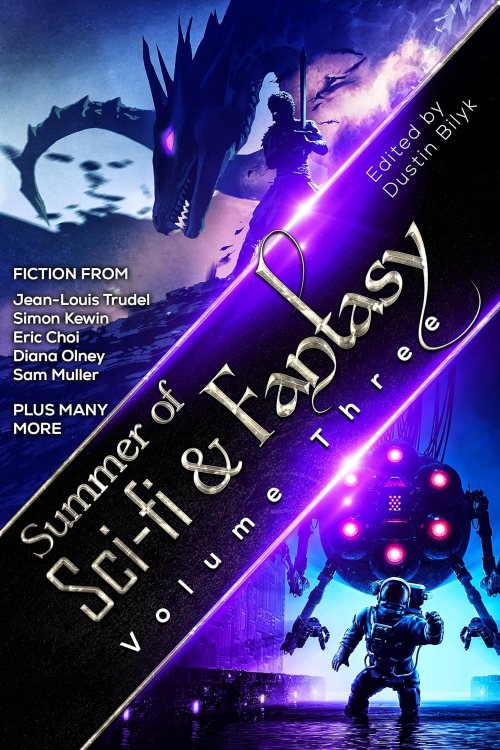
In my case, short stories beget short stories, or more specifically, a throwaway line in a story included in an anthology on time travel was the seed for my short story, One More Darrell, which was published in the anthology Summer of Sci-Fi & Fantasy: Volume Three.

I tried to find the exact line and the story it appeared in but I had no luck. It was something about a pill that let you experience a moment in someone else’s life. That struck a chord in me, so I got to work writing.

A brief flashback: I wrote this story during the height of the Covid lockdowns. I’d spent a lot of time on my own in my house drinking too much and lost in the online world. So just like most of the world. That whole experience left me with a profound sense of disconnect. Again like most of the world. And I began to reflect how we as humans tend to lose ourselves in other people’s stories, everything from fiction to theater to movies and TV, porn and video games, even social media to an extent where we become not so much ourselves but a curated persona.

And I also thought of the story in terms of one of the seven deadly sins: envy. It’s a seductive trait. That person over there has a better life than you do in some way. Imagining what they feel like with that benefit, with that gift, with that luck or skill or talent or blessing, can feel great. But it also cuts you off from your own life.

This is the framework I approached in writing One More Darrell. It’s about a near future where you can take a pill that lets you relive a perfect day or hour of someone else’s life. The pills are named. Some are more popular than others. Our poor narrator can barely manage the stress of his life without popping one pill or another, and his fave by far is Darrell. But his world begins to fall apart when he learns that Darrell is going to be discontinued.

This was one of the easier stories for me to write. It came to me pretty quickly, it was fun to write, and it connected with something in my life. Win, win, win. Not all stories are like that. Most are a hell of a lot of work. Hard, hard work.

And to all the so-called writers out there who don’t read fiction, you’re missing out on a universe of inspiration. Go pick up a book and read it. You never know what story will come out of it.

Trope or Choke: Episode 11

The challenge: write a complete story in 500 words or less following these guidelines*:

Setting: Outer space

Genre: Solar punk + Reddit comment thread

Trope: Sweating like a whore in church

Characters: Morally bankrupt real estate agent + Used tire saleswoman

POV: 3rd/past

*Note: writer’s choice to ignore two elements.

The result:

Everyone Has Their Price

“Listen, I just need to get this bucket of bolts over to the Taurus nebula. I’ve got these new colonists fresh from Europa and there’s this asteroid field that I know they’ll pay top dollar for. Bunch of useless rocks, but between you and me, they don’t need to know that.” Saul Treppingham told the bulk of a woman in grease-stained overalls.

She sipped her energy drink in long, slow draws while eyeing his expensive-looking suit. Her name tag read Dervish. “Looks like your little baby here’s about to blow a couple of space tires. I don’t know how you even managed to land her on this runway in one piece without blowing her all to bits.”

“What? These tires?” Saul kicked one with a shiny wingtip. “I just got them replaced on my last turn around the old sun. Supposed to be good for five million miles.”

Dervish took a long slurp from her energy drink. “You ask me, my tires will take you even further than five million miles. Ten. At least.”

“It’s not the tires. I swear. The dome light came on. All blinking and flashing. Danger. You know.”

“Oh, yeah, I know,” Dervish said. “That means the tires are about shot. Like I said you’re lucky you even landed here. I have some of the finest used rubber. No better secondhand tires for nearly a light year. Honest.”

Saul sighed and took stock of the mostly deserted landing strip, some godforsaken bit of real estate on an out-of-the way asteroid. “You know what you need here? Some development. Surely there’s some ore to be mined in the belly of this baby. Say, who’s the owner?”

Dervish squeezed both fists around the bottom of her energy drink. She slurped the last of the dregs like a hungry camel. Then she ripped open the pouch, jammed grease-stained fingers inside and licked them clean.

“God, woman. You act like you were raised among space pirates. Tell you what, why don’t you relay a message to your overlords. I’ll offer them a cool million for exclusive development rights. Really, I’m being generous.”

She watched him rake a hand through slicked-back hair. “My people settled this little old asteroid generations ago. It’s been our claim ever since.”

“Come on,” he said. “Everyone has their price.”

“Tell you what, I’ll give you replacements, half price. Beam back an offer, and I’ll see that my overlords get it.”

Saul unbuttoned his blazer. “I don’t really think the tires are the issue.”

“You want me to relay your offer or not?”

He chuckled nervously, then boomed a laugh. “Alright, as long as you promise.”

She slapped his rear. “I swear, sweetcheeks.”

An hour later she watched Saul Treppingham’s spacecraft zip away. She laughed as loud as she wanted, because there was no one to hear.

Those used tires were too used to be of any good. Scrap rubber, actually. No way could he land without a catastrophic wreck. She could already smell their burning.

Trope or Choke: Episode 10

The challenge: write a complete story in 500 words or less following these guidelines:

Setting: Australia when it was a penal colony

Genre: True crime + middle grade

Trope: Up shit’s creek without a paddle

Characters: Conspiracy theorist + World’s most annoying superhero

POV: First/Future

The result:

One Last Cigarette

I’ll be on my way to the bodega for what I swear will be my last pack of cigarettes when I’ll hit a brick wall.

Literally.

All of a sudden in the middle of the sidewalk there’ll be this brick wall out of nowhere. What the actual fuck I’ll say to the guy next to me, this white-haired ponytailed dude with a potbelly and dandruff on his cardigan.

“This, my inquisitive friend, is evidence of the illuminati,” he’ll say as he runs his sausage fingers along the bricks.

“Aw, shucks,” a twerpy voice says. “Ain’t no illuminati. It was me.”

I’ll turn to see a kid, twelve max, in a silver cape.

“I am Turbo Boy. It was supposed to be a portal.”

“Listen, son,” the man will say. “I am Donovan Corduroy, foremost expert on conspiracies. “Perhaps you’ve read my wikipedia page.”

We’ll both shake our heads.

“No such things as superheroes. Only conspiracies not yet uncovered.”

“Listen mister, I’m a fourth-generation superhero,” the kid whines. “That’s what my mom said.”

“And where is this so-called mother?”

“Murdered. And I’m using my portal-making powers to catch her killer.”

“Shouldn’t you leave that to the police?”

“They’re useless.” He’ll lift up a blood-stained shirt. “This here’s the killer’s blood, and I intend on using it to create a portal to catch the son of a bitch.”

“Don’t swear,” Corduroy says.

“Piss poop fart butt dick ass!”

“How about you just unmanifest this wall? I need a Marlboro something bad.”

“Smoking’s bad for you mister.”

“I’ve never kidney-punched a superhero,” I’ll say.

Of course I wasn’t planning on punching a kid. But god I needed that nicotine. “Just pull a Gorbachev and tear down this wall.”

“No!” Corduroy will throw his body against it. “This is evidence. I must study it.”

Turbo boy smirks. “Step away from it, dork. I’ve got a murder to solve.”

The kid’ll shoot both arms out. The brick wall trembles like a mother rocking her baby, then like a drunk shaking a toddler.

And the wall will crumble like it’s Berlin 1989.

Then a blinding flash and a sound like an oncoming train. I’ll smell sulfur, which only makes me jones harder for a smoke.

Finally it’ll end.

And my feet’ll be soaked.

“What the heck.”

When I open my eyes it’s not night but light. Blue skies. Scrubby desert. And me ankle deep in a creek.

“What deception is this?” Corduroy will say. “Must be some kind of illuminati mind control. We’ve got to uncover their deception.”

Just then a man’ll ride up on a horse holding the longest rifle ever, aimed at me. “What’re you doing out here?”

“Are you the man who killed my mom?” Turbo Boy will say.

“No, but you,” he points to me, “fit the description of John Wesley Rotheram. The most wanted man in Australia. Escaped in the year of the lord 1804.”

“Time travel, you little bastard?” I’ll hiss. “And all I wanted was one last cigarette.”

Trope or Choke: Episode 9

The challenge: write a complete story in 500 words or less following these guidelines:

Setting: Haunted House

Genre: Romance + Adventure

Trope: Love in rehab

Characters: A woman missing three fingers + a blind baseball player

POV: 3rd/past

The result:

Love Is Just Another Drug

Oliver dug his claws into Nina’s shoulder so hard she almost smacked him. God she hated that parrot.

“He’s gone, you know that.”

“He’s here,” Nina said. “I’ll find him.

“Careful. Your next door might be your last.”

She sighed because it was true. “One more door. I swear.”

“One more bump, you mean, right, girlie?”

Nina rested her hand on the knob. It burned. She let go, then grabbed it quick and twisted. Inside a swirl of mist coalesced into a woman with wild hair and a mouth pried open. “Devour!” she yelled.

The parrot squawked furiously. It released from Nina’s shoulder and bit off her pinkie finger. She tumbled back and shut the door behind her.

She lay on the floor and stared at her bleeding hand. “How could you?”

“I saved our lives.”

“Well don’t do that again.”

“If you simply exit,” Oliver said, “I won’t need to.”

“You know that’s not happening. Not until I find him.”

Oliver settled back on her shoulder. “Tragic. The baseball player who lost his sight and lost himself to heroin.”

“He kicked,” Nina said. “Like I did. And now we love each other.”

“Love? He doesn’t even know what you look like.”

“His words were true.”

Oliver squawked. “He’s a liar. Like that Helen Keller. You know she was a communist?”

“Jared’s no communist. He’s a good man. One more door.”

Nina shuffled deeper into darkness. She stopped before a black oak door and opened it. Inside a little girl sat at a desk drawing. Nina tiptoed closer to get a glimpse. The girl scribbled furiously, an exploding sun that devoured the earth. She looked up at Nina with black eyes. “You’re next.”

Oliver screeched. He flew up and around and before he settled back down he nipped off part of Nina’s ring finger. Nina screamed and ran out of the room and slammed the door behind her.

“Why did you do that?”

Oliver mimicked her words then cackled. “I warned you. Let’s leave.”

“No. Jared’s here somewhere. I feel him.”

“A love for the ages,” Oliver mocked. “The dark ages, that is.”

“I’m not leaving here without my happily ever after.”

“Don’t you know that love is just another drug?”

Nina ignored him. She climbed the staircase and rested her forehead on the first door. “This has to be it.”

She gave the knob one mighty twist. Inside, dusty furniture crowded the silent room. Two steps in and a hooded figure roared out from the shadows. “I’ve been waiting for you,” it moaned.

Before she could think she was on the other side of the shut door with one less finger. She screamed. “Stop torturing me.”

“Stop torturing yourself and give him up.”

She stalked back down and faced another door. This would be her last. She opened it and shielded her eyes from blinding sunlight and looked down. There he sat, all golden and mellow, a baseball clutched in his hand.

“I’ve missed you so much,” Jared said.

Trope or Choke: Episode 8

The challenge: write a complete story in 500 words or less following these guidelines:

Setting: A Saints game

Genre: Underwater exploration + English mystery

Trope: Overcoming a fear of flying

Characters: Brad Pitt’s stunt double + a character dying of cancer

POV: tense: 3rd/future

The result:

Hyperion

Buddy knows this: Gods still walk among men.

“Go deeper,” Brad will tell the captain. Truth is, Buddy hates spending time in this sub. Too tight and gray. Too thin, the steel against the cold sea. Could be worse. He could be flying. Even the thought knots his guts.

Five months earlier Brad got it in his head he could solve the mystery of the Hyperion, the gold-laden galleon the Spanish King sent Elizabeth as a peace offering, which vanished off the Cornwall coast.

“You’re the only one who gets me,” he’ll tell Buddy. Under the fluorescents Brad shines, otherworldly. Buddy doesn’t know what he does to “get” Brad, other than being there, being his body, the one whose taken his bruised and glistening blows ever since Fight Club. “They think I’m a fool,” he’ll say. “But not you.”

A month later Brad surrenders the Hyperion. The documentary won’t even make Sundance. He’ll stay in England. He says he likes the rain.

They’ll sit in a Manchester arena watching the Saints square off against the Bristol Wolves. Brad moves freely; no one imagines ever encountering Brad Pitt in public; their retinas never register him. Rather it’s Buddy who gets the “you know who you look like?” Sometimes Buddy hates his own false face. Brad will sip his lager. “I still think about her,” he’ll say. The galleon or some ex, Buddy asks. Brad doesn’t answer.

When the striker scores, the crowd will rise in a delirious fury. Brad remains languid. “Buddy’s a cool name,” he’ll say. “Bet you were one tough kid.”

“My name’s really Elliott.”

Brad’s eyebrows raise. “Elliott? Seriously?”

“You’re the one who started calling me Buddy.”

Brad will humpf. “Buddy’s better.”

Finally some brave mortal will break her own enchantment. “Are you him?” she’ll ask Brad. He’ll say no, of course not. She’ll deflate.

“Everyone wishes they were Brad Pitt,” Buddy will whisper.

“Me most of all.” Brad frowns. “Hey I was thinking of flying lessons. Like George.”

Clooney. Another aging god in the pantheon. “You know that’s my achilles.”

“You gotta get over that fear, man.”

Buddy will tell him, again, how his father died in a place crash when he was twelve. Twelve. What an awful year for children. “Oh yeah, right,” Brad says. “That’s a shame.” What exactly the shame is, Buddy will never know for sure.

“I always loved Kauai,” Brad will say. “George took me when he filmed the Descendants.”

The Saints will win. Afterwards, Brad snags a pack of smokes. “I never did this,” he’ll confess. “Not much, anyway. Didn’t seem to matter, though. Not in the end.”

Buddy will know. When you surrender your body to someone else, when you take their blows, you know. After the cancer finally claims Brad, Buddy will wonder what he ever truly got from this god. But he’ll take what he can. He’ll rise above his fear, climb into a helicopter and sprinkle what’s left of Brad onto the lush churning green of Kauai.

Writing Shit, or How Joseph Conrad Rekindled My Love of Writing

(Note: this is a long one.)

A work that aspires, however humbly, to the condition of art should carry its justification in every line.

I don’t aspire to write great literature. All I want is to create characters and situations that entertain me first, and then a wider audience. I do aspire to the condition of art.

Recently I’d been stuck on a question familiar to many writers: what’s the point? I’ve been writing seriously for a couple decades now. I’ve had some success: short stories in literary magazines and anthologies, representation from literary agents, and I’ve developed some genuine skills when it comes to craft (although the cliché is true: the more I learn, the less I know).

But then?

Bloodless. Lifeless. Pointless. These words described my state of mind. Maybe not just writing, but I’ll stick to this topic.

How did I get there?

My first novel taught me how not to write a novel. My second was a suspense novel that flirted with the supernatural. I learned to put my main character through hell, and I learned I preferred speculative fiction. I got my first agent with that novel. She was a new agent, I was a new writer, so I figured why not? Nothing came of it. Last I checked she only represents nonfiction.

For my third novel, a multi-generational ghost story, I used as my characters and setting American soldiers stationed in Germany (I’d been there myself in that circumstance, and I’d seen very little art that reflects the weirdness and uniqueness of that situation). I didn’t get an agent. Too unclassifiable (too early for the market), so I self published. I sold a couple thousand copies, but realized I’m not a natural marketer. I still adore that book.

My fourth book is where things took a bizarre turn. This was at the beginning of the YA craze, and I had an idea about a murdered teen resurrected as one of the Four Horsemen of the Apocalypse. It practically wrote itself. I got my second agent at a conference, and silly me, I thought that meant I was guaranteed to get published. Here’s a secret: getting an agent only means you have an agent. It does not equal the promise or probability of a book deal.

He had good feedback but was hellishly slow to respond to my emails. He hit up all the big editors. No dice. Meanwhile I told him about my next book, a story of possession set in an alternate future where the Nazis won. I finished that book and sent it to him a week before my father was killed in a plane crash. I pushed the book out of my mind for a couple months until I realized the agent never acknowledged receiving my book. I let him know what had happened with my father’s death and asked him to respond. He told me he’d been too depressed by the election to work for a couple months. His response pissed me off royally. I forget what I wrote back, but a few weeks later he returned a terse rejection of that book.

Two agents down. One to go.

I poured all my energy into my next book, a YA about a runaway monster fighter sent to a sadistic reform school. By this point, the YA market had shifted to stories by women with female protagonists, or books about social issues. I went to a conference to pitch agents, and nine months later one of those agents reached out. We talked, and he signed me on. By this time I’d pretty much accepted that my male protagonist YA book had almost no chance of getting picked up. Instead I focused on the next novel, an adult fantasy set in a modern-day Arthurian world. My agent shopped it around, and except for one editor who couldn’t get his bosses to sign on to it, nothing.

Then Covid hit.

A lot of people felt creatively sidelined. Not me. I caught Covid at the beginning of lockdown and recovered quickly. With no social life, I knocked out an adult version of my monster hunter story. I sent it to my agent, who said he looked forward to reading it. I sat tight for a few months and then touched base. A couple emails later he told me he was swamped but would prioritize my book. I began my next book, a space opera. A few months later I reached out again. Two emails later he responded with much of the same. I made it clear that if he wasn’t interested in my book—or me—I’d understand. He assured me that wasn’t the case. A few more months, nothing. By then I’d finished the first draft of my next book and my feelings on publishing and writing were beginning to sour.

Then my agent sent me an email. He was leaving the publishing industry. Honestly it was a relief. I no longer had an agent but I had finality.

So that was where I found myself. Since then I’d written some short pieces but the passion was gone. The industry side ground me down. (This isn’t a rant against literary agents or publishing. I get that it’s not personal.)

How could I rediscover that passion?

I found the answer in a piece written more than a century ago.

I go hot and cold on newer fiction. I really want to read something modern and amazing but most often I’m disappointed by the utter sameness of it all. How many books do we need where the spunky heroine claims her mystical birthright? How many sci-fi stories have to feature a discovery that will change humanity forever?

So I revert to old dead writers, one of them being Joseph Conrad. He held up a mirror up to the darkness of his world and didn’t flinch. He was an artist.

I picked up a collection of his works and the first story (I can’t write the full title due to the specific sensitivities of these times but it ends with Narcissus) contains a preface. Written in 1897, it’s Conrad’s declaration that writing, and art itself, should aspire to reveal some truth of the world.

He opens with an explanation of what art is: …an attempt to find in its forms, in its colours, in its light, in its shadows what is enduring and essential. The artist, then, like the thinker or the scientist, seeks the truth and makes his appeal to those qualities of our being that fit us best for the hazardous enterprise of being.

He notes how an artist works versus a thinker or scientist.

…the artist descends within himself, and in that lonely region of stress and strife, if he be deserving and fortunate, finds the form of his appeal.

Not appeal as in what’s appealing, but appeal as in what the artist can use to make his case to the world.

The artist appeals to our capacity for delight and wonder, to the sense of mystery surrounding our lives; to our sense of pity, and beauty, and pain; to the latent fellowship with all creation—and to the subtle but invincible conviction of solidarity that knits together the loneliness of innumerable hearts, to the solidarity in dreams, in joy, in sorrow, in aspirations, in illusions, in hope, in fear, which binds men to each other, which binds together all humanity—the dead to the living and the living to the unborn.

Next Conrad turns to fiction. How does fiction ascend to art? By seeing it all around us.

…there is not a place of splendour or a dark corner of the earth that does not deserve, if only a passing glance of wonder and pity…

Writers can find wonder and pity everywhere. A protagonist who is flat is evidence of the writer’s failure. Every person, real (or imaginary) has the capacity for heroism or villainy. Every soul has something unique to share with the world.

How does fiction work its magic?

Fiction—if it at all aspires to be art—appeals to temperament. It endows passing events with meaning, and creates the moral and emotional atmosphere of the place and time. Such an appeal to be effective must be an impression conveyed through the senses. It cannot be made any other way, because temperament, whether individual or collective, is not amenable to persuasion.

That last bit hits on something I’ve had a hard time articulating. I’m seeing more and more books and movies that preach a moral lesson. Art that does so is not art. It’s a sermon. It’s a polemic. Even worse, it’s a perversion of art. It’s a wolf in sheep skin looking for more sheep to eat. The age we live demands that art preaches moral lessons. There’s no attempt at persuasion. There’s no effort to reveal universal truths. This “art” won’t stand the test of time.

Next, Conrad shines the light on the writer. Any writer who has struggled can relate to this:

The sincere endeavour to accomplish that creative task, to go as far on that road as his strength will carry him, to go undeterred by faltering, weariness, or reproach, is the only valid justification for the worker in prose.

Read that again, especially the portion that says, to go as far on that road as his strength will carry him. The other day I was doing bench presses. I’d lowered the bar to my chest and my muscles refused to raise it one more time. I’d hit muscle failure. Conrad hit muscle failure, too. Instead of wallowing, he turns his attention to what HE wants from his writing.

My task which I am trying to achieve is, by the power of the written word, to make you hear, to make you feel…to make you see. That—and no more, and it is everything.

In that brief passage he focuses on the role of the writer: to make people feel and see the orld by illuminating it intensely. Even Conrad admits that’s easier said than done. In a later passage he describes the lost writer.

…all of these gods must, after a short period of fellowship, abandon him—even on the very threshold of the temple—to the stammerings of his conscience and to the outspoken consciousness of the difficulties of his work. In that uneasy solitude, the supreme cry of Art for Art itself loses the exciting ring of its apparent immortality. It sounds far off. It has ceased to be a cry and is heard only as a whisper, often incomprehensible, but at times faintly encouraging.

This next passage blew me away. Conrad is one of the more important writers of the modern era. By most measures he’s a success. But this dude from a century ago struggled. He knew doubt.

Art is long and life is short, and success is very far off. Doubtful of strength to travel so far, we talk a little about the aim—the aim of art, which, like life itself, is inspiring, difficult—obscured by mists; it is not the clear logic of a triumphant conclusion; it is not in the unveiling of one of those heartless secrets which are called the Laws of Nature. It is not less great, but only more difficult.

In other words, writers choose a difficult road. Writers, unlike scientists, won’t ever get certainty they’ve reached their destination.

His last paragraph is long and rambling but it conveys the promise of writing, using a metaphor of men digging a ditch who spot something brilliant in the distance.

To arrest, for the space of a breath, the hands busy about the working of the earth, and compel men entranced by the sight of distant goals to glance for a moment at the surrounding vision of form and colour, of sunshine and shadows; to make them pause for a look, for a sigh, for a smile—such is the aim, difficult and evanescent, and reserved only for a very few to achieve. But sometimes, by the deserving and the fortunate, even that task is accomplished. And when it is accomplished—behold!all the truth of life is there: a moment of vision, a sigh, a smile—and the return to an eternal rest.

This is why I write: to touch God and share that experience with the world.

Image by Corbis Images