Anatomy of a Story: One More Darrell

Someone once said books beget books. I can’t find out who. I thought it was Virginia Woolf, and since I read and really liked Mrs. Dalloway, I’ll go with her.

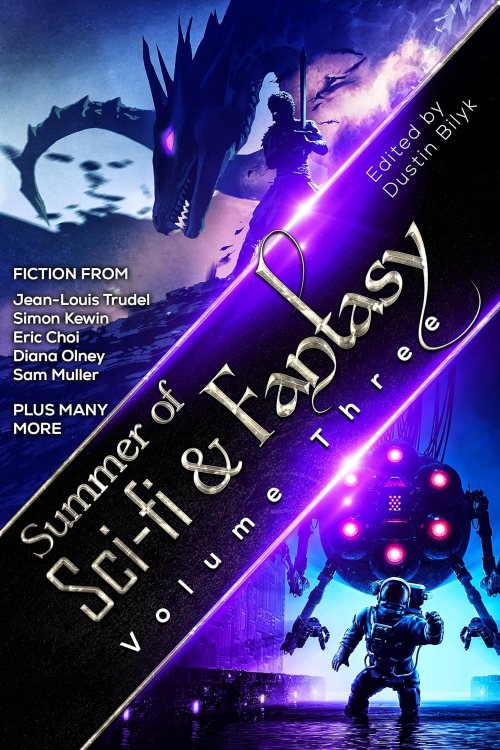
In my case, short stories beget short stories, or more specifically, a throwaway line in a story included in an anthology on time travel was the seed for my short story, One More Darrell, which was published in the anthology Summer of Sci-Fi & Fantasy: Volume Three.

I tried to find the exact line and the story it appeared in but I had no luck. It was something about a pill that let you experience a moment in someone else’s life. That struck a chord in me, so I got to work writing.

A brief flashback: I wrote this story during the height of the Covid lockdowns. I’d spent a lot of time on my own in my house drinking too much and lost in the online world. So just like most of the world. That whole experience left me with a profound sense of disconnect. Again like most of the world. And I began to reflect how we as humans tend to lose ourselves in other people’s stories, everything from fiction to theater to movies and TV, porn and video games, even social media to an extent where we become not so much ourselves but a curated persona.

And I also thought of the story in terms of one of the seven deadly sins: envy. It’s a seductive trait. That person over there has a better life than you do in some way. Imagining what they feel like with that benefit, with that gift, with that luck or skill or talent or blessing, can feel great. But it also cuts you off from your own life.

This is the framework I approached in writing One More Darrell. It’s about a near future where you can take a pill that lets you relive a perfect day or hour of someone else’s life. The pills are named. Some are more popular than others. Our poor narrator can barely manage the stress of his life without popping one pill or another, and his fave by far is Darrell. But his world begins to fall apart when he learns that Darrell is going to be discontinued.

This was one of the easier stories for me to write. It came to me pretty quickly, it was fun to write, and it connected with something in my life. Win, win, win. Not all stories are like that. Most are a hell of a lot of work. Hard, hard work.

And to all the so-called writers out there who don’t read fiction, you’re missing out on a universe of inspiration. Go pick up a book and read it. You never know what story will come out of it.

Anatomy of a story: Splinter

When thinking about writing this piece you’re reading at this very moment I struggled to find the correct word to use to describe a specific type of incident. Every word I could come up with felt wrong, and for a writer, that’s one of the most frustrating feelings.

So I gave up searching for that perfect word and kept on working the concept for this piece in my mind and then I sat down to write it, which is actually similar to the writing process for my recently published short story, Splinter, a tale of brothers Nate and Hud and their tangled dependency.

Here’s where I got stuck. November/December 2023 was interesting for me. I had three events happen to me in quick succession, three intense events. Each one on its own was something to handle. The three piled up led me to write Splinter as an outlet for what I’d experienced.

Now, what to call them. My first go-to was Trauma. But that word is so overused in our current society, it’s become a cliché. If everything can be traumatic then nothing is really traumatic. Incident? Police procedural Events? Bloodless. Nothing seems to fit.

So I’ll switch over to the three things (ugh I hate that word) that led me to write Splinter. I’ll skim over the first two, for personal reasons. One involved a family member over Thanksgiving that painfully plucked at old childhood strings. The second involved a night that included shrooms and whiskey and a friend going through some serious shit, probably among the strangest nights I’ve experienced, which is saying a hell of a lot if you know me.

The third was a garden variety street attack I experienced, where I was slammed to the ground by some asshole. I landed on the concrete on my back, upper left side. He was long gone when I got up. I felt fine. I think I even laughed. The next day and for a couple weeks later I had a sharp pain in my back. I told myself that violence is just a part of being a man in this world, of being a human. In other words, cope and denial.

Mostly I can handle pretty much anything that’s thrown my way, at least that’s what I tell myself. But this triplet pile-on began to claw at me. My dissociative skills were having trouble managing them, so I turned to my what’s been my salvation: writing.

The concept of Splinter is an ancient one. It has its roots in the Genesis story of Cain and Abel: two opposite brothers who (can or) cannot coexist. The challenge I gave to myself was as follows. First, incorporate all three “events” to some degree. Second, thread the needle between realism and speculative fiction. Third, take a panoramic view of the lives of Nate and Hud.

None of this was easy.

First lets get to the technical challenge. Rather than focus on a single event, I chose to lengthen the story out and follow the brothers over several years. I jumped back and forth through time. I interspersed Nate’s “splintering” with his recounting events in the past with a part of the story set in real time. Not easy. What I did was develop different styles for each of the three sections in order to make it easy for the reader to know where they were at any given moment. This took tons and tons of work. Any writer who says that writing is easy is either not good at it, a liar, or incredibly blessed.

Regarding the speculative element, I absolutely love writing spec fiction: light horror, contemporary fantasy, sci-fi, anything with an element of unreality in it. I love how there are fewer limits on your imagination. I love the playful aspect to it. Could I add a speculative element to this story without cheapening it? I chose a very subtle approach (some might call it cheating). I embedded some speculative options, sort of a choose-your-own-adventure take on this story, letting the reader decide for themselves. I’d say it worked: this is the quickest turnaround I’ve had from writing a story to getting it published.

What about the emotional aspect? My primary goal was to work through those three events I’d experienced. How did I do that?

By being as honest as I could bear.

No story is successful unless you get to its heart, and in order to do that you have to cut through flesh and bone and bleed. You have to go to the most painful points. You have to leave blood on the page. That’s what I set out to do here. Most of Splinter is fiction, but some of Splinter is fictionalized, if not factually then emotionally. No, I do not have a drug-addicted brother, but I could transpose sets of feelings that are true. No, I did not witness (or have) a breakdown at my father’s funeral but I could connect feelings of abandonment.

And to me, that’s what successful fiction is: embedding your words with feelings that are true, even if the events are not.

A couple years ago I read the collected fiction of Flannery O’Connor, all of it, her short stories and her two novellas, from start to finish. She’s a master, and what she taught me is that you have to bleed on the page. You have to go to those places you don’t want to go. You can incorporate and reconfigure your own biography in your fiction.

Readers can tell when there’s something real on the page, and after all, isn’t that what we all want from the stories we read and listen to and watch– to feel something real?

Photo © Joel Remland, edited by Amy Dupcak. All rights reserved.

Trope or Choke: Episode 12

The challenge: write a complete story in 500 words or less following these guidelines:

Setting: An operating room

Genre: Amish romance + Medical mystery

Trope: Decoding ancient texts

Characters: Acrophobic five-year-old math genius + Martian

POV: 2nd/future

The result:

Oddity

You’ll record these moments in your mind. You’ll transcribe them. For her. For posterity.

The boy will sit with his ankles crossed and dangling, refusing to look your way. “We’re 72,000 feet from the surface,” he’ll say. “If I plummet through that window it will take me 8.7 minutes to crash. My body will splatter in a diameter of 1.28 miles.”

With all the current strife, this laboratory on the peak of Olympus Mons is the safest place on Mars. Sometimes you forget he’s only five: frail and pale with wild hair. “I see. You’re afraid of heights. How about you turn your back to the window?”

He’ll comply and as he begins to swing his legs you bring forth the rune. He runs his fingers over it. “It’s not a forgery,” he’ll say. “These carvings resemble those on the Xanthe cave tablets.”

“Yes, Abigail found those stones.”

“Tell me about her again.”

You’ll sigh and stare out the window. You can almost see all the way to Drava Valles from here. You and Abigail were children when you met, seventh generation Amish colonists. You knew instantly you were fated to be together. You courted and pledged yourselves to each other, and when you both turned seventeen, you married. That first kiss was an electric shock. You can still feel it reverberate. “She was the most brilliant person I’ve ever met. And the most beautiful.”

“Sounds too good to be true,” the boy says, suddenly sounding too wise for his years.

“Isn’t every romance story?” You’ll glance over at the operating table. Empty. How much blood has pooled on this floor? You can’t think about that now. “Her life’s work was solving the mystery of the Xanthe tablet. And now with this rune we’ve discovered…there has to be a connection.”

“And you think it’s me?” the boy will ask.

Innocently. Too innocently. The first child genius was born nine months after the tablet was unearthed. This boy is the seventh. “Ever since we’ve found this proof that we’re not alone, there’s been so much turmoil. We have to know what they say.”

He’ll squint at the tablet, then the rune. “These markings form a code.”

“Can you decipher it?”

“Close enough, yes. It says, After one thousand years the soil makes them ours.”

A shiver will crawl down your spine. “We’ve been on Mars for nearly a millennia.”

“There’s more,” he’ll say. “Two in the blood will become three.”

“What blood?” you’ll ask.

He’ll look at you so mournfully that you’ll forget about his unnatural intellect and see him just as a child. The skin of his arm is so white, and in his silence you’ll find the answer. You won’t ask his

permission to draw his blood. He won’t resist. Under the microscope you’ll magnify until you hit his DNA. And then you’ll see it: not two strands entwined but three.

You’ll stare at this impossible Martian child, all the time wishing Abigail was here to witness this glory.

Trope or Choke: Episode 10

The challenge: write a complete story in 500 words or less following these guidelines:

Setting: Australia when it was a penal colony

Genre: True crime + middle grade

Trope: Up shit’s creek without a paddle

Characters: Conspiracy theorist + World’s most annoying superhero

POV: First/Future

The result:

One Last Cigarette

I’ll be on my way to the bodega for what I swear will be my last pack of cigarettes when I’ll hit a brick wall.

Literally.

All of a sudden in the middle of the sidewalk there’ll be this brick wall out of nowhere. What the actual fuck I’ll say to the guy next to me, this white-haired ponytailed dude with a potbelly and dandruff on his cardigan.

“This, my inquisitive friend, is evidence of the illuminati,” he’ll say as he runs his sausage fingers along the bricks.

“Aw, shucks,” a twerpy voice says. “Ain’t no illuminati. It was me.”

I’ll turn to see a kid, twelve max, in a silver cape.

“I am Turbo Boy. It was supposed to be a portal.”

“Listen, son,” the man will say. “I am Donovan Corduroy, foremost expert on conspiracies. “Perhaps you’ve read my wikipedia page.”

We’ll both shake our heads.

“No such things as superheroes. Only conspiracies not yet uncovered.”

“Listen mister, I’m a fourth-generation superhero,” the kid whines. “That’s what my mom said.”

“And where is this so-called mother?”

“Murdered. And I’m using my portal-making powers to catch her killer.”

“Shouldn’t you leave that to the police?”

“They’re useless.” He’ll lift up a blood-stained shirt. “This here’s the killer’s blood, and I intend on using it to create a portal to catch the son of a bitch.”

“Don’t swear,” Corduroy says.

“Piss poop fart butt dick ass!”

“How about you just unmanifest this wall? I need a Marlboro something bad.”

“Smoking’s bad for you mister.”

“I’ve never kidney-punched a superhero,” I’ll say.

Of course I wasn’t planning on punching a kid. But god I needed that nicotine. “Just pull a Gorbachev and tear down this wall.”

“No!” Corduroy will throw his body against it. “This is evidence. I must study it.”

Turbo boy smirks. “Step away from it, dork. I’ve got a murder to solve.”

The kid’ll shoot both arms out. The brick wall trembles like a mother rocking her baby, then like a drunk shaking a toddler.

And the wall will crumble like it’s Berlin 1989.

Then a blinding flash and a sound like an oncoming train. I’ll smell sulfur, which only makes me jones harder for a smoke.

Finally it’ll end.

And my feet’ll be soaked.

“What the heck.”

When I open my eyes it’s not night but light. Blue skies. Scrubby desert. And me ankle deep in a creek.

“What deception is this?” Corduroy will say. “Must be some kind of illuminati mind control. We’ve got to uncover their deception.”

Just then a man’ll ride up on a horse holding the longest rifle ever, aimed at me. “What’re you doing out here?”

“Are you the man who killed my mom?” Turbo Boy will say.

“No, but you,” he points to me, “fit the description of John Wesley Rotheram. The most wanted man in Australia. Escaped in the year of the lord 1804.”

“Time travel, you little bastard?” I’ll hiss. “And all I wanted was one last cigarette.”

Trope or Choke: Episode 8

The challenge: write a complete story in 500 words or less following these guidelines:

Setting: A Saints game

Genre: Underwater exploration + English mystery

Trope: Overcoming a fear of flying

Characters: Brad Pitt’s stunt double + a character dying of cancer

POV: tense: 3rd/future

The result:

Hyperion

Buddy knows this: Gods still walk among men.

“Go deeper,” Brad will tell the captain. Truth is, Buddy hates spending time in this sub. Too tight and gray. Too thin, the steel against the cold sea. Could be worse. He could be flying. Even the thought knots his guts.

Five months earlier Brad got it in his head he could solve the mystery of the Hyperion, the gold-laden galleon the Spanish King sent Elizabeth as a peace offering, which vanished off the Cornwall coast.

“You’re the only one who gets me,” he’ll tell Buddy. Under the fluorescents Brad shines, otherworldly. Buddy doesn’t know what he does to “get” Brad, other than being there, being his body, the one whose taken his bruised and glistening blows ever since Fight Club. “They think I’m a fool,” he’ll say. “But not you.”

A month later Brad surrenders the Hyperion. The documentary won’t even make Sundance. He’ll stay in England. He says he likes the rain.

They’ll sit in a Manchester arena watching the Saints square off against the Bristol Wolves. Brad moves freely; no one imagines ever encountering Brad Pitt in public; their retinas never register him. Rather it’s Buddy who gets the “you know who you look like?” Sometimes Buddy hates his own false face. Brad will sip his lager. “I still think about her,” he’ll say. The galleon or some ex, Buddy asks. Brad doesn’t answer.

When the striker scores, the crowd will rise in a delirious fury. Brad remains languid. “Buddy’s a cool name,” he’ll say. “Bet you were one tough kid.”

“My name’s really Elliott.”

Brad’s eyebrows raise. “Elliott? Seriously?”

“You’re the one who started calling me Buddy.”

Brad will humpf. “Buddy’s better.”

Finally some brave mortal will break her own enchantment. “Are you him?” she’ll ask Brad. He’ll say no, of course not. She’ll deflate.

“Everyone wishes they were Brad Pitt,” Buddy will whisper.

“Me most of all.” Brad frowns. “Hey I was thinking of flying lessons. Like George.”

Clooney. Another aging god in the pantheon. “You know that’s my achilles.”

“You gotta get over that fear, man.”

Buddy will tell him, again, how his father died in a place crash when he was twelve. Twelve. What an awful year for children. “Oh yeah, right,” Brad says. “That’s a shame.” What exactly the shame is, Buddy will never know for sure.

“I always loved Kauai,” Brad will say. “George took me when he filmed the Descendants.”

The Saints will win. Afterwards, Brad snags a pack of smokes. “I never did this,” he’ll confess. “Not much, anyway. Didn’t seem to matter, though. Not in the end.”

Buddy will know. When you surrender your body to someone else, when you take their blows, you know. After the cancer finally claims Brad, Buddy will wonder what he ever truly got from this god. But he’ll take what he can. He’ll rise above his fear, climb into a helicopter and sprinkle what’s left of Brad onto the lush churning green of Kauai.

Anatomy of a Story, or How I Came to Create the Tale of Poor Nori

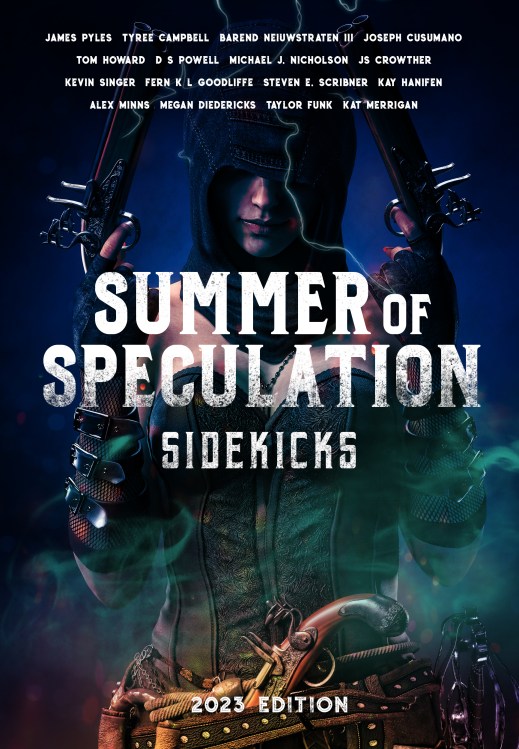
Self-promotion time: one of my stories has been picked up for inclusion in the now-available anthology Summer of Speculation: Sidekicks.

My story is called Champions of the Nereid, and it’s a story about a rudderless woman named Nori who falls under the spell of Hyacinth, a charismatic woman whose mission it is to cleanse the rivers. Nori assumes Hyacinth’s intentions are noble. I won’t spoil it, but it’s a horror story, so you can guess there’ll be trouble brewing for Nori.

This story came to me in a viral video that circulated a few years ago. By now everyone knows about those well meaning yet supremely annoying anti-oil protesters who block traffic and only end up alienating people from their cause. When I watched this video I sided with the angry doctor, and a kind of battle rush hit me.

But later I began to think about the screaming girl. And I couldn’t stop thinking about her. I had this curiosity as to how she got there, how she felt during the incident, and what happened to her after the incident. How did it change her? Instead of mocking her, as I initially did, I came to this place of sympathy. Not with her actions, but with her reaction. I felt something for her. So I decided to write about someone in a similar situation.

That’s how Nori, one of the champions of the nereid, was born (nereids are mythological mermaids, by the way. Hint hint).

From there I knew it would be a horror story.

While Nori’s story was fun to explore, it was tough to write. It’s a slow burn, and those types of stories are hard in terms of maintaining tension and momentum. I did several rewrites and workshopped it. A lot of the backstory had to be cut because it cluttered up the piece (too distracting). To be honest, I’m still not 100% sure I nailed it. But I must have done something right, because now it has a life out there in the world.

As for Nori…

Trope or Choke: Episode 6

The challenge: write a complete story in 500 words or less following these guidelines:

Setting: A deep freezer

Genre: Horror + ’90s redux

Trope: Wai-Fu (tiny girl who kicks ass)

Characters: Cleopatra + absent-minded professor

POV/tense: 3rd person/present tense

The result:

Mister Pointy Returns

It reads: Do not open.

Professer Wentworth purses her lips.

“What’s that awful odor, Stuart?”

Her assistant sighs. “You left yesterday’s salmon dinner on your desk.”

“It must’ve tasted atrocious,” she says. “Now, about this “do not open” situation. A deep freezer arrives from the estate of a murdered FBI agent. Dana Scully, right? With no other instructions. What do you suppose we should do?”

“Not open it.”

“You pathetic man. Where’s your curiosity?”

“I don’t want to end up being the cat.”

“Well it’s my laboratory,” she huffs. “I say open it.”

He sighs. “Fine. I’ll remove the padlock.”

He cuts the lock off and motions to the door. “Would you like to do the honors?”

She scoffs. “Grunt work? That’s why I have you.”

He tugs the handle. It refuses to give.

She snorts. “What a waste of testosterone.”

He gives it an angry yank. The door releases. Cold mist fills the room. Wentworth holds her nose. “It reeks worse than that blasted salmon.”

“It said do not open.”

She shoves Stuart aside. “Let the professional have a look.” She wipes frost from her bifocals and peers into the mist. “It appears to be two sarcophagi. There are name plates. Hard to read. This one reads B Summers. The other. C something. No other artifacts.”

An alarm sounds on her phone. Wentworth perks up. “I forgot. Tonight is Mister Fuzzykins birthday. We’ll pick this up in the morning.”

On the way out she trips on the freezer’s power cord, curses her clumsy shoe and dashes out the door.

The next morning Stuart notices the cord free of the outlet. As he plugs it in, Wentworth catches him on his knees.

“What now, boy?”

“It thawed out.”

“Providence indeed.” She orders Stuart to pry free the first sarcophagus. Inside is a woman, olive skin, long black hair. He opens the second. Another woman. Petite. Young.

“So this Scully collected women,” Wentworth says. “Odd.”

Stuart leans toward the first woman. “I think she moved.”

“Preposterous.” Wentworth shoves him away. The woman opens her eyes and parts her lips to reveal fangs, which rip the skin of Wentworth’s neck and lock onto an artery. Wentworth screams. Her blood splatters. The woman drains Wentworth and tosses her dead husk aside. “A bitter offering for Egypt’s Queen.” She eyes Stuart. “I trust you will taste better.”

Before he can move the second body sits up. “Bad girl, Cleopatra. Rude much? You’re barely awake and already killing people.”

Cleopatra turns. “The foul slayer.”

“I prefer Buffy. Hey cuddlemonkey,” she tells Stuart. “Throw me that broom-handle.” She catches and breaks it. “Hey, Cleo. Mister Pointy needs some love.”

Buffy roundhouses Cleopatra, pins her down and hovers the broomstick above Cleopatra’s heart. “This is for murdering my friends. And for baiting me to that lame FBI agent. And for getting me iced as a threat to the government.” She smirks. “Nah, I just like killing vamps.” She plunges Mister Pointy into Cleopatra, who turns to dust.

Image: (C) Ash Carli

Trope or Choke: Episode 5

The challenge: write a complete story in 500 words or less following these guidelines:

Setting: On the bus

Genre: Dark academia + Speculative

Situation: “I didn’t have anywhere else to go.”

Characters: Elon Musk + a hotshot

POV/tense: 1st person/future tense

The result:

Heart Like a Fortress

One day my heart will surrender its walls. It will break its shell and pierce the world around me. I know this. Until that day I will persevere. I will swallow down my screams and funnel my pain like bullets in my bloodstream and inside those barricades.

Until then I will ride the shuttlebus in my seat assigned not by the proctors of Blessed Musk Institute 67 in the Fourth Sluice of Olympus Mons, but by Damron, he of the titanium fist, he of the night vision eyes, he of the pack that gloats over their fifteen-generation lineage on Mars, their high-grade cybernetics, and their vulgar power.

“You failed advanced chelation,” he whispers in my ear. “Not me,” he purrs. “I aced it.”

That old tingle of shame pricks my limbs and flushes my face. I curse my weakness. “I never wanted to be here,” I whisper.

“Ha!” Damron barks to his pack. They yelp laughter as if on command. “Hear that? The Earthling doesn’t want to be here. Thinks he’s too good for us Redders.”

“I didn’t have anywhere else to go,” I say flatly. Two dead parents on Earth plus one living uncle on Mars equals a one-way trip to another planet, another institute, another mode of being.

“You don’t belong here,” Damron hisses. “Mars will crush you.” He wraps metal fingers around my earlobe. “We will crush you.”

He squeezes. I swallow the pain. I will rise from my seat and tell him: No, you can never crush me! Mars will never crush me! All the proctors and students at the Blessed Musk Institute with their leers and scorn will never crush me!

I tell him none of that. Instead I flinch and I let escape a treasonous “ouch.”

“Heeeah! What a pathetic meatboy you are.” Damron gloats in his victory. He slaps me on the side of the head.

“Don’t!”

I shield myself but it does no good. He batters my skull until I see more stars than the darkest night in the Hellas Planitia.

A girl in the back squeals laughter. “You made meatboy cry again.” My eyes burn. I wish I was invisible. Bullets of shame course through my bloodstream. They coagulate inside the shell of my heart with all the rest trapped there—my hurt and pain, my hopes and dreams, all encapsulated away from me, from the world, for my safety, for theirs, but all the while I am dead inside, without a heart to call my own.

“You’re so pathetic,” Damron whispers. “I bet that’s why your parents killed themselves.”

That’s it. That’s the one last bit of shrapnel to load into the fortress of my heart. My eyes bolt open. “I never failed advanced chelation,” I say. “I am not just a meatsack.”

One day that fortress heart of mine will explode, a bomb of metal mingled with blood, and I will send fragments of my pain into the hearts of all around me. That day is now.

Image: © iStock/nemchinowa