American Horror Story: Coven – the autopsy

Did the writers go astray, or was the whole show a goof?

What was it with American Horror Story: Coven? I could never look away, as much as I wanted to. It was like driving past an accident where you hope to get a glimpse of the burning wreckage.

CovenThe show had a lot going for it. Top-notch cast. Heavy buzz. Solid premise: a coven of witches under attack in New Orleans. That premise alone is overflowing with possibilities.

But sadly it failed to live up to its promise.

The finale gave us a glimpse of what American Horror Story: Coven could have been. The finale involved the selection of a new supreme witch after the reigning supreme, the narcissistic and evil Fiona Goode (Jessica Lange), was supposedly chopped up by her demonic lover and fed to the swamp creatures. After the selection process, the new supreme turned out to be none other than Fiona’s weak-willed daughter Cordelia (Sarah Paulson).

In one of the final scenes Fiona returns. It turns out she faked her death to draw out the new supreme and then hopefully kill her. But Fiona was by then severely weakened. This scene between mother and daughter relayed a complicated, damaged dynamic. If only the show had focused more on this, it would have had a solid footing. It could have been a case study of power, family, good vs evil.

But what we got instead was some unholy mess that bordered on farce.

Exhibit A: next-door-neighbor Joan Ramsey, a religious cliche who gave her grown son bleach enemas (?!?)

Exhibit B: Madame LaLaurie, a sadistic southern slave-owning madam from the 1800s, lalauriecursed to eternal life, who at one point was just a severed head singing (the context doesn’t make it better). LaLaurie goes from rich woman to prisoner to maid to severed body parts, and is then magically reassembled by Queenie, only to have her immortality revoked by Big Bad Voodoo Daddy. Everything about this character was a fail.

Exhibit C: Young witches Madison and Zoe resurrect Kyle after Madison kills him and his date-rapist fraternity brothers. Kyle spends the rest of the season moaning Frankenstein-style, eventually becoming the Coven’s attack dog/butler. What was the point?

Exhibit D: The previous butler, Spalding, collected dolls and likes to dress as a doll. Oh, and he was missing his tongue for the first half of the season. It was hidden in a box in a closet.

Exhibit E: Cordelia, the witch who became supreme, was so weak and pitiful throughout the eyescordshow that she stabbed her own eyes out (well, not her own eyes…long story) to regain powers that never materialized. Then, in the space of ten minutes she’s suddenly the most powerful witch.

Exhibit F: Death? What’s that?

–Madison: throat slit by Fiona, and resurrected by Misty, then strangled by Kyle
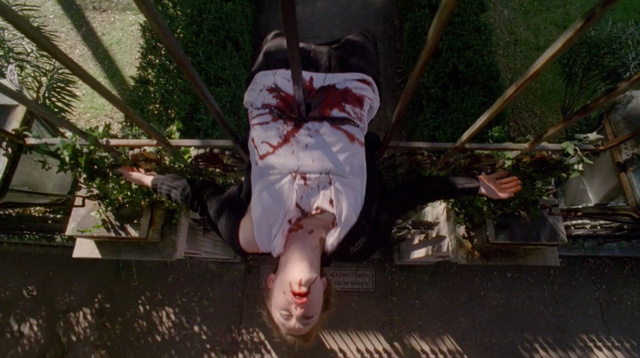
coven–Zoe: impaled on an iron fence and resurrected by Cordelia

–Kyle: killed in a horrific bus crash thanks to Madison and resurrected by Madison and Zoe

–Misty: burned at the stake and resurrected by her own self, then buried alive by Madison, then resurrected by Queenie (sort of — it was unclear how dead she was), then turned to ashes

–Queenie: killed by her own hand (long story), then somehow resurrected (she just shows up alive again and rattles off a 3-second explanation)

–Myrtle: burned at the stake by Fiona, then resurrected by Misty, only to be burned at the stake by Cordelia (after insisting on it (!?!))

–Joan Ramsey: gunned down as collateral damage by the witch hunters, then resurrected by Misty, then killed by mind-controlling Nan (forced to drink bleach) after smothering her enema-clean son (whose ashes told Nan what happened)

Exhibit G: Stevie Nicks showed up for a couple of episodes, as herself, a white witch. She sang and she twirled around. Whatever.

I could go on and on. I won’t. The bottom line: American Horror Story: Coven could have been great. It had an award-winning cast and a solid premise. But the most promising subplots (the witch hunting group, the Axeman) were pushed aside or minimized. Instead, the writers chose camp over coherence.
American Horror Story: Coven — the last gasp

Is it a good TV show gone bad, or was it never as good as the hype?

American Horror Story CovenOnly one episode left in this season of American Horror Story: Coven. I’ve seen every one. The first few game me some hope. The series had a top-notch cast, some clever ideas, and, most importantly, it is one of the few shows that focuses on horror.

But, the writing… boy oh boy. Sometimes you need to just give up on a TV show. I didn’t.

It’s not all bad. Jessica Lange’s Fiona Goode, the supreme witch, the head of the coven, is lucky. Her character has the best storyline. Her path through villainy is compelling, and Lange is skilled enough to underplay the camp that weighs down the series.

Fiona’s relationship with her daughter Cordelia, a witch who is much weaker than her mother, is compelling and complex. Watching Fiona battle cancer, the loss of her power, mortality, all the while remaining a villain is the highlight of the show for me.

There are several other characters on American Horror Story: Coven who are rich enough to keep my attention: most notably fellow witches Misty Day and Myrtle Snow, and Cordelia’s duplicitous husband Hank Foxx. Even the Axeman, a murderous musician, is 3-dimensional enough to keep me interested.

Most of the other characters, however, are either flat or downright annoying. There’s Madame LaLaurie, the psychotic noblewoman played by Kathy Bates (annoying), and Angela Bassett’s Marie Laveau (one-note). Though their final (joined) fates were well done.

The plotting is a lesson in absurdity. Characters die and are brought back to life. When death is not final it holds no power to shock or disturb. Fiona was supposedly killed. I’d be shocked if she didn’t reappear in the final episode.

American Horror Story: Coven is a show with no internal logic. From the beginning of the season it was emphasized that witches were in danger of dying out — they were being killed off. But in a recent episode, supreme witch Fiona claimed that the process to identify the new supreme would inevitably kill some of the girls. How does killing witches help strengthen the coven?

That is bad writing.

During the course of the season we got to meet the group responsible for hunting the witches down. With just one episode left, I would be rooting for them to kill every last one of these witches, even the so-called good ones. Unfortunately the writers screwed up again. An organization that spent centuries hunting witches had no way to protect themselves against witchcraft, and they were wiped out in the course of a single episode. you would think that such a group would know how to protect themselves.

Logic be damned. Then again, maybe I was expecting too much.

Helix: so much for zombies

Helix is Lost meets 28 Days Later with a little CSI thrown in. I’m in.

I was skeptical after seeing the previews. It seemed as if SyFy was trying to craft a CSI-style drama by grafting some vague sci-fi elements. The 15-minute preview wasn’t exactly encouraging. It relied heavily on a complicated backstory exposition involving lead Alan Farragut, his infected brother Peter, and his ex-wife Julia Walker (who became his ex because of Peter). Too soapy.

But… the premiere and the following episode delivered more than I expected.

The basics: Helix, which airs in the US on SyFy Friday nights, follows CDC scientists who travel to a remote Arctic lab to contain and identify a mysterious viral outbreak. This being TV, not everything is what it seems, and you never know the true identities/loyalties of the characters.

The big question: is this about zombies? Well, not in the dead-then-brought-back-to-life-to-eat-brains sense. Instead, think 28 Days Later, the great British horror flick (that also featured Doctor Who’s Christopher Eccleston). In Helix, as in 28 Days Later, the “zombies” are people who have been infected with some sort of pathogen. It doesn’t kill them. Instead, it makes them not quite themselves, as well as violent, aggressive, quick. There’s more, of course, which we’ll understand as the show goes on.

As for the rest of it, the soapy aspect that showed up in the first 15 minutes was quickly quarantined as subtext. After 3 hours of Helix, we’re already on Day 3. There simply isn’t enough time in the story for that type of boring drama. Good move by the writers.

The characters: We’ve got some complexity here, which is a requirement in books but seems to be optional in film and TV. The villain is nearly mustache twirling (and something else too…), but there are plenty of characters in Helix who are not as good (or bad) as they seem.

The setting: An undetermined number of people are trapped in an isolated, mysterious location. Sounds like Lost. I loved Lost, mainly because the writers focused on character. The writers of Helix have incorporated many of the best elements of Lost: the claustrophobic isolated location, unknown motives, mystery upon mystery. Let’s hope they don’t bog it down with crazy mythology too.

Bottom line: I’m hooked. Helix is fast paced, intriguing, and geeky enough to appeal to my science side. I raised an eyebrow at the angry black woman trope in one scene, but I’ll give them a pass on that one. Watch and enjoy.


Helix: sci-fi or scientific procedural?

If the first 15 minutes are anything to go by, with their new series Helix, SyFy is trying to blend the procedural with science fiction.

Zombies? Not zombies? Hard to tell based on the previews released by SyFy. Here’s what we know for sure:

–It follows a group of CDC officials who travel to a clandestine Arctic lab following reports of an outbreak

–The pathogen is a retrovirus (maybe)

–The side effects are black blood and enhanced strength (maybe)

–The side effects may have been intentional

–It was developed by Ronald D. Moore, the genius who tortured us with Battlestar Galactica

As far as the characters, the preview that SyFy has up throws a good chunk of expository back story at us, including a broken marriage. Conveniently the lead, Alan Farragut, is not only the ex-husband of fellow scientist Julia Walker, he is also the brother of infectee Peter Farragut (who slept with Julia). Kind of soapy. Hopefully that won’t be the focus.

And, it seems to be a sort of CSI: Arctic Circle, with a crack team of scientists battling a mystery illness (or is it a crime?).

So based on what little is out there, it’s hard to tell what the hell is going on. But, if the reviewers at io9.com are right (and they’ve screened the entire pilot), Helix marks a strong return of the dark horror to SyFy. In fact, they call it SyFy’s best new show in years. Then again SyFy has produced very little worth watching in years.

When it’s dangerous to dream

Dreams in fiction are hard — but not impossible — to pull off.

Why? Two reasons. 1) most dreams are fragmented (to ourselves) and boring (to others), and 2) a book/TV show/movie is essentially a dream: the writer is asking the reader to suspend their disbelief. To add a dream within a dream is tricky, and risks pulling the reader from the main story.

But dreams can be effective. Let’s look at the movies.

Cover of "Inception"

Cover of Inception

Inception was a great film about lucid dreamscapes. The viewer was never sure where reality ended and dreams began, even after the movie ended. Some people hated the whole movie because of this, but for me it worked.

The Nightmare on Elm Street series wasn’t just a bunch of teen slasher flicks. It was also a clever way to exploit nightmares common to all of us. Even in our worst nightmares we know on some level they are just dreams. In A Nightmare on Elm Street, this was no longer true.

And on TV?

I can’t skip over the single worst use of dreams EVER: when the writers of mega-soap Dallas passed a whole season off as a dream. Horrible. Unbelievable.

Anyway…

Restless (Buffy the Vampire Slayer)

Restless (Buffy the Vampire Slayer) (Photo credit: Wikipedia)

Buffy the Vampire Slayer had an episode titled Restless. It’s almost entirely dream sequences. Each of the four main characters, Willow, Xander, Giles and Buffy, experiences dreams–surreal dreams–that convey character and information vital for future episodes. It was unorthodox storytelling, and it worked. 

In Doctor Who, the episode Amy’s Choice followed Amy, Rory and the Doctor as they are forced to distinguish between reality and a dream world. They face mortal danger in both realms, and must choose to “die” in the dream in order to awaken in reality.

These all worked because the dream was integral to the story being told.

What about shorter dreams? I’ve used them in my writing, and it’s challenging. In The Last Conquistador, the main character, Randy, is awakened from a dream, and I describe fragments of it:

“It’s too early to be awake, and it’s not the sun bleeding through my curtains that wakes me. It’s the scratching. At first I think it’s the dream, the one where I’m swimming in the clear Caribbean waters when a hand pulls me under, but it’s not. Scratching, slicing, screeching. It’s not a dream. It’s coming from my window.”

The dream for Randy is part of a break from the world as we know it; as the book progresses, he will “slip” between worlds. And, it’s a short, singular image that melds waking and sleep.

In Always Mine, the main character, Danny, is targeted by an evil spirit after using a Ouija board. The entry point for this evil spirit? Dreams. He eats away at Danny through his unconscious mind. Dreams were the gateway.

Writing dreams is a tricky proposition. It usually only works if it’s an integral part of the story.

Doctor Who: Goodbye Matt Smith

Matt Smith managed to make the eleventh Doctor both world-weary and child-like. Now it’s time for a change.

Image

Confession: when I first saw the promo shots for the eleventh Doctor, Matt Smith, a few years back, my first thought was: why the hell are they casting this too-young beanpole as the Doctor? No one could top David Tennant. I figured Steven Moffat was swinging for the younger demos, acting skills be damned.

And… I was wrong. From the first scenes with a young Amy Pond, where he’s sampling custard and fish fingers, I got it. Matt Smith was using his age (or lack of) to bring a different quality to the Doctor.

Sticking with the relaunched series, Christopher Eccleston’s Doctor was haunted and zany. But Eccleston only stuck around for one season. Then came Tennant as the tenth. He redefined the Doctor. Tennant was so assured in the role; he filled it out completely. I still insist that the season with Donna Noble is the best, and the episodes where we first meet River Song are the pinnacle of Doctor Who, both in terms of acting and writing.

But back to Matt Smith. No actor wants to do Doctor Who forever, apparently, so when Tennant moved on, Smith came aboard. Slowly I warmed to him. But the episode where I truly became a Matt Smith fan was the two-parter The Rebel Flesh/Almost People, where Smith played two versions of the Doctor. Each was the same, yet distinct. Subtle but brilliant.

There’s so much to say about Smith’s incarnation of the Doctor. I loved the River Song arc. I felt his loss when Amy Pond was separated from him forever. And I understood that Smith’s doctor could be the man so dangerous that hordes would try to destroy him in A Good Man Goes to War.

Goodbye Matt Smith, and number eleven. It’s been great.

Helix: more zombies coming to television?

Previews are cryptic, but it’s from Battlestar Galactica‘s Ron Moore, so who knows?

Image

SyFy is promoting their new show Helix, set to air in January. It’s about a team of scientists fighting a viral outbreak in an Arctic research facility. This virus, from what I can tell, turns people into faster and stronger zombie-like creatures.

But aren’t zombies overdone? What’s left to do with them?

The promo for Helix focuses on the scientific process. Um, okay. Then what?

The good (or bad) news is that it’s exec produced by Ron Moore, the genius who resurrected Battlestar Galactica and then steered it into a wonderful mess by the time it ended after four seasons. Where will he take Helix? Based on his track record with BSG, it’s anyone’s guess.

Hell, he might not even know for sure.

I’ll give it a shot.

American Horror Story: Coven – Good, Bad and Ugly

What lies between a masterpiece and a mess?

I continue to be frustrated by American Horror Story: Coven. The show has loads of talent, creative writing, and a great cast. But still…

The good:

The writers are not afraid to give us complicated villains and complex heroes. Jessica Lange’s Fiona Good, the supreme leader of the struggling New Orleans coven, is  basically evil. She killed the previous supreme to usurp her powers, and she killed a young witch who threatened to challenge her standing. But lately we’ve seen Fiona struggle with terminal cancer. Maybe it’s due to Jessica Lange’s talent, but I actually felt sorry for Fiona. And now that there are new villains on the scene (the witch hunters), we might actually see a heroic Fiona.

And then there’s Zoe Benson, the young witch, and the hero of the story, or at least the character that the writers have used for the audience to identify with. She’s always been led into iffy situations (resurrecting Kit Walker Frankenstein-style), but now she’s killed Spalding, Fiona’s henchman. Yes, he was bad, but Zoe didn’t flinch. That doesn’t bode well for her, but it sure makes her a lot more interesting.

The bad:

Let’s stick with Zoe killing Spalding. It would have been nice to see a consequence for her (as a person). There was none. Then again, death seems to be irrelevant. Madison Montgomery was killed. She’s “alive” again. Myrtle Snow was burned at the stake and now she’s back. Can Madame Delphine ever die? (Please?) Death is no longer shocking or interesting.

And what about rules? When a writer constructs a universe, the rules should be clear and consistent. In American Horror Story: Coven they are not. Kit was brought back to life several episodes ago but he can still barely talk; everyone else resurrected was fine after a day or so. Madison said there was nothing after death, just blackness. But we’ve seen two spirit entities so far: the Axeman and Spalding. So something must exist after death.

So much for rules.

And the ugly:

Sometimes less is more. Tell that to the writers. Every scene involving the over-the-top Jesus freak next door neighbor Joan Ramsey and her dopey, cardboard son Luke make me want to change the channel. An enema as punishment? Death by bees? Really?

And get rid of Madame Delphine. She’s served her purpose.