Anatomy of a Story: Time Turns Blood to Dust

If you’re lucky, some stories come at you all of a sudden like an electric shock. The premise blazes in your brain. The bones of the architecture rise. All in a single moment.

This is what happened to me for my horror story, Time Turns Blood to Dust, just published here in the magazine Uncharted.

Not to say the story was an easy one to write. On the contrary. There was a puzzle I had to solve in crafting the narrative, and it took me what felt like forever to get it just right.

But I’m getting ahead of myself. Back to the beginning. Much like the four protagonists in my story, I was spending an aimless day wandering Manhattan when I saw this tiny nondescript bar. I decided to go in for a drink. The bartender was your average hipster white dude. I took a seat and got an IPA.

And then I went to the bathroom.

Right at the urinal someone had scribbled on the wall: DON’T LOOK UP.

Being both superstitious as hell and a not-quite-nonbeliever of things that go bump in the night, I definitely DID NOT look up. I left the men’s room, finished my beer, and went on with my life.

Of course I knew instantly what just happened: I’d been gifted with the premise of my next story. What if I had looked up? Was there some sort of monster up there waiting to consume me?

But premises are everywhere. Plots are harder to come across. My first question: what happens in the story?

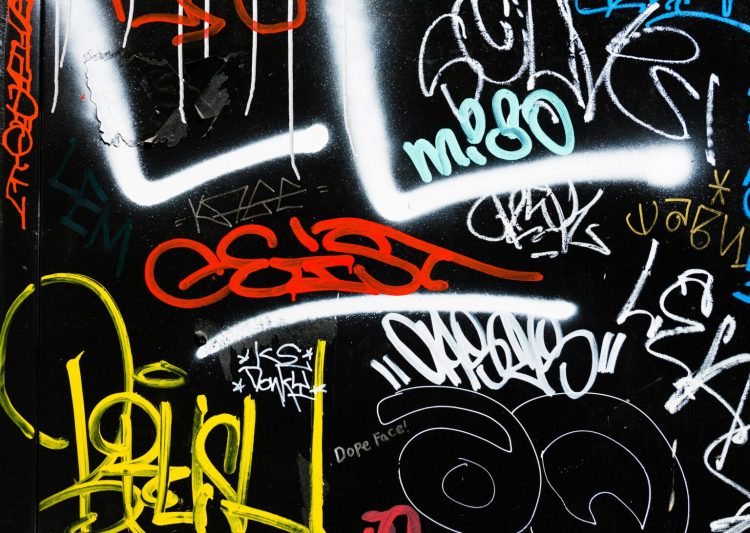
My biggest clue was the graffiti. In my story it was a warning. I had to figure out WHO wrote it, and why. Early on I knew I’d be writing four different perspectives. I wanted the challenge of crafting four complete characters in a tight timeline. I also knew all four characters would be men, since another challenge I set for myself was to capture four different emotional experiences from a distinctly male viewpoint.

But which one would be the graffiti author? How does he do it and why? Where should he be in the order of the four?

Another puzzle was this: how to get to a resolution. The great thing about horror is that it opens up new imaginary worlds. The bad thing about horror is that there’s often no real story arc. I used the four stories within a single story to create a story arc, with the first story setting the tone, the second one amping up that tone, the third shifting, and the fourth going in a different direction, all the while giving the horror its due.

And then came the last challenge. What to name it? Don’t Look Up was the obvious title but there was a movie (that I never saw) with that same name. I thought about Obsidian. I love one-word titles but it left me flat. Then, while reading a Flannery O’Connor novella I came across the phrase “time turns blood to dust.” Bingo. It has the word blood in it (always a plus for horror), it captures one of the themes of my story, and it’s slightly pretentious. Everyone should try and be a little pretentious now and then.
Anatomy of a story: Splinter

When thinking about writing this piece you’re reading at this very moment I struggled to find the correct word to use to describe a specific type of incident. Every word I could come up with felt wrong, and for a writer, that’s one of the most frustrating feelings.

So I gave up searching for that perfect word and kept on working the concept for this piece in my mind and then I sat down to write it, which is actually similar to the writing process for my recently published short story, Splinter, a tale of brothers Nate and Hud and their tangled dependency.

Here’s where I got stuck. November/December 2023 was interesting for me. I had three events happen to me in quick succession, three intense events. Each one on its own was something to handle. The three piled up led me to write Splinter as an outlet for what I’d experienced.

Now, what to call them. My first go-to was Trauma. But that word is so overused in our current society, it’s become a cliché. If everything can be traumatic then nothing is really traumatic. Incident? Police procedural Events? Bloodless. Nothing seems to fit.

So I’ll switch over to the three things (ugh I hate that word) that led me to write Splinter. I’ll skim over the first two, for personal reasons. One involved a family member over Thanksgiving that painfully plucked at old childhood strings. The second involved a night that included shrooms and whiskey and a friend going through some serious shit, probably among the strangest nights I’ve experienced, which is saying a hell of a lot if you know me.

The third was a garden variety street attack I experienced, where I was slammed to the ground by some asshole. I landed on the concrete on my back, upper left side. He was long gone when I got up. I felt fine. I think I even laughed. The next day and for a couple weeks later I had a sharp pain in my back. I told myself that violence is just a part of being a man in this world, of being a human. In other words, cope and denial.

Mostly I can handle pretty much anything that’s thrown my way, at least that’s what I tell myself. But this triplet pile-on began to claw at me. My dissociative skills were having trouble managing them, so I turned to my what’s been my salvation: writing.

The concept of Splinter is an ancient one. It has its roots in the Genesis story of Cain and Abel: two opposite brothers who (can or) cannot coexist. The challenge I gave to myself was as follows. First, incorporate all three “events” to some degree. Second, thread the needle between realism and speculative fiction. Third, take a panoramic view of the lives of Nate and Hud.

None of this was easy.

First lets get to the technical challenge. Rather than focus on a single event, I chose to lengthen the story out and follow the brothers over several years. I jumped back and forth through time. I interspersed Nate’s “splintering” with his recounting events in the past with a part of the story set in real time. Not easy. What I did was develop different styles for each of the three sections in order to make it easy for the reader to know where they were at any given moment. This took tons and tons of work. Any writer who says that writing is easy is either not good at it, a liar, or incredibly blessed.

Regarding the speculative element, I absolutely love writing spec fiction: light horror, contemporary fantasy, sci-fi, anything with an element of unreality in it. I love how there are fewer limits on your imagination. I love the playful aspect to it. Could I add a speculative element to this story without cheapening it? I chose a very subtle approach (some might call it cheating). I embedded some speculative options, sort of a choose-your-own-adventure take on this story, letting the reader decide for themselves. I’d say it worked: this is the quickest turnaround I’ve had from writing a story to getting it published.

What about the emotional aspect? My primary goal was to work through those three events I’d experienced. How did I do that?

By being as honest as I could bear.

No story is successful unless you get to its heart, and in order to do that you have to cut through flesh and bone and bleed. You have to go to the most painful points. You have to leave blood on the page. That’s what I set out to do here. Most of Splinter is fiction, but some of Splinter is fictionalized, if not factually then emotionally. No, I do not have a drug-addicted brother, but I could transpose sets of feelings that are true. No, I did not witness (or have) a breakdown at my father’s funeral but I could connect feelings of abandonment.

And to me, that’s what successful fiction is: embedding your words with feelings that are true, even if the events are not.

A couple years ago I read the collected fiction of Flannery O’Connor, all of it, her short stories and her two novellas, from start to finish. She’s a master, and what she taught me is that you have to bleed on the page. You have to go to those places you don’t want to go. You can incorporate and reconfigure your own biography in your fiction.

Readers can tell when there’s something real on the page, and after all, isn’t that what we all want from the stories we read and listen to and watch– to feel something real?

Photo © Joel Remland, edited by Amy Dupcak. All rights reserved.