Battlestar Galactica Rewatch Part 2: Old vs New

(For Part 1 in this series on the Battlestar Galactica reboot, click here)

When I was a kid I hated Jimmy Carter for one reason: he got the Israelis and the Egyptians to sign a peace deal, and the televised signing of that peace deal interrupted the 1978 premiere of the original Battlestar Galactica. I still haven’t forgiven him for this.

The first incarnation of Battlestar Galactica, created by Glen A. Larsen, lasted just one season with 24 episodes. There was a short-lived resurrection called Battlestar 80 that expired after ten episodes. I forget a lot of the details of Battlestar 80 but reading the synopsis it sounds like the writers were heavily into whiskey and cocaine.

I won’t get into how the original compares to the reboot overall. I don’t think that’s a fair comparison for a couple of reasons. First, television technology—special effects specifically—has improved vastly over the quarter century between the two shows. Second, although they’re essentially the same stories with a bunch of the same characters, they’re from different writers who had different visions.

Also, I’m not going to go through a detailed list of the differences. But there are three differences I want to highlight.

The first, in the scheme of things, is relatively minor.

Seven-year-old me wanted to be the ace fighter pilot Starbuck. Played by Dirk Benedict, he was brash and wisecracking and cigar chomping and a good time. When news of the reboot came out, I learned that Starbuck was getting a sex change. He’d now be a woman, played by a woman (Katee Sackhoff). Seven-year-old me was not happy. Adult me considered it a cheap PC stunt. Nowadays sex-swapping characters is so commonplace it’s almost a cliché, if not a joke. But back then I can’t recall it happening all that much.
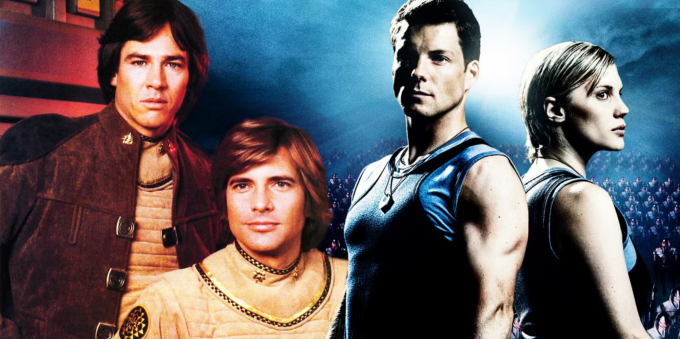
So, yes a stunt. Yes, odd. Yes, annoying. But…

…thanks to the writing and Sackhoff’s portrayal, it worked. Kara Thrace, aka Starbuck, was gritty and brash and complex and messy and fun, and while, in my opinion she could have remained a he (we didn’t really need that forced romance between her and Apollo), Sackhoff helped make the show what it was.

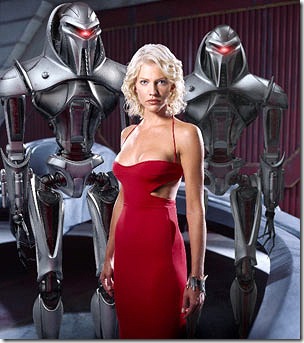
The second difference between the two series was a major change. In retrospect it seems like such an obvious idea I’m surprised it wasn’t in the original. In the original, the cylons were these hulking and bulky metallic toaster-looking robots.

The reboot had these steel cylons in spades, plus another type of cylon, a type that looked human, 12 models with many copies, to be exact, models with different personalities, and the reboot introduced yet another twist: some of these humanoid cylons didn’t even know they weren’t truly human.

This opened up a universe of tension. Who is a cylon and who isn’t? Who is a sleeper agent? Are cylons redeemable? Do they have a sense of self? A soul? All these questions are great plot fodder, and they’d be much harder to pull off with robots that look like toasters.

Another major change had to do with tone. Seventies sci-fi in general was fun and colorful, unintentionally campy even when trying to be serious. And the special effects were definitely underwhelming. The original fit this profile.

The reboot, in contrast, was darker. Literally. Early episodes employed the shaky camera technique that was trendy back in the zeroes (I hate it).

The tone was darker, too. It had a sheen of noir, which totally fit a series about the nearly total holocaust of the human race. No, you can’t necessarily call a show about robots massacring humans lighthearted, but compared to the original, the reboot went a thousand times darker. Torture of all kinds. Lots of violence. Lots of sex (censored). Humanoid cylons acting monstrous and humans acting monstrous.

It might all sound too heavy, but this is a heavy premise. Taking out the camp and throwing it away worked.

Next up, a look at the major themes of the Battlestar Galactica reboot.

Battlestar Galactica Rewatch Part 1: History of the Reboot

Even when it first appeared in 2003, the reboot of the classic 1970s series Battlestar Galactica was considered an instant classic, and not just by me. Part of that success had to do with the megawatt casting of two Oscar nominees, Edward James Olmos and Mary McDonnell in the leads, and part had to do with the gritty writing and visual style that was all the rage in the early zeroes. Battlestar Galactica started off as a miniseries but quickly launched into a full-time series that lasted four seasons on Syfy, becoming one of that channel’s flagship shows.

I watched it faithfully when it first came out. At the time I loved it. I couldn’t get enough. I was obsessed by the original show as a kid (although it looks incredibly cheesy to me now). I wanted to be Dirk Benedict’s Starbuck! And I was definitely psyched by the prospect of a reboot.

Before I get too far I suppose I should tell you all what Battlestar Galactica (the reboot) was about. A human civilization called the Colonials creates robots called cylons, which rebel and launch a deadly war against them. Decades after a stalemate, human-looking cylons infiltrate colonial defenses, enabling the cylons to launch an overwhelming attack. Out of 20 billion humans, only about 40,000 survive aboard a handful of spacefaring vessels led by the battlestar Galactica. Chased by the cylons, they set out to find a legendary lost colony called Earth.

The miniseries came out as a standalone three-hour event in late 2003. It launched to strong acclaim, both critical (positive reviews, a Saturn Award, Emmy nominations) and audience (83% audience score on Rotten Tomatoes), and then came the series, which was also lauded.

The series was directed by Michael Rymer and written by Ronald M. Moore, who’d previously worked on various Star Treks as a writer and/or producer, and who went on to shows including Helix and Outlander.

All told, there were 76 episodes of Battlestar Galactica spread out over four seasons from 2004 to 2009, plus ancillary episodes, including a movie rehashing the entire series from the cylon’s point of view (The Plan), a webisode prequel featuring the young Commander Adama (Battlestar Galactica: Blood and Chrome), and a prequel series, Caprica, that lasted for a single 19-episode season. Caprica was kind of a mess, but it was interesting, at least.

Its strong writing and acting and imaginative plot earned Battlestar Galactica a ton of awards and nominations, including Saturns, Hugos, Emmys, and even a Peabody. Critics mostly praised the show, although some criticized it for being heavy handed (true) and straying too far from the premise of the original series (true).

I don’t know if it can be said that Battlestar Galactica cemented the Syfy channel’s place in the early 21st century cable ecosystem, but it definitely helped. One thing I can say for sure is that Battlestar Galactica has left a towering legacy in the sci-fi universe. Its lofty position in sci-fi lore is cemented, for good reason.

With all this in mind, I decided to rewatch the entire series 20 years on to see how it all held up. At first I thought I could fit everything I wanted to say about it in maybe a few posts, but honestly who likes to read three thousand words on a blog post? So I’ll spread this over several posts and let you all know my verdict.

Wanna live forever (well, at least 30% longer)?

Immortality beckons. It’s that one thing unattainable to all of us. No matter how lucky, rich, or good looking we are, the odds are 99.999999% that we will die (there’s always the slimmest of chances that someone, somewhere has outsmarted death).

immortality

But like modern day Ponce de Leons rambling through Florida searching for the fountain of youth (the irony of him searching in Florida of all places), scientists are diligently trying, if not to have us live forever, then at least a bit longer.

One idea that’s been tossed around has been to upload our consciousness onto the web, or some other computer. But that begs the question — even if it would be possible to map our gray and white matter into bits and bytes, would it really be us?

Forget that for now. We won’t be cylons any time soon.

cylons-bsg

Instead scientists are focused on taking what we have — our flesh and blood bodies — and making them better.

The latest: scientists at UCLA have targeted a gene that counterbalances the harmful but seemingly unavoidable aging process, and by manipulating it in fruit flies, they’ve been able to extend life spans (in the flies) by as much as 30%.

fruitflyFirst question: what good are fruit flies? We’re a lot more complex than them after all. Well, fruit flies are easy to study for one thing. Scientists know all the fruit fly genes, and can switch them on and off at will. Plus, their genetics correspond to 75% of our disease-causing genes. It’s not proof, but it’s a good first start.

Second question: what are they doing exactly? They identified a gene called AMPK that, when activated specifically in the nervous system and the gut, spread beneficial effects throughout the body. It is believed that this gene could help offset the damaging effects of a range of diseases.

If this hold true in humans, the average lifespan could be shifted to well over 100. And not only would we theoretically live longer, but our quality of life would be vastly improved. Yes, in a way it’s science meets sci-fi.

Don’t rush down to the nearest gene therapy clinic just yet. This work is all very preliminary. But it’s got to start somewhere.


Was Battlestar Galactica too religious?

Is there a role for faith in sci-fi? I say of course, but the battle simmers.

Image

This recent post from a Netflix-sponsored blog brings up the issue of religion as discussed in the 2000s now-classic series Battlestar Galactica. The four-season-long reboot of the 1970s show was well written, well acted, and wasn’t afraid to take on the big issues of the day (the opening battles of the global war on terror). But by the time the show ended its run, there was simmering controversy among its fans: why end it with all the overt religious references?

I would say they weren’t truly paying attention.

Battlestar Galactica in its fun and campy 1970s incarnation was an allegory for Mormonism. And it was great television sci-fi, even to my 7-year-old mind. When it was relaunched it kept a strong element of religion. The cylons were inspired by the one true god, and they despised the humans not only as their creators, but for their polytheism. The cylons consistently talked of “a plan” and of their faith in god. Meanwhile, the humans always implored and paid tribute to their Greek-named gods. Take a look at this promo picture below. Can this get any more overtly religious?

Image

So if the religion was in the DNA of Battlestar Galactica, why the controversy?

Two reasons:

–There are many in the science community–and the sci-fi community–who see religion and science as antagonistic. They view science as the antithesis of religion. Therefore, having a sci-fi show that takes religion seriously (and not just as a metaphor or a plot device) is at its heart a betrayal of all that is sci-fi. I am not one of these people.

Battlestar Galactica fully embraced religion. It took faith seriously. However, it failed in that it used the mystery of religion to paper over plot holes. The biggest: when Starbuck disappeared, seemingly died, and came back. Was she some sort of angel? Was she reanimated? The writers never even tried to explain. Faith was used in the wrong sense. The viewer was expected to have faith that things were happening for a reason.

Image

What reason, though?

Unfortunately we were never given a satisfying answer. All we heard were things like “this has all happened before, and it will all happen again.” Uh, ok.

The cause for the Battlestar Galactica controversy are twofold – one inevitable and the other avoidable. All in all though, the series is brilliant television. Its strengths far outweigh its flaws.