Problematic Protagonists: I Saw the TV Glow

Recently I checked out the 2024 indie film I Saw the TV Glow. Ask me what genre it is and I’d have to take a moment. Somewhere in the dark contemporary fantasy camp. Not quite horror but wishing it could be.

First off, what it’s about.

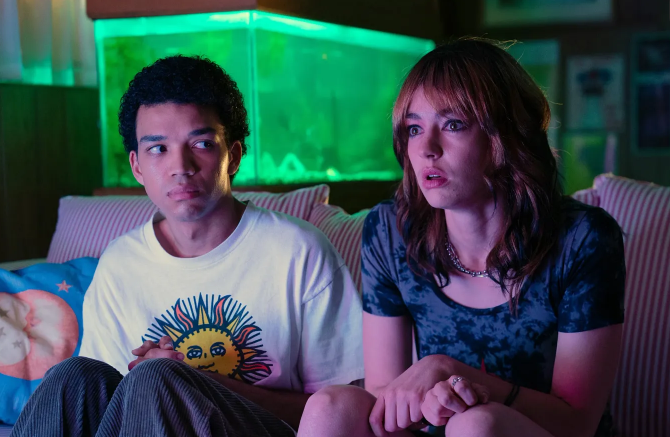
High schooler Owen befriends an older student, Maddy. They bond over a cult TV show called the Pink Opaque, which is about two psychic girls who fight bad guys. Owen is too young to watch the show at home, so he sneaks over to Maddy’s house. Stuff happens. Maddy is a lesbian and Owen is apparently asexual (more on that later). Owen’s mother dies of cancer and he’s stuck with his ignoring father. Maddy runs away then returns claiming that they are really the characters from the Pink Opaque and have been trapped in this fake world, then she’s gone again and Owen is left to figure out what’s what for himself.

My overall take is that there are things I enjoyed about it. The movie had a fun retro indie shoestring vibe (I mean that as a compliment). It had heart. It was a little goofy and it played to the tropes. Also, the show within the movie, the Pink Opaque, was clearly a callback to one of my favorite TV shows, Buffy the Vampire Slayer, including the font used in the credits, and a cameo by Amber Benson, who played Tara in Buffy (Fred Durst, the Limp Bizkit frontman, also has a very small role).

And I didn’t mind that the ending is left vague. In fact I liked that ending. And the writers earned it.

What hold the movie back, massively, is the character of Owen.
I’m of the camp that protagonists are make or break to your story. They don’t have to be likeable or noble or superhuman. They don’t even have to be relatable or identifiable. But there is one thing that every protagonist absolutely must have. He or she must WANT SOMETHING. It can be a small something (to go get a Slurpee) or a big thing (to save the universe from collapse), but there has to be something.

Poor Owen. He didn’t seem to want anything. Clearly he was disconnected from the world. He tells Maddy in a key scene that he doesn’t have any sexual feelings whatsoever, like he’s been scooped out hollow. If he was just a normal human like one of us that would be sad and probably a cause to get therapy. In a piece of fiction? It’s a huge red flag. It signifies your character is disconnected from his own wants and desires.

Now this could be a great launching point. How does that character reconnect with his internal desires? How does he take concrete action to fix this?

But that’s not what we get in this movie. Instead Owen drifts passively through life. His voice rarely rises above a whisper. His facial expression barely changes. Clearly this is a guy with some serious low-grade depression. Again, normal in the real world but do we want to watch this play out for two hours?

By the time we get toward the end of the movie, after Maddy returns and tells Owen that he’s really one of the characters from the Pink Opaque, trapped in this fake identity, we’re aching for Owen to do something, but all we get is nothing. Even after the climactic scene, the one where you can make a case that a) yes, he really is that trapped character or b) no, he’s just seriously mentally ill, Owen is back to being the same old mopey Owen we all know and don’t love.

Like I said, there was a lot of goofy charm to this movie. I really wanted to like it. But poor Owen left me not caring in the least what happened to him. So my take: give your protagonist a purpose. Give him a goal. Make us root for him.

Xena reboot: yes or no?

There was a time when genre shows were a rare thing on TV. In the years after The Twilight Zone and Star Trek, and before Buffy the Vampire Slayer and Lost, genre fans had only a few choices: the super serious X-Files, and the wacky Hercules, with Kevin Sorbo.

XENA

In 1995, the producers of Hercules launched a spinoff: Xena: Warrior Princess. It was like nothing on TV at the time. It starred not one but two action-oriented women, Xena and her trusted sidekick Gabrielle. Lucy Lawless, who went on to become a genre mainstay in both Battlestar Galactica and Spartacus, shot to fame playing the larger-than-life, nearly superhuman warrior. She played the role on two levels: she took it completely seriously, and she was in on the fun.

Xena_Gabrielle

But, like all good (and not so good) shows, Xena: Warrior Princess had to end. There are only so many storylines one can write, and Xena pushed it to the limit. It went off the air in 2001 after getting way too complex (I remember a plot line regarding an evil-spawn child of Gabrielle, for instance). By then, though, TV was opening up to shows that involved some element of the mystical or fantastic. Buffy the Vamipre Slayer was a critical hit, and SyFy (then Sci-Fi) was plowing ahead with original programming such as Farscape.

While it was great fun, Xena hasn’t been missed. There are so many choices when it comes to quality genre TV today, and strong female characters are no longer a novelty. Now comes a rumor that the powers that be are prepping for a reboot of Xena. Honestly I’m torn.

xena2

On one hand, the world of Xena is rich one, bursting with mythology that could be spun into entertaining stories. She’s an iconic character, and it would be interesting to see how she’d be portrayed in a reboot. Who could possibly fill Lucy Lawless’s boots?

On the other hand, we have (dare I say it) too many great genre shows out there. I cannot keep up. I have a list of series that I’m itching to watch. But when do I fit them all in? And is it fair to all the amazing writers out there to continually recycle old ideas, rather than bring something new to the screen?

This is a tough call for me. As much as I’d like to see a new Xena (out of curiosity, if nothing else), I wouldn’t want to see my favorites — Buffy, Lost, Farscape — reimagined with a different cast. But I said the same thing when they rebooted Battlestar Galactica, and that turned out to be brilliant.

Genre TV: a golden age or too much of a good thing?

It is a sad fact that there are too many great books in the world, of all genres, that I will never have time to read. I’m sure that I’m missing out on some life-changing classics, but there’s nothing I can do about that.

Star TrekWhen it comes to TV, though, there used to be a time when you could be up on all the great TV shows. For fans of all things sci-fi/supernatural/horror like myself, it wasn’t that hard, because there were so few TV shows that had a sci-fi or supernatural theme. Back in the 1950s you had The Twilight Zone and in the 1960s came The Outer Limits, Star Trek, and in England, Doctor Who. Along the way there were a smattering of other TV shows, notably the X-Files and Buffy the Vampire Slayer in the ’90s, but with only a handful of networks (and the BBC in England) the options were severely limited.

Buffy the Vampire Slayer

That’s all changed. Now there seems to be a new network popping up every week, along with new TV shows. When Lost premiered, it reinvigorated the genre by making it commercially and critically viable. As flawed as Lost was, the emmy-winning series showed the powers that be that genre shows could make money and win awards.

Lost

Since then, there’s been an explosion of genre shows. A few decades ago, who would have predicted that two of the most hyped television shows would include dragons and zombies? These two shows, Game of Thrones and The Walking Dead are worldwide cultural events. Game of Thrones and The Walking Dead bring more than just supernatural/fantastical/horror elements: they have high production values, are well acted, and have great writing.

Walking Dead

And these are just two of the latest and greatest. The past couple of decades have given us so many great genre shows, from SyFy’s Farscape and the Battlestar Galactica reboot, to BBC’s relaunched Doctor Who and BBC America’s Orphan Black. I should be happy, right?

Orphan Black Tatiana Maslany

In a way, I’m not. There are SO MANY genre shows out there I can’t keep up. And neither can the people who are writing them. The Walking Dead has given us the derivative Z Nation. The second season of SyFy’s Helix was a mess (a glorious, batshit crazy mess, but still a mess). And Netflix’s Hemlock Grove was half-baked camp. We’ve got a glut of genre shows out there, some of which should have never been made, and others that could have used a little more seasoning.

helixNot to mention that I don’t have the time to watch the vast majority. I’d love to watch The Strain, and there’s a new Salem TV show with Lucy Lawless that looks interesting. But between work, writing, play, family, how could I possibly fit all these shows into my life?

Maybe Hollywood needs to scale back a little — if not in the number of shows, then at least in the number of episodes. In the UK, it’s a common practice for TV shows to be short runs. Each season is perhaps six episodes, and the TV shows only run for a few seasons, if that. What you get is concise storytelling that does not require a lifetime commitment of the viewer. I’d fully support this idea; even the best shows suffer from episode bloat and could use some trimming (I’m looking at you, Walking Dead).

Can you really laugh while watching sci-fi/horror?

Sometimes humor can cut the tension and seriousness, but it’s rarely done well.

I love most things horror and sci-fi related. But it can all get so heavy. Horror is basically about ghosts, witches, demons, vampires, etc. And as for sci-fi, well… science isn’t very funny. Scientists take what they do so damn seriously sometimes. Most times. Ok, 99% of the time.

In the fictional world there seems to be a stark divide. On one hand, there’s the hardcore, where pinhead2you never laugh, except maybe unintentionally. Take Hellraiser‘s Pinhead. There is nothing funny about him. Compare that with the comedies — Spaceballs, Scary Movie 1 to infinity. Those play it only for laughs.

But then along come those rare shows that can balance drama with comedy.

The first one that comes to mind is the iconic series Buffy the Vampire Slayer. At its core it was a tragedy: a teenage girl is chosen (against her will) to become a vampire slayer. These girls rarely see their 18th birthday. Fun, right?

Well, head writer and creator Joss Whedon and Buffy herself — Sarah Michelle Gellar — made it fun. The writing was sharp and clever and the jokes would fly.

buffy

But Buffy the Vampire Slayer never let you forget the tragedy at its core.

Another example is from the SyFy channel (or SciFi as it was called back then). Farscape was about John Chrichton (Ben Browder), an American astronaut who is shot through a wormhole to a thoroughly alien part of the universe. He accidentally kills the brother of a psychotic military captain, and winds up aligned with a band of escaped convicts. He spends the series on the run while trying to get back to Earth.

farscape 2

Farscape could be heavy, and many times it was. But Chrichton was written as a loose cannon, confounding his adopted compatriots for better and for worse. He was often serious as hell. But he was also funny, sharp and crafty.

I think we need more of this in these genres. Take time travel. Most of the time travel movies are 100% serious (the Terminator franchise). The only non-serious time travel movie I can think of is Hot Tub Time Machine. But that’s straight up comedy.

But there could be alternatives. I came across this short clip below, courtesy of io9.com. It takes place in a world where time travel is common, and is used by drunken assholes. It’s clever, and it left me thinking… what if? What if someone could successfully inject humor into time travel, while keeping the drama?

<p><a href=”http://vimeo.com/70410780″>Timeholes</a&gt; from <a href=”http://vimeo.com/mallaby”>Ben Mallaby</a> on <a href=”https://vimeo.com”>Vimeo</a&gt;.</p>

I’m waiting, Hollywood.

When it’s dangerous to dream

Dreams in fiction are hard — but not impossible — to pull off.

Why? Two reasons. 1) most dreams are fragmented (to ourselves) and boring (to others), and 2) a book/TV show/movie is essentially a dream: the writer is asking the reader to suspend their disbelief. To add a dream within a dream is tricky, and risks pulling the reader from the main story.

But dreams can be effective. Let’s look at the movies.

Cover of "Inception"

Cover of Inception

Inception was a great film about lucid dreamscapes. The viewer was never sure where reality ended and dreams began, even after the movie ended. Some people hated the whole movie because of this, but for me it worked.

The Nightmare on Elm Street series wasn’t just a bunch of teen slasher flicks. It was also a clever way to exploit nightmares common to all of us. Even in our worst nightmares we know on some level they are just dreams. In A Nightmare on Elm Street, this was no longer true.

And on TV?

I can’t skip over the single worst use of dreams EVER: when the writers of mega-soap Dallas passed a whole season off as a dream. Horrible. Unbelievable.

Anyway…

Restless (Buffy the Vampire Slayer)

Restless (Buffy the Vampire Slayer) (Photo credit: Wikipedia)

Buffy the Vampire Slayer had an episode titled Restless. It’s almost entirely dream sequences. Each of the four main characters, Willow, Xander, Giles and Buffy, experiences dreams–surreal dreams–that convey character and information vital for future episodes. It was unorthodox storytelling, and it worked. 

In Doctor Who, the episode Amy’s Choice followed Amy, Rory and the Doctor as they are forced to distinguish between reality and a dream world. They face mortal danger in both realms, and must choose to “die” in the dream in order to awaken in reality.

These all worked because the dream was integral to the story being told.

What about shorter dreams? I’ve used them in my writing, and it’s challenging. In The Last Conquistador, the main character, Randy, is awakened from a dream, and I describe fragments of it:

“It’s too early to be awake, and it’s not the sun bleeding through my curtains that wakes me. It’s the scratching. At first I think it’s the dream, the one where I’m swimming in the clear Caribbean waters when a hand pulls me under, but it’s not. Scratching, slicing, screeching. It’s not a dream. It’s coming from my window.”

The dream for Randy is part of a break from the world as we know it; as the book progresses, he will “slip” between worlds. And, it’s a short, singular image that melds waking and sleep.

In Always Mine, the main character, Danny, is targeted by an evil spirit after using a Ouija board. The entry point for this evil spirit? Dreams. He eats away at Danny through his unconscious mind. Dreams were the gateway.

Writing dreams is a tricky proposition. It usually only works if it’s an integral part of the story.