Trope or Choke: Episode 8

The challenge: write a complete story in 500 words or less following these guidelines:

Setting: A Saints game

Genre: Underwater exploration + English mystery

Trope: Overcoming a fear of flying

Characters: Brad Pitt’s stunt double + a character dying of cancer

POV: tense: 3rd/future

The result:

Hyperion

Buddy knows this: Gods still walk among men.

“Go deeper,” Brad will tell the captain. Truth is, Buddy hates spending time in this sub. Too tight and gray. Too thin, the steel against the cold sea. Could be worse. He could be flying. Even the thought knots his guts.

Five months earlier Brad got it in his head he could solve the mystery of the Hyperion, the gold-laden galleon the Spanish King sent Elizabeth as a peace offering, which vanished off the Cornwall coast.

“You’re the only one who gets me,” he’ll tell Buddy. Under the fluorescents Brad shines, otherworldly. Buddy doesn’t know what he does to “get” Brad, other than being there, being his body, the one whose taken his bruised and glistening blows ever since Fight Club. “They think I’m a fool,” he’ll say. “But not you.”

A month later Brad surrenders the Hyperion. The documentary won’t even make Sundance. He’ll stay in England. He says he likes the rain.

They’ll sit in a Manchester arena watching the Saints square off against the Bristol Wolves. Brad moves freely; no one imagines ever encountering Brad Pitt in public; their retinas never register him. Rather it’s Buddy who gets the “you know who you look like?” Sometimes Buddy hates his own false face. Brad will sip his lager. “I still think about her,” he’ll say. The galleon or some ex, Buddy asks. Brad doesn’t answer.

When the striker scores, the crowd will rise in a delirious fury. Brad remains languid. “Buddy’s a cool name,” he’ll say. “Bet you were one tough kid.”

“My name’s really Elliott.”

Brad’s eyebrows raise. “Elliott? Seriously?”

“You’re the one who started calling me Buddy.”

Brad will humpf. “Buddy’s better.”

Finally some brave mortal will break her own enchantment. “Are you him?” she’ll ask Brad. He’ll say no, of course not. She’ll deflate.

“Everyone wishes they were Brad Pitt,” Buddy will whisper.

“Me most of all.” Brad frowns. “Hey I was thinking of flying lessons. Like George.”

Clooney. Another aging god in the pantheon. “You know that’s my achilles.”

“You gotta get over that fear, man.”

Buddy will tell him, again, how his father died in a place crash when he was twelve. Twelve. What an awful year for children. “Oh yeah, right,” Brad says. “That’s a shame.” What exactly the shame is, Buddy will never know for sure.

“I always loved Kauai,” Brad will say. “George took me when he filmed the Descendants.”

The Saints will win. Afterwards, Brad snags a pack of smokes. “I never did this,” he’ll confess. “Not much, anyway. Didn’t seem to matter, though. Not in the end.”

Buddy will know. When you surrender your body to someone else, when you take their blows, you know. After the cancer finally claims Brad, Buddy will wonder what he ever truly got from this god. But he’ll take what he can. He’ll rise above his fear, climb into a helicopter and sprinkle what’s left of Brad onto the lush churning green of Kauai.

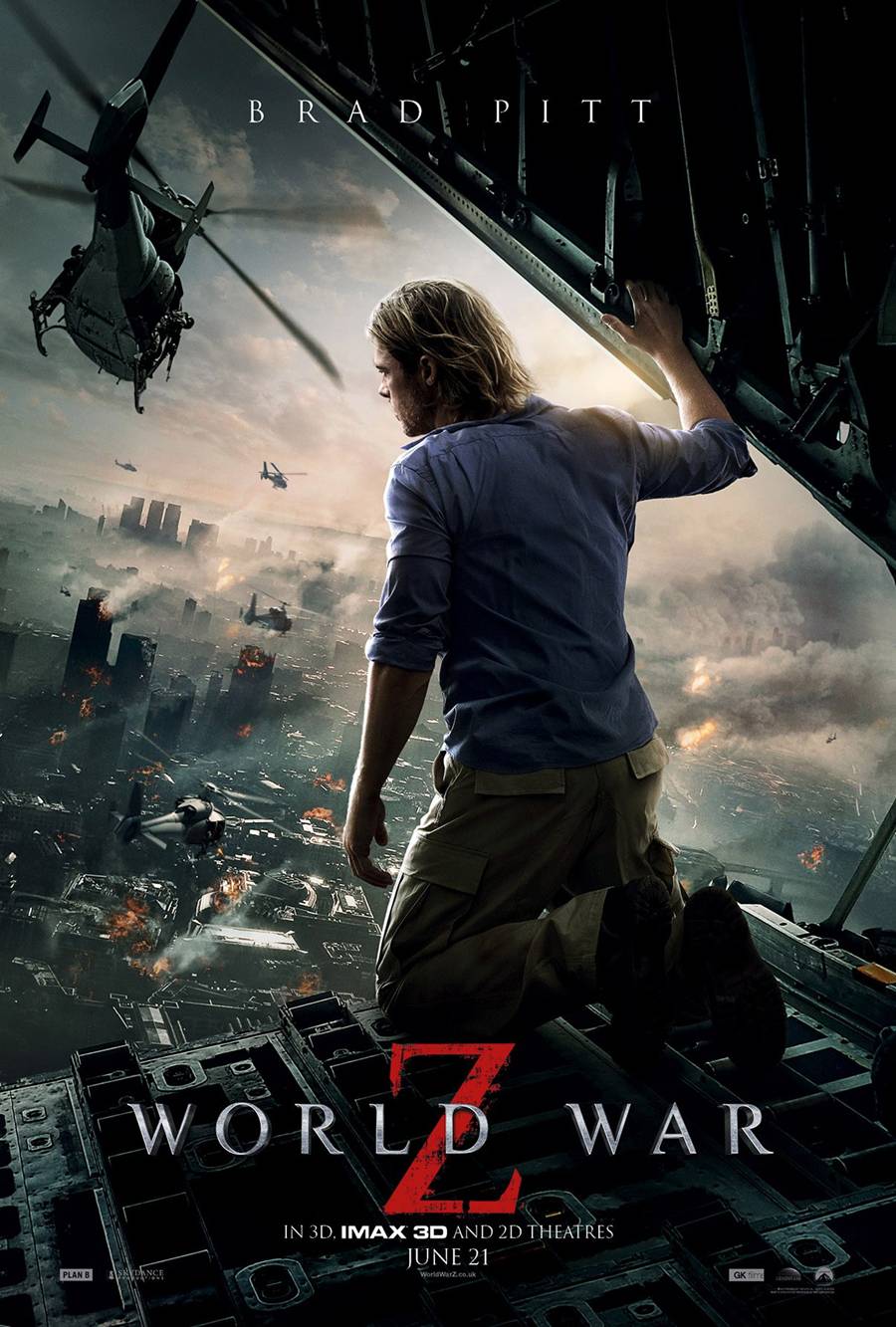
Book vs movie: World War Z

It was nearly an impossible book to film, but they filmed it anyway.

There’s only one book that comes to mind as a successful movie adaptation (though I’m sure there are tons of others), and that’s The Hunger Games.

Zombie thriller World War Z by Max Brooks was a mega-successful book.

Image

World War Z the movie, produced by Brad Pitt, was a moderately successful movie.

Image

Both are vastly different beasts, and the adaptation didn’t quite make the Hunger Games standard.

To be fair, the book is nearly unfilmable as written. It’s told in the style of The Good War, an oral history of World War II by Studs Terkel. World War Z (book) is written after a global zombie pandemic/attack/war. It’s narrator is a UN rep who is compiling reports on the war from around the globe. In a neat literary trick, while the narrator appears in every chapter — he actually interviews the survivors — we never even know his name, or much else about him. This allows the focus to be on the individual stories throughout the book.

And the stories are gripping. We hear from normal folks who have to bury their pain to soldiers who relay harrowing tales of near death to higher-ups who reflect on the war from a matter-of-fact perspective. Max Brooks excelled at writing these micro-tales that not only have genuine human drama, but combine facts on worldwide culture and geopolitics. Brooks covers nearly every facet of the global war and its aftermath, including the new world order that results. It’s fascinating to see how Russia has become a theocracy, Cuba is a capitalist powerhouse, Israel and Palestine finally live in peace, and China is a democracy.

The movie version of World War Z. goes in a different direction. The hero (Hollywood loves its heroes) is Gerry Lane (Brad Pitt). He is a former UN investigator who gets caught up in the zombie outbreak in Philadelphia with his wife and daughters. After a close escape from a Newark rooftop, Lane and his family are flown to a ship, where Lane is called back to duty to help a CDC scientist search for a cure. This search takes Lane (and the viewer) to South Korea, Israel, and Wales.

The movie tried to stay true to the book in the sense that it was a global story. It was exciting to travel to those locations, even if the plot felt forced. For instance, I was unsure as to why Wales, in particular.

But while the book was one of my favorite reads, it did lack that central human character, and that’s the role that Gerry Lane served.

The movie also improved the book in its use of zombies. These were not the slow, ambling (though still menacing) zombies that we’re used to ,and which Brooks used. These zombies were lightning fast. The opening scene of Lane’s escape in the Philly streets was outstanding. The swarm happens in real time. It’s intense. There’s nothing like that in the book, though to be fair, it’s much easier to relay menace on film than in a book. And the scene with the zombie swarm scaling the wall in Jerusalem is a classic.

Image

Still, the movie couldn’t quite match the book in its scope. And as with most action movies, it stretched my belief nearly to the breaking point. A zombie outbreak on a plane results in a too-neat escape that could never happen in real life. Also, in the movie, the Israelis survived because they spotted the threat before any other country and walled themselves off. Yet they didn’t realize that noise would attract the zombies? The movie turned one of the most hopeful parts of the book — a lasting Israeli-Palestinian peace — into a tragedy.

In short, there were too many harrowing escapes for Pitt, and the last act in Wales nearly put me to sleep.

My recommendation — read the book if nothing else. Then see the movie, at the very least for it’s amazing visual effects. I hear there are sequels to the movie planned. Hopefully they figure out how to add more of the book’s heart.