Battlestar Galactica Rewatch Part 2: Old vs New

(For Part 1 in this series on the Battlestar Galactica reboot, click here)

When I was a kid I hated Jimmy Carter for one reason: he got the Israelis and the Egyptians to sign a peace deal, and the televised signing of that peace deal interrupted the 1978 premiere of the original Battlestar Galactica. I still haven’t forgiven him for this.

The first incarnation of Battlestar Galactica, created by Glen A. Larsen, lasted just one season with 24 episodes. There was a short-lived resurrection called Battlestar 80 that expired after ten episodes. I forget a lot of the details of Battlestar 80 but reading the synopsis it sounds like the writers were heavily into whiskey and cocaine.

I won’t get into how the original compares to the reboot overall. I don’t think that’s a fair comparison for a couple of reasons. First, television technology—special effects specifically—has improved vastly over the quarter century between the two shows. Second, although they’re essentially the same stories with a bunch of the same characters, they’re from different writers who had different visions.

Also, I’m not going to go through a detailed list of the differences. But there are three differences I want to highlight.

The first, in the scheme of things, is relatively minor.

Seven-year-old me wanted to be the ace fighter pilot Starbuck. Played by Dirk Benedict, he was brash and wisecracking and cigar chomping and a good time. When news of the reboot came out, I learned that Starbuck was getting a sex change. He’d now be a woman, played by a woman (Katee Sackhoff). Seven-year-old me was not happy. Adult me considered it a cheap PC stunt. Nowadays sex-swapping characters is so commonplace it’s almost a cliché, if not a joke. But back then I can’t recall it happening all that much.
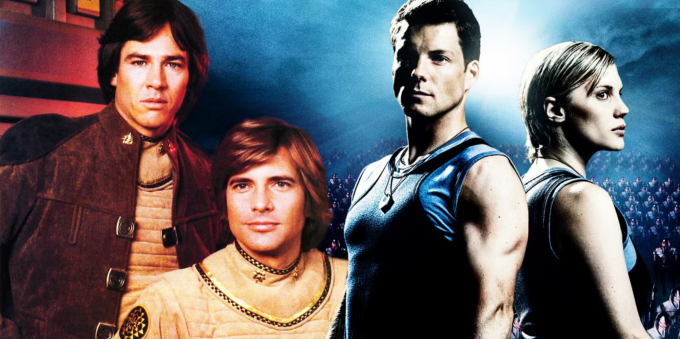
So, yes a stunt. Yes, odd. Yes, annoying. But…

…thanks to the writing and Sackhoff’s portrayal, it worked. Kara Thrace, aka Starbuck, was gritty and brash and complex and messy and fun, and while, in my opinion she could have remained a he (we didn’t really need that forced romance between her and Apollo), Sackhoff helped make the show what it was.

The second difference between the two series was a major change. In retrospect it seems like such an obvious idea I’m surprised it wasn’t in the original. In the original, the cylons were these hulking and bulky metallic toaster-looking robots.

The reboot had these steel cylons in spades, plus another type of cylon, a type that looked human, 12 models with many copies, to be exact, models with different personalities, and the reboot introduced yet another twist: some of these humanoid cylons didn’t even know they weren’t truly human.

This opened up a universe of tension. Who is a cylon and who isn’t? Who is a sleeper agent? Are cylons redeemable? Do they have a sense of self? A soul? All these questions are great plot fodder, and they’d be much harder to pull off with robots that look like toasters.

Another major change had to do with tone. Seventies sci-fi in general was fun and colorful, unintentionally campy even when trying to be serious. And the special effects were definitely underwhelming. The original fit this profile.

The reboot, in contrast, was darker. Literally. Early episodes employed the shaky camera technique that was trendy back in the zeroes (I hate it).

The tone was darker, too. It had a sheen of noir, which totally fit a series about the nearly total holocaust of the human race. No, you can’t necessarily call a show about robots massacring humans lighthearted, but compared to the original, the reboot went a thousand times darker. Torture of all kinds. Lots of violence. Lots of sex (censored). Humanoid cylons acting monstrous and humans acting monstrous.

It might all sound too heavy, but this is a heavy premise. Taking out the camp and throwing it away worked.

Next up, a look at the major themes of the Battlestar Galactica reboot.

Battlestar Galactica Rewatch Part 1: History of the Reboot

Even when it first appeared in 2003, the reboot of the classic 1970s series Battlestar Galactica was considered an instant classic, and not just by me. Part of that success had to do with the megawatt casting of two Oscar nominees, Edward James Olmos and Mary McDonnell in the leads, and part had to do with the gritty writing and visual style that was all the rage in the early zeroes. Battlestar Galactica started off as a miniseries but quickly launched into a full-time series that lasted four seasons on Syfy, becoming one of that channel’s flagship shows.

I watched it faithfully when it first came out. At the time I loved it. I couldn’t get enough. I was obsessed by the original show as a kid (although it looks incredibly cheesy to me now). I wanted to be Dirk Benedict’s Starbuck! And I was definitely psyched by the prospect of a reboot.

Before I get too far I suppose I should tell you all what Battlestar Galactica (the reboot) was about. A human civilization called the Colonials creates robots called cylons, which rebel and launch a deadly war against them. Decades after a stalemate, human-looking cylons infiltrate colonial defenses, enabling the cylons to launch an overwhelming attack. Out of 20 billion humans, only about 40,000 survive aboard a handful of spacefaring vessels led by the battlestar Galactica. Chased by the cylons, they set out to find a legendary lost colony called Earth.

The miniseries came out as a standalone three-hour event in late 2003. It launched to strong acclaim, both critical (positive reviews, a Saturn Award, Emmy nominations) and audience (83% audience score on Rotten Tomatoes), and then came the series, which was also lauded.

The series was directed by Michael Rymer and written by Ronald M. Moore, who’d previously worked on various Star Treks as a writer and/or producer, and who went on to shows including Helix and Outlander.

All told, there were 76 episodes of Battlestar Galactica spread out over four seasons from 2004 to 2009, plus ancillary episodes, including a movie rehashing the entire series from the cylon’s point of view (The Plan), a webisode prequel featuring the young Commander Adama (Battlestar Galactica: Blood and Chrome), and a prequel series, Caprica, that lasted for a single 19-episode season. Caprica was kind of a mess, but it was interesting, at least.

Its strong writing and acting and imaginative plot earned Battlestar Galactica a ton of awards and nominations, including Saturns, Hugos, Emmys, and even a Peabody. Critics mostly praised the show, although some criticized it for being heavy handed (true) and straying too far from the premise of the original series (true).

I don’t know if it can be said that Battlestar Galactica cemented the Syfy channel’s place in the early 21st century cable ecosystem, but it definitely helped. One thing I can say for sure is that Battlestar Galactica has left a towering legacy in the sci-fi universe. Its lofty position in sci-fi lore is cemented, for good reason.

With all this in mind, I decided to rewatch the entire series 20 years on to see how it all held up. At first I thought I could fit everything I wanted to say about it in maybe a few posts, but honestly who likes to read three thousand words on a blog post? So I’ll spread this over several posts and let you all know my verdict.

Trope or Choke: Episode 7

The challenge: write a complete story in 500 words or less following these guidelines:

Setting: Scotland Yard

Genre: Dystopian + military sci-fi

Trope: New frontier

Characters: Captain Kirk + manic pixie dream girl

POV/tense: 2nd/present

The result:

A New Frontier Awaits You

His name: Ossetian. Lieutenant in the Global Atlantic Empire’s Forces. Red hair. Muscled. Suspicious eyes. Seeing those eyes in person convinces you he is indeed a counterrevolutionary. He sits across from you in the cafe with a gesticulating Asian man not in any dossier.

How’s the coffee?

The waitress pulls you from your observation. She’s fit, hint of makeup, severe brown bob, twinkling green eyes.

Fine, you say.

Just fine? She pouts. Never seen you here before.

You glance at Ossetian. His companion stalks out. Ossetian remains.

The waitress cocks her hip. You need something sweet in your life. How about a strawberry croissant?

You debate trailing the companion. The waitress lingers with a sly smile. On me, she says.

You’ve already got a snap of the companion to feed into the Mil-FBI database. Sure.

She returns with the croissant. I’m Minka. She waits for your answer. Don’t be rude now.

Kirk, you confess.

As you leave she slides beside you and whispers something in your ear you don’t quite catch. Before you step in the rain she says clearly, come back to me.

You go back, though not for her. Ossetian meets with a revolving retinue at the cafe. Still no proof he’s been corrupted by the group that calls themselves Scotland Yard. They’ve corrupted the wetware of millions. How, though? Your enhanced interrogations produced nothing. At this frustrating rate you’ll never advance beyond captain.

Minka grows brazen. She says her shift ended. She joins you for espresso and says you really need to loosen up, Kirk. Surely the empire would want you to unwind. Then she’s in your bed whispering words that melt into nothing. As the sunrises on yet another morning together, you think maybe she’s right. Maybe there is more to life than fortifying the principles of the empire.

Ossetian stops going to the cafe. After three days you realize you miss her. You try to dismiss these unsanctioned emotions; it feels as if something’s infected your wetware. If true, you’ll be ejected from Mil-FBI. Or worse.

Midnight. Intel suggests the factory is Scotland Yard’s HQ. You lead your squad inside. You stalk empty rooms. You climb stairs. No sign of anything remotely Scotland Yard. Third floor your squad grows restless. It’s a bust, your second says. Basement, you order. You descend. Dank rooms. Darkness. A light from behind a closed door. You crack it open.

The Asian man, Ossetian’s first companion at the cafe, sits beneath a dangling bulb.

Lovely to see you again, Captain.

I don’t know you.

But we know you.

Your squad rustles behind you. One more word he’ll ruin your career. You level your weapon at him.

What a prize, he mutters. He locks eyes and tells you clearly, A new frontier awaits you.

The words strike a memory: Minka’s whispers. They worm into your wetware. You feel the corruption in real time. A cracking. A shattering. Shackles break.

Clarity, for the first time. You turn and fire. Four bodies fall.

Image by vecstock on Freepik

Trope or Choke: Episode 5

The challenge: write a complete story in 500 words or less following these guidelines:

Setting: On the bus

Genre: Dark academia + Speculative

Situation: “I didn’t have anywhere else to go.”

Characters: Elon Musk + a hotshot

POV/tense: 1st person/future tense

The result:

Heart Like a Fortress

One day my heart will surrender its walls. It will break its shell and pierce the world around me. I know this. Until that day I will persevere. I will swallow down my screams and funnel my pain like bullets in my bloodstream and inside those barricades.

Until then I will ride the shuttlebus in my seat assigned not by the proctors of Blessed Musk Institute 67 in the Fourth Sluice of Olympus Mons, but by Damron, he of the titanium fist, he of the night vision eyes, he of the pack that gloats over their fifteen-generation lineage on Mars, their high-grade cybernetics, and their vulgar power.

“You failed advanced chelation,” he whispers in my ear. “Not me,” he purrs. “I aced it.”

That old tingle of shame pricks my limbs and flushes my face. I curse my weakness. “I never wanted to be here,” I whisper.

“Ha!” Damron barks to his pack. They yelp laughter as if on command. “Hear that? The Earthling doesn’t want to be here. Thinks he’s too good for us Redders.”

“I didn’t have anywhere else to go,” I say flatly. Two dead parents on Earth plus one living uncle on Mars equals a one-way trip to another planet, another institute, another mode of being.

“You don’t belong here,” Damron hisses. “Mars will crush you.” He wraps metal fingers around my earlobe. “We will crush you.”

He squeezes. I swallow the pain. I will rise from my seat and tell him: No, you can never crush me! Mars will never crush me! All the proctors and students at the Blessed Musk Institute with their leers and scorn will never crush me!

I tell him none of that. Instead I flinch and I let escape a treasonous “ouch.”

“Heeeah! What a pathetic meatboy you are.” Damron gloats in his victory. He slaps me on the side of the head.

“Don’t!”

I shield myself but it does no good. He batters my skull until I see more stars than the darkest night in the Hellas Planitia.

A girl in the back squeals laughter. “You made meatboy cry again.” My eyes burn. I wish I was invisible. Bullets of shame course through my bloodstream. They coagulate inside the shell of my heart with all the rest trapped there—my hurt and pain, my hopes and dreams, all encapsulated away from me, from the world, for my safety, for theirs, but all the while I am dead inside, without a heart to call my own.

“You’re so pathetic,” Damron whispers. “I bet that’s why your parents killed themselves.”

That’s it. That’s the one last bit of shrapnel to load into the fortress of my heart. My eyes bolt open. “I never failed advanced chelation,” I say. “I am not just a meatsack.”

One day that fortress heart of mine will explode, a bomb of metal mingled with blood, and I will send fragments of my pain into the hearts of all around me. That day is now.

Image: © iStock/nemchinowa

Read This Book: Children of Time

620 pages. That’s how long this brick of a book turned out to be when I got it in the mail. Hell no, I thought. But then I started to read it and I didn’t want to stop.

Children of Time, the 2015 sci-fi novel by British writer Adrian Tschaikovsky, is a supremely imaginative story about one planet and two rival species vying for control of it. On the one side we have an ark ship of humans, the survivors of a spacefaring civilization that blew themselves up millennia earlier, leaving a rump population on Earth to reestablish technology and, one day, flee their dying home for the stars.

To where exactly?

Well, here’s where Tschaikovsky takes the trope of a colony ship in a wholly unexpected direction.

Let’s rewind. Millennia earlier at the start of that cataclysmic war, megalomaniacal scientist Avrana Kern was going to seed a terraformed planet with monkeys and a virus that would selectively enhance their evolution in favor of intelligence. Her creepy plan goes awry, and what we get is not a rehashed Planet of the Apes, but something much creepier, especially for those of us who are arachnophobes.

Spoiler…the monkeys didn’t make it to the planet, and the virus, which did, selected for intelligence mostly among the insects, the top dogs being a certain species of spider.

Centuries later, as the spiders evolve into a complex and intelligent society, that ragtag ship nears what they believe to be a green paradise just waiting for them to land and populate it. As you can guess, there will be conflict.

I won’t spoil the rest of the story. Instead, here’s my breakdown:

The good:

Children of Time alternates between both groups. For the first hundred pages or so, the story and pace were riveting. I didn’t want to put it down.

–The writing is pristine and engaging. As someone who obsesses over words, zero complaints.

–Tschaikovsky managed to make spiders (not a fan) into sympathetic and relatable characters. He wove spiders’ natural biology into humanlike functions and hierarchies. He made it seem effortless, though I am sure this was the product of hours upon hours of research and craft.

–The human characters were all compelling. Even the minor ones seemed real to me.

The not as good:

Children of Time sagged in the middle. There was a lot of back and forth that made me wonder if the writer had to figure out a way to account for the passage of time (and the spiders’ continued evolution). Also in the middle section, the chapters were overly long, when shorter and punchier would have been more effective.

–A subplot regarding the ship’s captain, while interesting, felt like it belonged in another book.

–While I liked the ending (totally unexpected), something about it felt off. Not sure what or why. It could have just been a pacing issue.

But these are minor flaws. I wouldn’t normally buy or recommend a 600-page book. Children of Time is a fantastic exception.

Wait…Gendercide Is a Thing?

I like to consider myself a fan of all things speculative–horror and supernatural and sci-fi books, movies, TV shows, etc., and I believe I know a ton about these genres.

Apparently I don’t. The other day I was rabbit holing into the latest of a long line of literary controversies (I won’t go into it here) and I read this article asking whether it’s time do do away with the gendercide trope, a trope I’ve never heard of before.

What is gendercide? It sounds nasty, because it is. Gendercide is where either the men or the women in any given story are killed or die off from some nefarious or mysterious or viral reason. The book that inspired the article introducing me to gendercide is The Men by Sandra Newman. I haven’t read it yet, but it’s about a world where all males suddenly vanish. The remaining women adjust to this disappearance, while videos online depict the men living in a hellish landscape.

There are others, too, such as Y: The Last Man, a comic turned TV show where (almost) all men die of a virus. One of my favorite books, The Knife of Never Letting Go by Patrick Ness, is a variant of the gendercide trope; the novel opens in an all-male society where the women have mysteriously died off.

According to TVtropes.org, gendercide isn’t super popular, and most of the time only a variant is used (only some or most of either men or women die or disappear). Stories where the men disappear are more in line with the theme of feminist utopia, and stories where the women vanish are considered dystopic.

In reading about Newman’s book, I found it disturbing that all the men were sent to a hellscape ruled by demons. Oddly, the writer of the article critical of gendercide (and Newman’s book), didn’t write about that disturbing aspect of it. From me, though, disturbing is not a criticism. I want to learn more about this trope, and see how different writers explore it.

Watch this movie: High Life

This one’s a tricky recommendation.

It’s not often that I like revolting movies, movies that are repulsive for the sake of being repulsive, movies that are obviously trying to shock you.

But here I am.

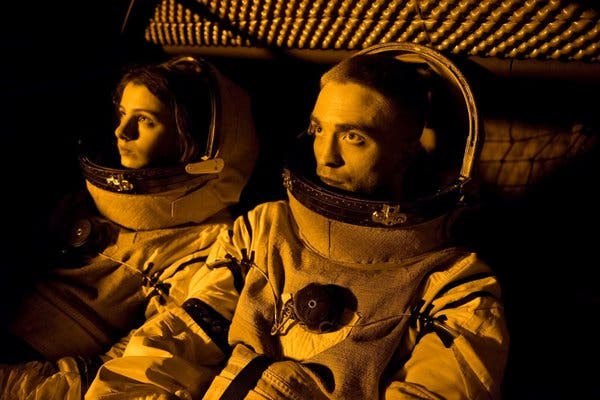
high life

High Life is a recent sci-fi film by French director Claire Denis. It stars Robert Pattinson and Juliette Binoche as travelers on a spacecraft on a one-way mission to harness the energy of a black hole. And perform experiments.

The twist? There are two. Number one: all onboard are death row convicts. Number two: the experiments involve trying to bring a baby to term in deep space.

That all sounds like a run-of-the-mill sci-fi plot. High Life is definitely, absolutely, 100% not. Like I said, it’s revolting. It’s graphic. There should be a whole list of trigger warnings attached. Every trigger warning ever invented.

But it’s also beautiful. Beautifully shot. Beautifully scripted. Beautifully acted.

I was never a Twilight fan. I watched the first one in German and that was enough. But Robert Pattinson is one hell of an actor. His character is reserved (mostly) and mysterious enough to not be annoying.

Juliette Binoche is a madwoman in every sense. The rest of the cast are all great — intense and hateful — with the exception of Andre Lauren Benjamin (aka Outkast’s Andre 3000), who plays a convict full of regret for what he left behind on Earth.

High Life is not for everyone. Some scenes were straight-up sick. Still, this movie is one hell of a trip.

Read this book: The Space Between the Stars

“Life is its own point. It’s just a series of moments, some of them memorable, some of them not. There’s no redemption but what we’re prepared to grant ourselves. No point when we’re finished becoming what we’re going to be. There’s just this breath, and the next one, and the next one. Each of those breaths, each of those moments, help shape us.”

The Space Between the Stars

This bit of gorgeous nihilism is to me the heart of Anne Corlett’s sci-fi novel The Space Between the Stars, the story of a group of plague survivors: the .0001 percent or so of humanity spread across several worlds who were not turned to dust.

I didn’t plan on reading a book about a plague, not right now. Living through a much milder one than in this book is about all I wanted to do with anything plague related.

Once I started reading, it was hard for me to stop.

The Space Between the Stars is centered on Jamie, a thirtysomething veterinarian who is estranged from her long-term boyfriend, isolated from her own historical grief, and the only survivor on a small colony world.

Or so she thinks.

Plague stories can go in several directions. The Walking Dead was once my favorite TV show. Now just a droning, repetitive PSA that humans can be monsters too (ok, I get it!). When Jamie finds other survivors, I was expecting some Walking Dead-ish human vs. human confrontations.

Not so much.

I won’t get into spoilers, but a search for survivors–and her boyfriend–takes on some twists. Not too many, though. The Space Between the Stars is not a hard sci-fi novel (spacecraft can traverse great distances in unbelievably short spans of time). It is also not a thriller.

Instead, it’s more of a character study. On that note, I found Jamie wholly unlikable. She is prickly. She snaps at people. She is self righteous. She’s a horrible communicator. But Corlett does a great job in showing some of the whys, and also showing how maybe Jamie doesn’t like being so flawed. So, while Jamie is unlikable, she’s relatable, if not quite sympathetic.

The Space Between the Stars is not perfect. There were things I couldn’t relate to–as an American, I don’t get the English obsession with class, which was one of the themes of this book. And I wished the sci-fi was amped up (several scenes felt too present day, and not set a century or two in the future).

Still, I was glad to be along for the ride. The writing was beautiful (almost to the point of distraction), and Corlett hit all the right emotional notes. By the end, I wanted to stay in that plague wrecked world just a little while longer.