(Here’s the latest in my sporadically spaced BSG Rewatch. Click the links for Part 1, Part 2, and Part 3.)
Two decades is good for perspective. We have a moment to breathe, to take in a new view (literally; the world around us changes), and we can look back at something with fresh eyes.
So with all these cliches in mind, after rewatching all four seasons of Battlestar Galactica straight through, what worked, and what didn’t?
I’ll start with what worked.

Cylons
The best part of the reboot was the enemy. Heroes are (usually) necessary for any story. We need someone to identify with, a man or woman to root for, to escape into. But, what really makes a story shine is the enemy. We love to hate them, and we sometimes secretly love them as well. A good enemy can be our outlet for all those parts of ourselves we disown. We might not want to literally be Hannibal Lecter, but there’s a small part of us that revels in the villain’s total disregard for good society.
Or maybe this is just me.
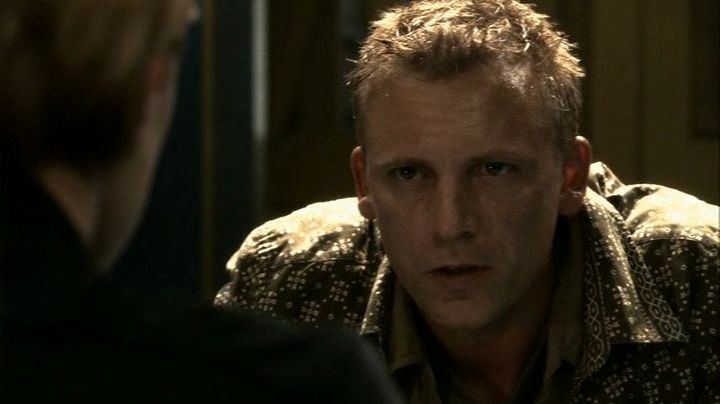
Either way, the thing I love most about Battlestar Galactica is the cylons, not so much the chrome toasters but the humanlike twelve. Take Caprica Six. She’s stunning and hot and cruel (she snapped a baby’s neck!) but also riveting. Or Leoben. He’s probably my favorite of the cylon models. Spiritual. Unhinged. Fanatical. Mystical. He was obsessed with Starbuck. He fucked with her mind on New Caprica. No, I wasn’t rooting for him, but I always wanted to know more about him.
Just think about the sheer audacity of the cylons. Their resentment drove them to massacre billions of humans. And they weren’t satisfied with driving them off their home planets. They insisted on hunting down every last one of the 40,000 or so surviving humans. That’s hardcore.
But the writers had the foresight to mix it up. The cylons could have easily become two dimensional. Same old same old. Instead, partway through the series run they changed things. One faction of the cylons splintered. Rather than destroying the humans, they wanted to coexist with them (more on that later). Some villains remained villains, and some became allies. In my opinion, this was one of the best parts of the series.
A Complex Society
Another strength of Battlestar Galactica was the way the writers portrayed a rich and complex society among the ragtag group of survivors. We could have gotten a series about military warfare vs robots. Instead we got a rich tapestry on a human civilization that was struggling to reassert itself in extreme conditions. We got religious fervor. We got dissent. Treachery. Terrorism. Political wrangling.
One episode that stands out for me happened way in the first season. A pregnant woman wants to get an abortion. But her religious community is against it. Laura Roslin, the civilian president, is forced to deal with this. Her dilemma: she’s pro-choice, but she sees the cold facts that there are only roughly 40,000 humans left. Every life is needed. So she goes against her own personal beliefs and outlaws abortion. I thought it was a surprising, daring and wholly logical storyline. Not your typical sci-fi or space opera fare.
Plot Twists
We know the basics of Battlestar Galactica: a ragtag group of humans travels the universe fleeing an overwhelming foe in search of a mythical lost group of humans. Pretty straightforward. But a plot so linear can easily turn stagnant. Luckily the writers mixed it up a little. One standout plot curveball came in the form of a woman named Admiral Helena Cain.

Cain was commander of the Battlestar Pegasus, another Battlestar presumed lost. Only it wasn’t. For months the Pegasus traveled and fought not knowing that the Galactica had also survived. And there were a couple of twists with Cain’s introduction. First, she outranked Adama. Second, her group of survivors had taken a more militaristic turn. She was a harsh and a brutal leader, damn near a dictator, and her group of humans gave us a view of how the Galactica could have turned out under different leadership.
Cain didn’t last long, but she definitely made the show more interesting.
Another twist was the introduction of the Final Five. According to series lore, there were twelve human models of cylons. During the course of the series we got to see six models: One (Cavil), Two (Leoben), Three (D’Anna), Four (Simon), Five (Aaron), Six (Caprica), Eight (Sharon). That left six unaccounted for. You can scratch one off that list, a model named Daniel, a sensitive model who John contaminated out of jealousy (I really wish the series had found a way to resurrect him—definitely a lost opportunity).
So that left five models who were likely living among the survivors. And among the cylons, only Cavil knew their identity.
When this revelation came, it heightened the tension, not just among the characters, but also the viewers. It became a guessing game—who’s the cylon? What will they do?
As it turned out, the Final Five were an integral part of the Battlestar Galactica story. They were both the catalyst for all the events of the story, and also the resolution. Yes, I have my criticisms, but all in all it was a great twist.
The Use of Mythology
Battlestar Galactica, both the original series and the reboot, is steeped in Greek mythology (Apollo, etc). The colonists pray to the gods (versus the one true god of the cylons). I think in the original series it was to tie the colonists to ancient earth civilization. In the reboot, I suppose it was used to have them seed earth culture (since the reboot takes place 150,000 years in our past).
This mythology permeates their lives. Take Laura Roslin. She’s presented as a humanist atheist type, yet she believes in the prophecy of the Sacred Scrolls of Pythia with all her heart. It drives her actions. It undergirds her clawing for power. She uses this mythology to justify her fight to remain in control of the civilian government, to the point where she almost steals an election.
But Battlestar Galactica developed its own mythology aside from the Greek one. Take, for instance, Kobol. Or the lost Earth colony. This unique mythology formed a continuity within the series. We were continually reminded that all this had happened before, and it would all happen again, and when we finally get to what they called Earth, we see this repetition in action: the events we witnessed in the series are just one small part of a larger story that has repeated again and again. This use of internal mythology resonated. I felt it and I imagined these other stories. That’s what I call effective use of mythology.
The End
As a writer I know it can be incredibly difficult to stick the landing. The television landscape is littered with series that had controversial or unsatisfying endings (Seinfeld, Lost, The Sopranos). While I’m sure some people would disagree, I think Battlestar Galactica gave us a solid ending. We could have gotten lost in space. We could have gone on forever and ever. Instead, the writers brought us home. They gave us final resolutions for all the characters that felt earned and deserved. Would I have loved sequels? Of course. But sometimes it’s good to leave on a high note. (We did get a prequel, and let’s just say sometimes it’s better to leave well enough alone.)
Next up: I dig into the not-so-good.
 Read by Kevin