Battlestar Galactica Rewatch Part 2: Old vs New

(For Part 1 in this series on the Battlestar Galactica reboot, click here)

When I was a kid I hated Jimmy Carter for one reason: he got the Israelis and the Egyptians to sign a peace deal, and the televised signing of that peace deal interrupted the 1978 premiere of the original Battlestar Galactica. I still haven’t forgiven him for this.

The first incarnation of Battlestar Galactica, created by Glen A. Larsen, lasted just one season with 24 episodes. There was a short-lived resurrection called Battlestar 80 that expired after ten episodes. I forget a lot of the details of Battlestar 80 but reading the synopsis it sounds like the writers were heavily into whiskey and cocaine.

I won’t get into how the original compares to the reboot overall. I don’t think that’s a fair comparison for a couple of reasons. First, television technology—special effects specifically—has improved vastly over the quarter century between the two shows. Second, although they’re essentially the same stories with a bunch of the same characters, they’re from different writers who had different visions.

Also, I’m not going to go through a detailed list of the differences. But there are three differences I want to highlight.

The first, in the scheme of things, is relatively minor.

Seven-year-old me wanted to be the ace fighter pilot Starbuck. Played by Dirk Benedict, he was brash and wisecracking and cigar chomping and a good time. When news of the reboot came out, I learned that Starbuck was getting a sex change. He’d now be a woman, played by a woman (Katee Sackhoff). Seven-year-old me was not happy. Adult me considered it a cheap PC stunt. Nowadays sex-swapping characters is so commonplace it’s almost a cliché, if not a joke. But back then I can’t recall it happening all that much.
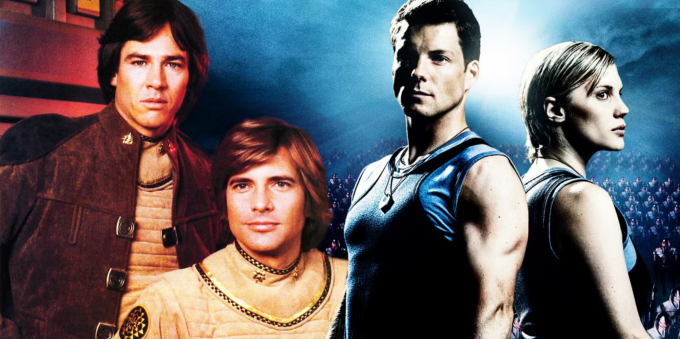
So, yes a stunt. Yes, odd. Yes, annoying. But…

…thanks to the writing and Sackhoff’s portrayal, it worked. Kara Thrace, aka Starbuck, was gritty and brash and complex and messy and fun, and while, in my opinion she could have remained a he (we didn’t really need that forced romance between her and Apollo), Sackhoff helped make the show what it was.

The second difference between the two series was a major change. In retrospect it seems like such an obvious idea I’m surprised it wasn’t in the original. In the original, the cylons were these hulking and bulky metallic toaster-looking robots.

The reboot had these steel cylons in spades, plus another type of cylon, a type that looked human, 12 models with many copies, to be exact, models with different personalities, and the reboot introduced yet another twist: some of these humanoid cylons didn’t even know they weren’t truly human.

This opened up a universe of tension. Who is a cylon and who isn’t? Who is a sleeper agent? Are cylons redeemable? Do they have a sense of self? A soul? All these questions are great plot fodder, and they’d be much harder to pull off with robots that look like toasters.

Another major change had to do with tone. Seventies sci-fi in general was fun and colorful, unintentionally campy even when trying to be serious. And the special effects were definitely underwhelming. The original fit this profile.

The reboot, in contrast, was darker. Literally. Early episodes employed the shaky camera technique that was trendy back in the zeroes (I hate it).

The tone was darker, too. It had a sheen of noir, which totally fit a series about the nearly total holocaust of the human race. No, you can’t necessarily call a show about robots massacring humans lighthearted, but compared to the original, the reboot went a thousand times darker. Torture of all kinds. Lots of violence. Lots of sex (censored). Humanoid cylons acting monstrous and humans acting monstrous.

It might all sound too heavy, but this is a heavy premise. Taking out the camp and throwing it away worked.

Next up, a look at the major themes of the Battlestar Galactica reboot.

Trope or Choke: Episode 10

The challenge: write a complete story in 500 words or less following these guidelines:

Setting: Australia when it was a penal colony

Genre: True crime + middle grade

Trope: Up shit’s creek without a paddle

Characters: Conspiracy theorist + World’s most annoying superhero

POV: First/Future

The result:

One Last Cigarette

I’ll be on my way to the bodega for what I swear will be my last pack of cigarettes when I’ll hit a brick wall.

Literally.

All of a sudden in the middle of the sidewalk there’ll be this brick wall out of nowhere. What the actual fuck I’ll say to the guy next to me, this white-haired ponytailed dude with a potbelly and dandruff on his cardigan.

“This, my inquisitive friend, is evidence of the illuminati,” he’ll say as he runs his sausage fingers along the bricks.

“Aw, shucks,” a twerpy voice says. “Ain’t no illuminati. It was me.”

I’ll turn to see a kid, twelve max, in a silver cape.

“I am Turbo Boy. It was supposed to be a portal.”

“Listen, son,” the man will say. “I am Donovan Corduroy, foremost expert on conspiracies. “Perhaps you’ve read my wikipedia page.”

We’ll both shake our heads.

“No such things as superheroes. Only conspiracies not yet uncovered.”

“Listen mister, I’m a fourth-generation superhero,” the kid whines. “That’s what my mom said.”

“And where is this so-called mother?”

“Murdered. And I’m using my portal-making powers to catch her killer.”

“Shouldn’t you leave that to the police?”

“They’re useless.” He’ll lift up a blood-stained shirt. “This here’s the killer’s blood, and I intend on using it to create a portal to catch the son of a bitch.”

“Don’t swear,” Corduroy says.

“Piss poop fart butt dick ass!”

“How about you just unmanifest this wall? I need a Marlboro something bad.”

“Smoking’s bad for you mister.”

“I’ve never kidney-punched a superhero,” I’ll say.

Of course I wasn’t planning on punching a kid. But god I needed that nicotine. “Just pull a Gorbachev and tear down this wall.”

“No!” Corduroy will throw his body against it. “This is evidence. I must study it.”

Turbo boy smirks. “Step away from it, dork. I’ve got a murder to solve.”

The kid’ll shoot both arms out. The brick wall trembles like a mother rocking her baby, then like a drunk shaking a toddler.

And the wall will crumble like it’s Berlin 1989.

Then a blinding flash and a sound like an oncoming train. I’ll smell sulfur, which only makes me jones harder for a smoke.

Finally it’ll end.

And my feet’ll be soaked.

“What the heck.”

When I open my eyes it’s not night but light. Blue skies. Scrubby desert. And me ankle deep in a creek.

“What deception is this?” Corduroy will say. “Must be some kind of illuminati mind control. We’ve got to uncover their deception.”

Just then a man’ll ride up on a horse holding the longest rifle ever, aimed at me. “What’re you doing out here?”

“Are you the man who killed my mom?” Turbo Boy will say.

“No, but you,” he points to me, “fit the description of John Wesley Rotheram. The most wanted man in Australia. Escaped in the year of the lord 1804.”

“Time travel, you little bastard?” I’ll hiss. “And all I wanted was one last cigarette.”

Battlestar Galactica Rewatch Part 1: History of the Reboot

Even when it first appeared in 2003, the reboot of the classic 1970s series Battlestar Galactica was considered an instant classic, and not just by me. Part of that success had to do with the megawatt casting of two Oscar nominees, Edward James Olmos and Mary McDonnell in the leads, and part had to do with the gritty writing and visual style that was all the rage in the early zeroes. Battlestar Galactica started off as a miniseries but quickly launched into a full-time series that lasted four seasons on Syfy, becoming one of that channel’s flagship shows.

I watched it faithfully when it first came out. At the time I loved it. I couldn’t get enough. I was obsessed by the original show as a kid (although it looks incredibly cheesy to me now). I wanted to be Dirk Benedict’s Starbuck! And I was definitely psyched by the prospect of a reboot.

Before I get too far I suppose I should tell you all what Battlestar Galactica (the reboot) was about. A human civilization called the Colonials creates robots called cylons, which rebel and launch a deadly war against them. Decades after a stalemate, human-looking cylons infiltrate colonial defenses, enabling the cylons to launch an overwhelming attack. Out of 20 billion humans, only about 40,000 survive aboard a handful of spacefaring vessels led by the battlestar Galactica. Chased by the cylons, they set out to find a legendary lost colony called Earth.

The miniseries came out as a standalone three-hour event in late 2003. It launched to strong acclaim, both critical (positive reviews, a Saturn Award, Emmy nominations) and audience (83% audience score on Rotten Tomatoes), and then came the series, which was also lauded.

The series was directed by Michael Rymer and written by Ronald M. Moore, who’d previously worked on various Star Treks as a writer and/or producer, and who went on to shows including Helix and Outlander.

All told, there were 76 episodes of Battlestar Galactica spread out over four seasons from 2004 to 2009, plus ancillary episodes, including a movie rehashing the entire series from the cylon’s point of view (The Plan), a webisode prequel featuring the young Commander Adama (Battlestar Galactica: Blood and Chrome), and a prequel series, Caprica, that lasted for a single 19-episode season. Caprica was kind of a mess, but it was interesting, at least.

Its strong writing and acting and imaginative plot earned Battlestar Galactica a ton of awards and nominations, including Saturns, Hugos, Emmys, and even a Peabody. Critics mostly praised the show, although some criticized it for being heavy handed (true) and straying too far from the premise of the original series (true).

I don’t know if it can be said that Battlestar Galactica cemented the Syfy channel’s place in the early 21st century cable ecosystem, but it definitely helped. One thing I can say for sure is that Battlestar Galactica has left a towering legacy in the sci-fi universe. Its lofty position in sci-fi lore is cemented, for good reason.

With all this in mind, I decided to rewatch the entire series 20 years on to see how it all held up. At first I thought I could fit everything I wanted to say about it in maybe a few posts, but honestly who likes to read three thousand words on a blog post? So I’ll spread this over several posts and let you all know my verdict.